

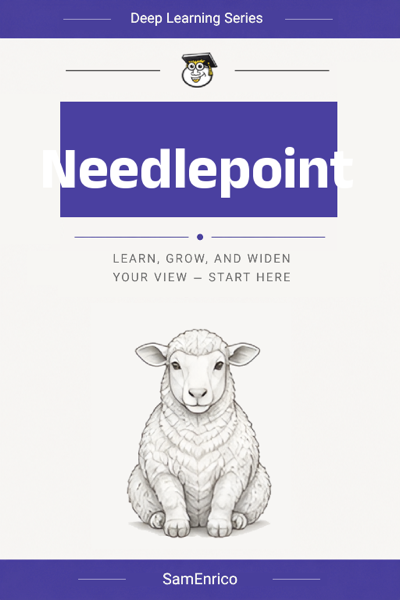
Non-FictionInformativeEducational
Needlepoint eBook
A Coursebook on Needlepoint
A Coursebook on Needlepoint
Formats
Free sample
Chapter 1: The Stitched Awakening...--–- Every needlepoint artist remembers the exact moment they fell in love with the craft. For some, it was the first time they saw a blank canvas transform under their hands—a grid of empty intersections becoming a landscape, a flower, an heirloom. For others, it was the quiet satisfaction of creating something tangible in a world that feels increasingly digital and fleeting. And for many, it was the unexpected discovery that needlepoint is not just a hobby, but a lifeline—a source of calm in chaotic times, a community of kindred spirits, and a creative outlet that asks nothing more than your attention and your willingness to try.–- This book is not a reference encyclopedia you will skim and shelve. It is a coursebook—a guided journey from your very first stitch to your first original design.
By the time you turn the final page, you will have completed projects you never thought possible, mastered stitches whose names once intimidated you, and developed an artist's eye for color and composition. But more importantly, you will understand why millions of people across centuries have returned to this craft again and again: because needlepoint stitches more than fabric. It stitches peace back into a scattered mind, purpose back into idle hands, and beauty back into everyday life.–- Before we thread a single needle, let us be clear about what this chapter will accomplish. We will explore what needlepoint actually is—and what it is not. We will trace its surprising journey from utilitarian necessity to contemporary art form.
We will examine the science-backed reasons why stitching reduces anxiety, improves focus, and creates a state of flow that athletes and meditators spend years chasing. And most importantly, we will help you choose your first project: something small enough to finish, exciting enough to motivate you, and perfectly matched to your personality and goals.–- By the end of this chapter, you will not have stitched anything yet. But you will have something arguably more valuable: clarity. You will know why you are here, what you want to make, and why needlepoint deserves a place in your life. The technical skills come in Chapter 2.
The first stitches come in Chapter 3. But first, we must answer the question that every great journey begins with: Why this? And why now?What Needlepoint Actually Is (And What It Is Not)–- Let us clear up a common confusion right at the start. Needlepoint is not cross-stitch. It is not embroidery.
And while these crafts share tools and occasionally overlap in technique, they are fundamentally different art forms with distinct histories, materials, and visual languages.–- Needlepoint is defined by one non-negotiable characteristic: it is worked on an open-weave canvas, and the stitches completely cover the canvas. You are not decorating fabric. You are replacing it. Every single intersection of the canvas mesh gets covered with yarn or thread, creating a dense, durable fabric that is both beautiful and structurally sound. This is why needlepoint has historically been used for chair seats, pillows, rugs, and other high-use items—the finished product is tough enough to withstand decades of sitting, leaning, and loving.–- Cross-stitch, by contrast, is worked on Aida fabric (a stiff, even-weave cloth) and leaves the fabric visible between stitches.
Those iconic X-shaped stitches form a pattern, but the background remains exposed fabric. Cross-stitch is generally faster and uses less thread, but the finished piece is less durable and has a distinctly different aesthetic—more pixel art than tapestry.–- Surface embroidery is the broadest category of all. It involves decorating existing fabric (anything from cotton to denim to silk) with stitches that sit on top of the material. The fabric remains fully intact underneath. Embroidery can be breathtakingly beautiful—think of a christening gown with delicate rose motifs or a denim jacket covered in colorful flowers—but it serves a different purpose than needlepoint.
Embroidery embellishes. Needlepoint creates.–- Why does this distinction matter? Because the materials, techniques, and finishing methods for each craft are different. A cross-stitcher who tries to make a chair seat using Aida fabric will be disappointed when it shreds after six months. An embroiderer who tries to cover a canvas entirely will find their stitches sagging and their fabric puckering.
By understanding what needlepoint is from the very beginning, you will save yourself money, frustration, and the heartbreak of a project that fails because you used the wrong foundation.–- That said, many stitchers eventually learn all three crafts. Needlepoint teaches you tension control and color theory. Cross-stitch teaches you chart reading and precision. Embroidery teaches you improvisation and decorative techniques. They are cousins, not rivals.
But for the purposes of this book, we will stay firmly in the needlepoint family—and by the time you finish, you will have skills that transfer beautifully to the other forms if you choose to explore them later.The Surprising History of an Ancient Craft–- Needlepoint is often dismissed as "grandma's hobby"—a gentle, old-fashioned pastime for retirement communities and country fairs. This could not be further from the truth. Needlepoint has a history that includes pharaohs, pirates, royalty, and revolutionaries. It has been a marker of wealth, a tool of political protest, a source of income for impoverished women, and a form of therapy for soldiers recovering from war.–- The earliest known examples of canvas work date back to ancient Egypt, where fragments of stitched linen have been found in tombs dating to 1500 BCE. These early pieces were functional—tent panels, saddle cloths, and floor coverings—but they already showed an attention to pattern and color that suggests their makers took pride in beauty as well as utility.
The Egyptians understood something that modern science is only now confirming: repetitive handwork quiets the mind. Their stitchers may not have had a name for "flow state" or "mindfulness," but they knew the feeling.–- Needlepoint as we recognize it today emerged in Europe during the Middle Ages, when it was known as "canvas work" or "tent stitch." (The name "needlepoint" did not appear until the 19th century.) Wealthy households employed professional stitchers to create opulent bed hangings, chair covers, and wall panels—often working from expensive imported silks and metallic threads. These pieces were status symbols, displayed prominently to signal that a family could afford both the materials and the labor. A single large hanging might take a team of stitchers a year or more to complete.–- The 17th century saw the rise of "stumpwork"—a wildly elaborate form of raised embroidery that incorporated needlepoint techniques alongside wire, beads, and even human hair. These three-dimensional scenes depicted biblical stories, allegorical figures, and pastoral landscapes, with figures that literally stood off the canvas.
Stumpwork caskets, small boxes covered in intricate stitching, are among the most collectible antiques in the needlepoint world today.–- The Victorian era democratized needlepoint. The invention of printed canvas patterns (previously, designs had to be drawn by hand or counted from charts) meant that middle-class women could attempt projects that once required professional training. Needlepoint became a respectable leisure activity for ladies, taught in finishing schools and practiced in parlors.…
This is the end of the free sample. Get the eBook to keep going. Buy now
About this book
Details
- Author
- Cowles Kandis
- Publisher
- SamEnrico
- Language
- English
- Genre
- Non-Fiction, Informative, Educational
- Released
- 2026-06-02
- Pages (approx.)
- 158
- Available as
- eBook, Audiobook

Read better in the ZLOADR app
Your eBooks on your phone or tablet. Sign in with your SamEnrico account and start reading.
More by Cowles Kandis
 The Self Hypnosis for Performance ReviewCowles Kandis$11.99
 Cross Border Franchise Women In LeadershipCowles Kandis$11.99
 Male Athlete NutritionCowles Kandis$11.99
 PSA Density Calculation GuideCowles Kandis$11.99
 Anger Management for PoliceCowles Kandis$11.99
 The Nobel Pioneers: Black Genius in the SciencesCowles Kandis$11.99
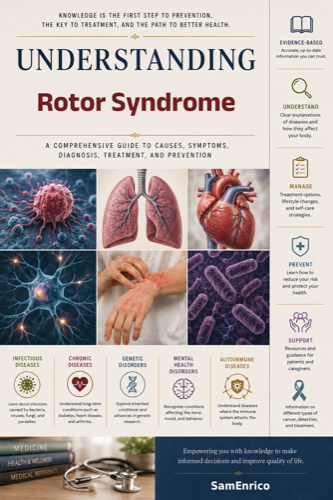 Understanding Rotor SyndromeCowles Kandis$17.99
 Invoice Factoring Pakistan GuideCowles Kandis$12.99
 EU Beneficial Ownership RegisterCowles Kandis$12.99
 How to Start a Academy School Business (Beginners Guide)Cowles Kandis$11.99
You may also like
 Hong Kong Handover 1997Dunn Johnnie$11.99
 Zumba For Postnatal Recovery CourseNeal Christian$11.99
 Zumba for BeginnersLadner Nikia$11.99
 YouTube Comment Mining GuideHumes Pandora$12.99
 Worry Box MeditationCarlin Rudy$11.99
 Workplace Stress MeditationNguyen Lynn$11.99
 Workplace Stress and Sleep RepairHawley Ivory$11.99
 Workplace Perfectionism CureDelaney Jeffry$11.99
 Workplace Injustice Anger GuideWallen Isabelle$11.99
 Work Addiction and Burnout LinkGreenwood Ester$11.99
 Women in Yoga and WellnessBeattie Galina$11.99
 Women in Stand Up ComedyChun Evangeline$11.99