
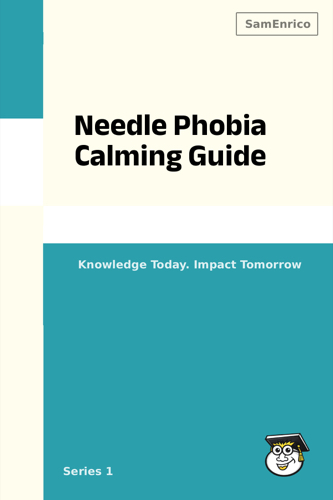
Needle Phobia Calming Guide eBook
Use focused attention during shots or blood draws
by Dunn Duane
Use focused attention during shots or blood draws to reduce fainting.
Formats
Free sample
Chapter 1: The Fainting Paradox--–- The first time Sarah fainted, she was twenty-two years old, wearing her favorite navy blue sweater, and sitting in a sterile white examination room at a routine physical. She wasn't afraid of the needle. At least, she didn't think she was. She had watched the phlebotomist tie the rubber tourniquet around her arm, had felt the cold swab of alcohol, had even taken a deep breath like the internet had told her to do. The needle went in.
She felt a brief pinch. And then the world tilted sideways, the fluorescent lights blurred into white streaks, and she woke up on the floor with a bruised cheekbone and three worried faces staring down at her.The phlebotomist, a kind woman named Diane who had drawn blood from thousands of patients, handed her a cup of orange juice and said something that would echo in Sarah's mind for the next twelve years: "You just need to relax more next time."Sarah believed her. For more than a decade, Sarah believed that her fainting was a failure of will, a sign that she wasn't calm enough, grounded enough, or spiritually centered enough to handle something as simple as a blood draw. She tried meditation apps. She tried breathing exercises.
She tried aromatherapy, visualization, positive affirmations, and even hypnosis. And every single time she encountered a needle—whether for a vaccine, a blood test, or an IV—the same thing happened. Her heart would slow. Her vision would tunnel. Her knees would buckle.
And she would wake up on the floor, embarrassed and confused, convinced that she was the problem.She was not the problem. The advice was the problem. And that advice—the universal, unchallenged, seemingly obvious advice to "just relax"—is exactly why you need to read this chapter very carefully.The Lie You've Been Told Your Entire Life Everywhere you look, the message is the same. When you're anxious, breathe deeply. When you're scared, calm yourself.
When you're facing a medical procedure, meditate, visualize a peaceful beach, or practice progressive muscle relaxation. This advice is so pervasive, so deeply embedded in our cultural understanding of fear, that questioning it feels almost blasphemous. How could relaxation ever be a bad thing?Here is the answer that took Sarah twelve years to discover, and that most doctors will never tell you: Relaxation lowers blood pressure.For most people, that's a good thing. For you, if you are among the approximately 10 to 15 percent of the population who experiences vasovagal syncope in response to needles, relaxation is not your friend. It is the trigger that pulls the pin on your fainting grenade.This chapter is going to explain why.
We are going to dismantle the single most dangerous piece of advice ever given to people with needle phobia, and we are going to replace it with a counterintuitive truth that will change everything about how you approach shots and blood draws. By the time you finish this chapter, you will understand why your body crashes when it should charge, why "calming down" is the worst possible instruction for someone like you, and what your body is actually trying to do when it faints—because once you understand the physiology, you will realize that you have been fighting the wrong battle entirely.Two Fear Responses, Only One Enemy Before we can understand why fainting happens, we have to understand that not all fear responses are created equal. The human body has more than one way to be afraid, and confusing the two is like trying to put out a grease fire with water—not only ineffective, but actively dangerous.Let's start with the fear response that most people know about. You've heard it called "fight or flight." It's the adrenaline rush you feel when someone cuts you off in traffic, when you hear a strange noise in your house at night, or when you have to give a public speech. In this response, your sympathetic nervous system—the gas pedal of your autonomic nervous system—slams down hard.
Your heart races. Your blood pressure spikes. Your pupils dilate. Blood rushes to your large muscles, preparing you to either stand your ground or run for your life. This response is fueled by epinephrine and norepinephrine, and it feels like electricity in your veins.
Your hands might shake. Your voice might tremble. You might feel hot, agitated, and intensely alert.Now here's the critical point: This is not what happens to you during a needle procedure.If you are a fainter, your body does something entirely different. Instead of activating the sympathetic "gas pedal," your body slams on the parasympathetic "brake pedal." Specifically, it activates the vagus nerve—a long, wandering nerve that runs from your brainstem down through your chest and into your abdomen. The vagus nerve is responsible for slowing your heart rate, lowering your blood pressure, and promoting a state of calm and rest.
Normally, this is a good thing. The vagus nerve is why you can fall asleep at night. It's why your heart doesn't explode every time you stand up too quickly. But in people with vasovagal syncope, the vagus nerve overreacts to certain triggers—like the sight of a needle, the sensation of a skin puncture, or even just the anticipation of a blood draw. It hits the brakes so hard that your heart rate and blood pressure drop precipitously.
Blood pools in your legs. Oxygen delivery to your brain decreases. And then, to protect itself, your brain essentially pulls the emergency brake and shuts down consciousness. You faint.This is called the vasovagal response, and it is a physiological event, not a psychological failure. It has nothing to do with how brave you are, how much you've meditated, or whether you had a good breakfast.
It is a reflex, as involuntary as your knee jerking when tapped with a reflex hammer. And like any reflex, it can be interrupted and retrained—but only if you stop doing the one thing that makes it worse.Why "Just Relax" Is Medical Malpractice Let's return to Sarah and her well-meaning phlebotomist. When Diane told Sarah to "just relax more next time," she was operating from the assumption that Sarah's fainting was caused by anxiety. This is the same assumption made by countless doctors, nurses, parents, and partners. It seems logical, doesn't it?
Needle phobia is a fear. Fear causes anxiety. Anxiety causes physical symptoms. Therefore, reducing anxiety should reduce the physical symptoms.The flaw in this logic is that it confuses correlation with causation. Yes, you may feel anxious before a needle procedure.
Yes, that anxiety may make you uncomfortable. But the anxiety is not causing the faint. In fact, in many cases, anxiety is the only thing keeping you upright.Here's why. Anxiety—the kind that makes your heart race and your palms sweat—is driven by the sympathetic nervous system. It raises your blood pressure.
It increases your heart rate. It keeps blood flowing to your brain. For a person with vasovagal syncope, that sympathetic activation is actually protective. It's the guard dog that keeps the vagus nerve from taking over completely.Now imagine what happens when…
This is the end of the free sample. Get the eBook to keep going. Buy now
About this book
Details
- Author
- Dunn Duane
- Publisher
- SamEnrico
- Language
- English
- Genre
- Non-Fiction, Self-Help
- Released
- 2026-06-08
- Pages (approx.)
- 151
- Available as
- eBook, Audiobook

Read better in the ZLOADR app
Your eBooks on your phone or tablet. Sign in with your SamEnrico account and start reading.
More by Dunn Duane
 Senior Alcohol Recovery ManualDunn Duane$11.99
 Meryl Streep JourneyDunn Duane$11.99
 The Group Memory TrainingDunn Duane$11.99
 Notion Progress Bar FormulaDunn Duane$11.99
 Terminal Illness Anticipatory GriefDunn Duane$11.99
 Laid Off to EntrepreneurDunn Duane$11.99
 Islamic Textiles and TradeDunn Duane$11.99
 Jörmungandr: The World Serpent’s TetherDunn Duane$11.99
 How to Produce Motorcycle Rims and WheelsDunn Duane$11.99
 How to Produce Mining Machinery PartsDunn Duane$11.99
 Meeting with Difficult Boss WorkbookDunn Duane$12.99
 Growing BesseraDunn Duane$11.99
You may also like
 Hong Kong Handover 1997Dunn Johnnie$11.99
 Zumba For Postnatal Recovery CourseNeal Christian$11.99
 Zumba for BeginnersLadner Nikia$11.99
 YouTube Comment Mining GuideHumes Pandora$12.99
 Worry Box MeditationCarlin Rudy$11.99
 Workplace Stress MeditationNguyen Lynn$11.99
 Workplace Stress and Sleep RepairHawley Ivory$11.99
 Workplace Perfectionism CureDelaney Jeffry$11.99
 Workplace Injustice Anger GuideWallen Isabelle$11.99
 Work Addiction and Burnout LinkGreenwood Ester$11.99
 Women in Yoga and WellnessBeattie Galina$11.99
 Women in Stand Up ComedyChun Evangeline$11.99