
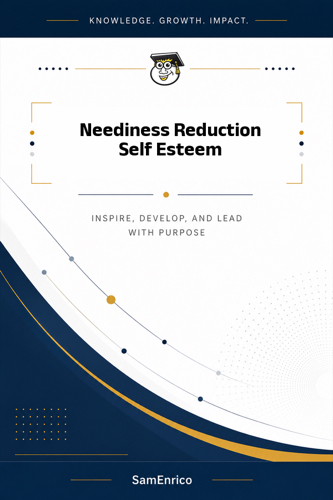
Neediness Reduction Self Esteem eBook
Decrease clingy behaviors by developing a full lif
by Grier Marla
Decrease clingy behaviors by developing a full life outside your partnership.
Formats
Free sample
Chapter 1: The Neediness Loop--–- The first time Sarah’s boyfriend didn’t text her back for four hours, she checked her phone forty-two times. She re-read their last exchange—a perfectly mundane conversation about what to eat for dinner—searching for evidence of a hidden insult. By hour three, she had drafted seven different follow-up texts, deleted all of them, and then sent the eighth: “Did I do something wrong?” When he finally replied, “Sorry, work meeting ran long,” the relief lasted exactly eleven minutes. Then the dread returned, because now she knew: the next silence would feel exactly the same. Sarah is not weak.
Sarah is not dramatic. Sarah is trapped in the Neediness Loop.Every person who has ever described themselves as “too much,” “clingy,” or “needy” knows this exact sequence. You feel a moment of disconnection—real or imagined. Your brain interprets it as an emergency. You reach out more intensely, seeking reassurance.
Your partner, feeling pressured, pulls back slightly to get air. Their withdrawal confirms your fear that something is wrong. So you reach out even harder. They pull back further. The loop tightens until someone breaks, cries, or leaves the room.The tragedy of the Neediness Loop is that it is a self-fulfilling prophecy.
You are not predicting abandonment; you are triggering it. Not because your partner is cruel, but because human beings instinctively recoil from pressure. When someone tells you “I need you to prove you love me,” the heart does not open wider. It hesitates. And that hesitation—perfectly natural, often temporary—becomes the proof you feared existed all along.This chapter is not about blaming yourself.
It is about seeing the machine. Once you understand how the Neediness Loop works, you cannot unsee it. And once you cannot unsee it, you can begin to interrupt it.The Architecture of the Anxious Chase To understand the Neediness Loop, you must first understand attachment theory—not as an abstract academic concept, but as a description of your nervous system’s survival logic. Attachment theory, pioneered by John Bowlby and Mary Ainsworth and popularized for a general audience in Attached by Amir Levine and Rachel Heller, argues that human beings are biologically wired to seek proximity to a “secure base” when we feel threatened. This wiring is not a flaw.
It is the reason our species survived. An infant who did not cry out when separated from a caregiver was an infant who died.The problem is that your nervous system cannot distinguish between a life-threatening separation and a partner not texting back for three hours. To your amygdala—the almond-shaped threat-detection center in your brain—both events register as: “I am alone. Alone is dangerous. Do something now.”Levine and Heller identify three primary attachment styles in adults: secure, anxious, and avoidant.
The anxious attachment style, which underpins the Neediness Loop, is characterized by what researchers call “hyper-activation” of the attachment system. When you have an anxious attachment style, your threat-detection is set to a hair trigger. You notice small changes in a partner’s tone, frequency of contact, or body language that a secure person would not register as significant. Because you have learned—usually from inconsistent caregiving in childhood—that love can disappear without warning, you remain perpetually vigilant for the first sign of withdrawal.This is not a choice. It is a learned neural pathway.
And what has been learned can be unlearned.Dr. Levine uses a telling phrase: “Activation without resolution.” The anxious brain fires an alarm, but unlike a secure brain, it does not have a reliable off switch. The alarm keeps ringing until the partner responds—and sometimes even after that, because a history of inconsistent responsiveness has taught you that “responding now” does not guarantee “responding next time.” You are not paranoid. You are statistically correct about your past. The work is learning that your past is not your future.But here is the distinction that changes everything: the feeling of alarm is automatic.
The action you take in response to that alarm is not.The alarm will sound. You cannot prevent that in the early stages of recovery. What you can prevent is the second, third, and fourth action that turns a momentary spike of anxiety into a hours-long spiral. The difference between a person with an anxious attachment style and a person who has healed that style is not the absence of fear. It is the presence of a pause.The Difference Between a Bid and a Protest Before we go further, you need a vocabulary for what you do.
In relationship science, a “bid for connection” is any attempt—verbal or nonverbal—to initiate positive contact with a partner. Bids can be as small as a glance across a room, a hand on a shoulder, or the question “How was your day?” Dr. John Gottman’s research found that couples who stay together long-term respond to bids at a rate of approximately 86 percent. Couples who divorce respond to approximately 33 percent.Bids are healthy. Bids are necessary.
Bids are how love stays alive.The Neediness Loop, however, does not run on bids. It runs on what Levine and Heller call “protest behaviors.” Protest behaviors are actions taken not to invite connection, but to test it. They are designed to force a partner to prove their loyalty, often by creating a crisis that demands a response. Common protest behaviors include:Texting multiple times without a reply and escalating the emotional intensity with each message (“Hey” “Everything okay?” “Did I do something?” “I guess you’re ignoring me now.”)Withholding affection to see if your partner notices or cares Monitoring their social media activity for evidence of where they are or who they are with Threatening to leave (or actually leaving) to see if they will stop you Saying “It’s fine” in a tone that clearly means it is not fine, and waiting to see if they ask again Asking repetitive reassurance questions: “Do you still love me?” “Are we okay?” “Do you promise you’re not going to leave?”Protest behaviors feel like urgency. They feel like “I am fighting for this relationship.” But here is the brutal reframe that changed my own life: protest behaviors are not fighting for love.
They are fighting against the fear of losing love. And fear, when weaponized, never produces genuine reassurance.Think of it this way. Imagine you are walking through a park, enjoying the sunshine, when a stranger runs up to you and screams, “TELL ME YOU ARE NOT GOING TO HURT ME! SWEAR IT! RIGHT NOW!” What do you feel?
Even if you had no intention of hurting this person, their demand triggers a defensive reaction. You step back. You raise your hands. You look for an exit. You have not become dangerous.
You have simply responded to aggression with self-protection.That is what your partner feels when you use protest behaviors. Not because they are cold or unloving, but because they are human. No one likes to be tested. No one likes to be interrogated. And no one can produce genuine, spontaneous affection on command.The healthy bid for connection sounds entirely different.
A healthy bid is vulnerable without being demanding. It names a feeling without blaming the partner for that feeling. It…
This is the end of the free sample. Get the eBook to keep going. Buy now
About this book
Details
- Author
- Grier Marla
- Publisher
- SamEnrico
- Language
- English
- Genre
- Non-Fiction, Self-Help, Neediness
- Released
- 2026-06-10
- Pages (approx.)
- 138
- Available as
- eBook, Audiobook

Read better in the ZLOADR app
Your eBooks on your phone or tablet. Sign in with your SamEnrico account and start reading.
More by Grier Marla
 Deadlift Technique MasterclassGrier Marla$11.99
 Acupuncture For Tension HeadacheGrier Marla$11.99
 Breach Notification Call Center GuideGrier Marla$11.99
 Gut Brain Axis ConnectionGrier Marla$11.99
 TM for Chronic Pain GuideGrier Marla$11.99
 HR Team Compassion FatigueGrier Marla$11.99
 Cyrus VanceGrier Marla$11.99
 Big Book Study GuideGrier Marla$11.99
 Pythagoras and the Cosmos: The Music of the SpheresGrier Marla$11.99
 The Last Broadcast: The Mystery of the War of the Worlds PanicGrier Marla$11.99
 The Tablet of Eridu: When the Gods Wrote in FireGrier Marla$11.99
 Subscription Management with PaddleGrier Marla$11.99
You may also like
 Hong Kong Handover 1997Dunn Johnnie$11.99
 Zumba For Postnatal Recovery CourseNeal Christian$11.99
 Zumba for BeginnersLadner Nikia$11.99
 YouTube Comment Mining GuideHumes Pandora$12.99
 Worry Box MeditationCarlin Rudy$11.99
 Workplace Stress MeditationNguyen Lynn$11.99
 Workplace Stress and Sleep RepairHawley Ivory$11.99
 Workplace Perfectionism CureDelaney Jeffry$11.99
 Workplace Injustice Anger GuideWallen Isabelle$11.99
 Work Addiction and Burnout LinkGreenwood Ester$11.99
 Women in Yoga and WellnessBeattie Galina$11.99
 Women in Stand Up ComedyChun Evangeline$11.99