
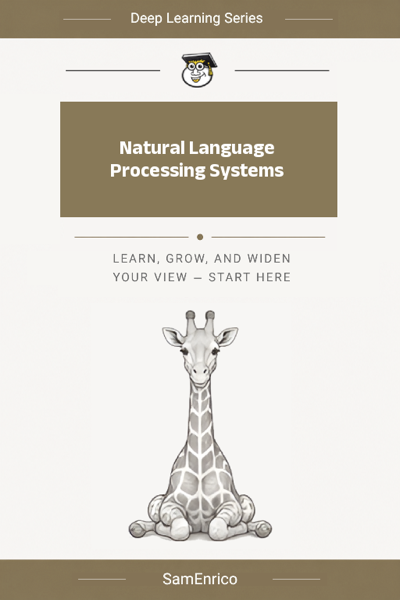
Natural Language Processing Systems eBook
A Coursebook on Natural Language Processing System
A Coursebook on Natural Language Processing Systems
Formats
Free sample
Chapter 1: The 24-Hour Sprint--– You are about to build two working natural language processing systems in the next thirty minutes. Not mockups. Not prototypes. Real systems that take text as input, do something useful with it, and return an answer. By the time you finish this chapter, you will have deployed a sentiment analyzer that reads movie reviews and a conversational agent that answers questions about the weather and the time. You will also have learned something that most introductory NLP courses hide from you for weeks: the vast majority of practical NLP work is not about inventing new algorithms or deriving mathematical proofs. It is about knowing which tool to pick up, how to connect it to the rest of your application, and how to avoid the seven most common mistakes that cause NLP systems to fail silently in production.This chapter inverts the traditional academic approach entirely. Conventional courses begin with definitions, history, and mathematical foundations. They teach you what a morpheme is before they let you touch a line of code. They explain the noisy channel model before you have ever seen a confusion matrix. That approach makes sense if you are training to become a research scientist. It makes very little sense if you are an engineer who needs to ship something that works by Friday. This book operates on a different principle: build first, understand second. You cannot appreciate why tokenization is hard until you have watched a model fail because it split "New York" into two tokens. You cannot understand why the noisy channel model matters until you have debugged a sentence boundary detector that broke on Dr. Smith's email address. So we will build first.The chapter proceeds in four movements. First, you will build a sentiment analyzer using a pre-trained model and deploy it as a public API. Second, you will build a simple but functional chatbot that can answer factual questions without any machine learning training whatsoever. Third, you will step back and understand what you just built – the NLP pipeline, the four historical epochs of the field, and the distinction between processing, understanding, and generation. Fourth, you will learn why NLP is considered an AI-complete problem and why that matters for how you scope your projects. By the end, you will have shipped working code and gained a mental map of the entire field that will make every subsequent chapter feel like filling in details rather than learning from scratch.The First Thirty Minutes: Building a Sentiment Analyzer Sentiment analysis is the "hello world" of natural language processing. Given a piece of text, you want to know whether the expressed opinion is positive, negative, or neutral. Product reviews, social media posts, customer support tickets, and survey responses all contain sentiment signals that businesses use to monitor brand health, prioritize complaints, and track trends over time. The task is simple enough to be approachable but rich enough to expose the fundamental challenges of NLP: ambiguity, context dependence, and the gap between what words say and what they mean.Open your terminal or your preferred Python environment. You will need Python 3.8 or newer. If you have never installed a Python package before, stop here and run pip install transformers gradio. The Transformers library, built by Hugging Face, gives you access to thousands of pre-trained models with a consistent interface. Gradio lets you turn any Python function into a web interface in three lines of code. Together, they form the fastest path from idea to deployed NLP system.Create a new file called sentiment_app.py. Type the following code exactly as written. Do not skip any lines. Do not assume you understand what each part does yet. The explanation comes after the build.python Copy Downloadfrom transformers import pipeline
import gradio as gr
# Load a pre-trained sentiment analysis model # This downloads the model the first time you run it (about 500MB) classifier = pipeline("sentiment-analysis", model="distilbert-base-uncased-finetuned-sst-2-english")
def analyze_sentiment(text): result = classifier(text)[0] label = result['label'] score = result['score']
if label == 'POSITIVE': return f"✅ Positive (confidence: {score:.2%})" else: return f"❌ Negative (confidence: {score:.2%})"
# Create a simple web interface iface = gr.Interface( fn=analyze_sentiment, inputs=gr.Textbox(lines=3, placeholder="Type a movie review here..."), outputs="text", title="Sentiment Analyzer", description="Enter any text and this model will tell you if it's positive or negative." )
iface.launch(share=True)Run the file: python sentiment_app.py. You will see output that includes a local URL (something like http://127.0.0.1:7860) and a public URL ending in .gradio.live. Open the public URL in your browser. You should see a text box, a submit button, and an output area. Type "This movie was absolutely incredible. I loved every minute." Click submit. The model returns "Positive (confidence: 99.2%)" or something close. Type "Terrible film. Waste of two hours." Negative, with high confidence. Type "It was okay." The model hesitates – maybe 60% positive, 40% negative. That uncertainty is not a bug; it reflects genuine ambiguity in the input.You have just built and deployed a sentiment analyzer. The total time from opening your editor to sharing a public URL was under five minutes. The model you used, Distil BERT, is a smaller, faster version of BERT, one of the most influential NLP models ever created. It was trained on the Stanford Sentiment Treebank, a dataset of movie reviews labeled by humans. The pipeline function abstracts away tokenization (breaking text into words or subwords), model inference (running those tokens through a neural network), and post-processing (turning raw outputs into labels and confidence scores). You did not need to understand any of those details to get a working system.Now let us break the system on purpose. Type "I don't hate this movie." What does the model predict? Depending on the exact phrasing, it might say negative, because it sees "hate" and weights that word heavily. But the phrase means the opposite of "I hate this movie" – in fact, it expresses mild approval. This is the negation problem, and it is one of the oldest unsolved challenges in NLP. Simple bag-of-words models (which we will cover in Chapter 4) fail catastrophically on negation. Modern Transformers do better but are still not perfect. Try "The movie was not bad." The model might still lean negative because it has learned that "bad" is a strong negative signal. This is not a flaw in your implementation; it is a fundamental limitation of current technology that researchers continue to work on.Keep the sentiment analyzer running. You will come back to it at the end of this chapter. But first, you will build something different: a chatbot that does not use any machine learning at all.The Second Thirty Minutes: A Chatbot That Works Without Training Machine learning is not always the right answer. For many tasks, a simple rule-based system is faster, cheaper, more predictable, and easier to debug. The chatbot you will build now uses no neural networks, no training data, and no GPU. It uses pattern matching and a few if statements. It will answer questions about the weather and the current time. It will not hallucinate, it will not go off-topic, and you will understand exactly why it produces every response it produces.Create a new file called simple_chatbot.py.…
This is the end of the free sample. Get the eBook to keep going. Buy now
About this book
Details
- Author
- Hardin Shakira
- Publisher
- SamEnrico
- Language
- English
- Genre
- Non-Fiction, Informative, Educational
- Released
- 2026-05-06
- Pages (approx.)
- 154
- Available as
- eBook, Audiobook

Read better in the ZLOADR app
Your eBooks on your phone or tablet. Sign in with your SamEnrico account and start reading.
More by Hardin Shakira
 Self Hypnosis For Intuition DevelopmentHardin Shakira$11.99
 The Civil Engineer Creative ProjectsHardin Shakira$11.99
 Sensory Walking MeditationHardin Shakira$11.99
 Spouse Loss Anger ManagementHardin Shakira$11.99
 Blood Dream Jungian MeaningHardin Shakira$11.99
 Ayurvedic Herbal RemediesHardin Shakira$11.99
 Cocaine Cold Water TherapyHardin Shakira$11.99
 Cloze Deletion Technique GuideHardin Shakira$11.99
 IBS Gut Brain ConnectionHardin Shakira$11.99
 The Bitcoin Boom and Bust: How a Digital Dream Turned into a Global NightmareHardin Shakira$11.99
 The Great Unwind: How a Tiny Island Toppled a Global Financial GiantHardin Shakira$11.99
 The Divine Architect: Bach, Mozart, and Beethoven’s Harmonic RevolutionHardin Shakira$11.99