
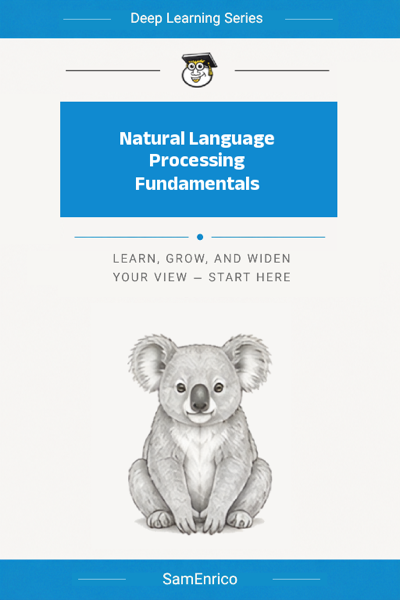
Non-FictionInformativeEducational
Natural Language Processing Fundamentals eBook
A Coursebook on Natural Language Processing Fundam
A Coursebook on Natural Language Processing Fundamentals
Formats
Free sample
Chapter 1: The Language Illusion--–- Every day, you perform a miracle without noticing. You take a chaotic stream of sounds—a 240-millisecond burst of air pushed through vocal cords, shaped by a tongue and lips into something called a “phoneme”—and you transform that sound into meaning. Not just meaning, but intention, emotion, sarcasm, subtext, and shared understanding. You do this effortlessly, automatically, and so quickly that you never stop to ask the obvious question: How?This chapter is not about computers. Not yet.
It is about understanding the problem before you try to solve it. Because for sixty years, the smartest engineers in the world have tried to teach machines to do what you just did in the time it took to read the word “miracle.” And they have failed, succeeded, failed again, and recently succeeded so dramatically that the world is now rethinking what intelligence even means.Welcome to Natural Language Processing. You are about to learn how to build systems that read, understand, and generate human language. But first, you need to understand why this problem is simultaneously the easiest and hardest thing you will ever attempt.The Paradox of Language Consider this sentence: “I saw a man on a hill with a telescope.”Who has the telescope? Do you see the ambiguity?
The man could have the telescope. The hill could have a telescope on it (unlikely, but grammatically possible). Or you could be using the telescope to see the man. Four different interpretations, one string of eleven words. A human resolves this instantly, probably without even noticing the ambiguity until it was pointed out.
A computer sees eleven tokens and eleven billion possible parses.This is the fundamental problem of NLP: human language is underspecified, while machines demand precision.When you speak to another person, you rely on a vast shared context. You assume they know what a telescope is, what a hill is, that people stand on hills, and that seeing something from a distance typically involves an optical instrument. You assume they share your cultural understanding of how sentences are structured. You assume they can infer intentions, resolve ambiguities, and fill in gaps.A machine assumes nothing. A machine starts with zero knowledge.What This Book Is (And Is Not)Before we go any further, let me be explicit about what you are about to read.This is a coursebook.
It is designed to be worked through, not just read. Each chapter includes hands-on code, exercises, and a cumulative project that builds from Chapter 2 all the way to Chapter 12. By the end, you will have built a production-ready system that can read a PDF and answer questions about its contents.This is not a theoretical linguistics textbook. We will not spend four chapters debating the syntactic structure of the English auxiliary verb system. We will cover enough linguistics to understand why the problems exist, but our goal is engineering, not analysis for its own sake.This is not a deep learning textbook.
We will cover neural networks, Transformers, and attention mechanisms in detail. But we will also cover regex, tokenization, and TF-IDF—the classical tools that still pay the bills in production systems worldwide. You cannot build a career on Transformers alone, because most of the world’s data pipelines still run on technology from 2010.This is not a beginner’s guide to Python. You should know basic Python (variables, loops, functions, lists, dictionaries). If you need a refresher, Appendix A provides a crash course.
If you have never written a line of code, this book will move too fast for you.What You Will Build Let me show you your destination, so the journey makes sense.By Chapter 12, you will have built a Document Question-Answering System—a complete application that:Takes a PDF file (a contract, a research paper, a medical report—anything with text)Cleans and normalizes the text (removing headers, fixing broken characters, handling Unicode)Breaks the text into sentences and tokens Identifies named entities (people, organizations, dates, medical terms)Builds both sparse and dense vector representations of each passage Indexes those vectors for fast retrieval Takes a natural language question from a user Expands that query using lexical resources (Word Net)Retrieves the most relevant passages from the document Feeds those passages into a fine-tuned BERT model Returns an exact answer with a citation showing where the answer came from This system is not a toy. It is the same architecture used by startups building legal document analyzers, medical record query systems, and enterprise knowledge bases. The difference is that you will understand every line of code, every model, and every tradeoff.Now, let me show you why this matters—and why you should care even if you never build a question-answering system.The Five Places NLP Already Controls Your Life You interact with NLP systems dozens of times per day, often without noticing. Let me name five.1. Your Email Spam Filter Every time an email lands in your spam folder instead of your inbox, an NLP classifier made that decision.
The filter doesn’t just look for the word “Viagra.” It looks at patterns: the frequency of exclamation marks, the ratio of links to text, the presence of certain phrases (“act now,” “you’ve been selected”), and the relationship between subject line and body. Modern filters use deep learning to detect novel spam campaigns they have never seen before.2. Your Search Engine Google processes over 8.5 billion searches per day. When you type “best Italian restaurant near me,” the search engine doesn’t just match keywords. It understands that “near me” means “within a certain geographic radius of my current location.” It knows that “Italian” refers to cuisine, not the language.
It knows that “best” is subjective and must be inferred from reviews, ratings, and relevance. And it does all of this in under half a second.3. Your Autocomplete and Spell Check When you type “I’m goin to the store,” your phone knows you meant “going.” When you type “definately,” it suggests “definitely.” These are not dictionaries—they are probabilistic language models trained on billions of sentences, learning that certain sequences of letters are more likely than others. The same technology powers predictive text (“I am looking forward to...” → “seeing you,” “hearing back,” “the weekend”).4. Your Customer Service Chatbot That chatbot that pops up when you visit an airline or bank website?
It is almost certainly an NLP system. It must understand variations of the same request (“I lost my card,” “my card is missing,” “can I cancel my card,” “someone stole my wallet”), extract entities (the card number, the date, the user’s identity), and route the query to the correct resolution path. The best ones now use large language models to generate natural responses rather than selecting from a fixed menu.5. Your Recommendation Systems Netflix, Spotify, Amazon—they all use NLP to understand content. Netflix analyzes movie descriptions, user reviews, and dialogue transcripts to understand that “The Irishman” is similar to “Goodfellas” not just because both are crime dramas, but because both feature slow pacing, long runtimes, voiceover narration, and themes of aging and regret.
Spotify analyzes lyrics, not just listening history, to recommend songs you have never heard but will likely enjoy.These are not…
This is the end of the free sample. Get the eBook to keep going. Buy now
About this book
Details
- Author
- Minton Monika
- Publisher
- SamEnrico
- Language
- English
- Genre
- Non-Fiction, Informative, Educational
- Released
- 2026-06-02
- Pages (approx.)
- 144
- Available as
- eBook, Audiobook

Read better in the ZLOADR app
Your eBooks on your phone or tablet. Sign in with your SamEnrico account and start reading.
More by Minton Monika
 Diversification After Client LossMinton Monika$11.99
 Nobel Physics Black Hole DiscoveriesMinton Monika$11.99
 The 48 Hour Rule WorkbookMinton Monika$11.99
 Hesitation Pause DetectionMinton Monika$11.99
 Rewire Shame Self TalkMinton Monika$11.99
 Guided Meditation Scripts BeginnerMinton Monika$11.99
 Mammoth Cave VanishedMinton Monika$11.99
 The Timbuktu Calculus: How African Mathematicians Outpaced the WorldMinton Monika$11.99
 The Phantom Fleet: How a Rogue Navy Saved the WhalesMinton Monika$11.99
 The Mineral Guide to AdeliteMinton Monika$11.99
 How to Become a AdjudicatorMinton Monika$11.99
 Hong Kong BOI RequirementsMinton Monika$12.99
You may also like
 Hong Kong Handover 1997Dunn Johnnie$11.99
 Zumba For Postnatal Recovery CourseNeal Christian$11.99
 Zumba for BeginnersLadner Nikia$11.99
 YouTube Comment Mining GuideHumes Pandora$12.99
 Worry Box MeditationCarlin Rudy$11.99
 Workplace Stress MeditationNguyen Lynn$11.99
 Workplace Stress and Sleep RepairHawley Ivory$11.99
 Workplace Perfectionism CureDelaney Jeffry$11.99
 Workplace Injustice Anger GuideWallen Isabelle$11.99
 Work Addiction and Burnout LinkGreenwood Ester$11.99
 Women in Yoga and WellnessBeattie Galina$11.99
 Women in Stand Up ComedyChun Evangeline$11.99