
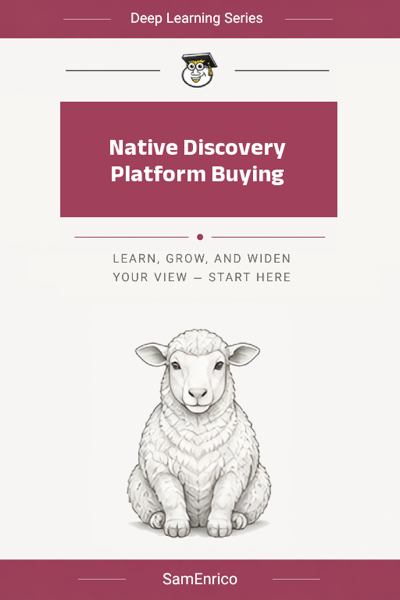
Non-FictionInformativeEducational
Native Discovery Platform Buying eBook
A Coursebook on Native Discovery Platform Buying
A Coursebook on Native Discovery Platform Buying
Formats
Free sample
Chapter 1: The $200 Billion Blind Spot--–- Most digital advertisers are fighting over the wrong customers. They bid up prices on Google for people already searching for their product. They compete on Facebook for users who were going to buy anyway. And they call this "performance marketing." I call it paying for intent that already existed.Consider this: when someone types "best running shoes for flat feet" into Google, they have already decided to buy running shoes. Your ad is not creating demand.
It is intercepting demand that someone else—a coach, a friend, an article—already generated. The auction you just won was not for a new customer. It was for the right to be the last click before a purchase that was already going to happen.This is the dirty secret of digital advertising that no platform wants you to understand. Google and Meta sell you incrementality that does not exist. They take credit for sales that would have happened anyway.
And their stock prices depend on you never running the one test that would expose the truth: a holdout group of users who never see your ads.The numbers are staggering. A 2023 study by the Analytics Partners Institute found that 74 percent of digital ad spend on mature campaigns delivers zero incremental lift. Zero. You are lighting money on fire, and the platforms are selling you the matches.But there is a corner of the advertising ecosystem where the rules are different. Where users are not searching and not scrolling past friends.
Where they are reading—consuming content, learning, being entertained, and crucially, not buying anything. Yet.That corner is Native Discovery.Discovery platforms like Taboola, Outbrain, MGID, and Revcontent place sponsored content within the editorial feeds of the world's largest publishers. CNN. ESPN. Buzz Feed.
USA Today. Thousands of niche blogs and specialty sites. When you finish reading an article, the "You May Also Like" widget at the bottom—the one showing articles about weight loss, financial strategies, or home improvement tips—that is a Discovery feed. Those are ads disguised as recommendations. And most advertisers have no idea how to use them profitably.This book is going to change that.The Problem with Search and Social To understand why Discovery matters, you must first understand what is broken about the channels where most advertisers spend their money.Search advertising (Google, Bing) has a fatal flaw that gets worse every year: rising costs meeting declining incremental value.
As more advertisers bid on the same keywords, CPCs rise. But the intrinsic value of those clicks does not increase. You are paying more for the same thing. Meanwhile, Google has expanded its real estate with shopping tabs, local packs, and knowledge panels—pushing paid results down the page and reducing click-through rates.The incrementality problem is even worse. A user who searches for "best CRM for small business" is already in the market for CRM software.
If they do not click your ad, they will click someone else's. Or they will find you through organic search. Or they will remember your brand from a podcast and go directly to your site. The point is: some percentage of those searchers were going to become customers regardless of whether you ran the ad. That percentage is often 50 to 80 percent for branded keywords and 30 to 60 percent for non-branded high-intent keywords.You are bidding against yourself for customers you already had.Social advertising (Facebook, Instagram, Tik Tok) has a different but equally painful problem: attention decay.
The average user spends 2.5 seconds looking at a social feed ad before scrolling. In that time, you must stop their thumb, convey your value proposition, and earn a click. And you are competing with baby pictures, vacation videos, and memes.Social platforms are also losing targeting fidelity. Apple's App Tracking Transparency framework reduced Facebook's targeting accuracy by an estimated 40 percent. The deprecation of third-party cookies will further erode behavioral targeting.
Google's Privacy Sandbox is not a replacement; it is a different set of limitations. The era of stalking users across the web with perfect precision is ending.Yet advertisers keep spending. They keep bidding. They keep hoping that the next creative test or audience segment will unlock profitability. And the platforms keep collecting their 30 to 50 percent margins on spend that often delivers zero incremental value.There has to be a better way.The Discovery Alternative Native Discovery platforms operate on a fundamentally different economic and psychological model.Psychologically, Discovery reaches users in a passive browsing state.
They have finished reading an article. They are not looking for a product. They are not comparing prices. They are not checking their friends' vacation photos. They are simply...
consuming. Their guard is down. Their brain is in content-acquisition mode, not decision-making mode.This is the critical insight that makes Discovery profitable. When you interrupt a search user, you are competing with their intent. When you interrupt a social user, you are competing with their relationships.
When you interrupt a Discovery user, you are competing with... nothing. They were doing nothing important. They were reading an article about the best hiking trails in Colorado or the ten signs of a toxic workplace. Your ad is not an interruption.
It is a suggestion.Economically, Discovery platforms monetize remnant inventory—the unsold ad space on publisher sites that would otherwise generate zero revenue. Because this inventory has no alternative buyer, the platforms acquire it cheaply. They then resell it to advertisers at a markup, but that markup starts from a very low base. The result is cost per click that can be 80 to 90 percent lower than search CPCs and 50 to 70 percent lower than social CPCs.At the time of this writing, average CPCs on Google Search range from $2 to $5 for commercial keywords, with some industries (legal, insurance, finance) exceeding $50. Average CPCs on Facebook range from $0.50 to $2.00 depending on industry and targeting.
Average CPCs on Discovery platforms range from $0.05 to $0.30.Yes, you read that correctly. Five to thirty cents per click.But low CPCs mean nothing if the traffic does not convert. And that is where most advertisers fail. They take the creative and landing page strategies that work on search or social, apply them to Discovery, and get terrible results. Then they declare that Discovery traffic is "low quality" and go back to paying $5 per click on Google.The problem is not the traffic.
The problem is the strategy.The Three Fatal Mistakes of Discovery Beginners Over five years of managing Discovery campaigns across e-commerce, Saa S, publishing, and lead generation, I have watched advertisers make the same three mistakes again and again. Avoiding these mistakes is the difference between profitable scaling and burning cash.Mistake One: Direct Selling to a Cold Audience The most common failure pattern is running a Discovery ad that links directly to a product page or sales letter. The user sees a headline like "Best Wireless Headphones Under $50," clicks, lands on a product page with a "Buy Now" button, and bounces.Why? Because the user was not ready to buy. They were curious about headphones.
They wanted information, not a transaction. Your ad promised information (best headphones) and delivered a sales pitch. The psychological contract was broken.Discovery traffic is…
This is the end of the free sample. Get the eBook to keep going. Buy now
About this book
Details
- Author
- Nickel Kirstie
- Publisher
- SamEnrico
- Language
- English
- Genre
- Non-Fiction, Informative, Educational
- Released
- 2026-06-03
- Pages (approx.)
- 149
- Available as
- eBook, Audiobook

Read better in the ZLOADR app
Your eBooks on your phone or tablet. Sign in with your SamEnrico account and start reading.
More by Nickel Kirstie
 The Gacy Burial GardenNickel Kirstie$11.99
 LTC Insurance For LGBTQ SinglesNickel Kirstie$11.99
 Pattern Recognition HandbookNickel Kirstie$11.99
 Benzo Taper Calculator WorkbookNickel Kirstie$11.99
 Breath Awareness for JealousyNickel Kirstie$11.99
 Sexual Addiction ScreeningNickel Kirstie$11.99
 Shift Work Memory ImpairmentNickel Kirstie$11.99
 TM For ExecutivesNickel Kirstie$11.99
 Robespierre MaximilienNickel Kirstie$11.99
 The Last Ronin's Shadow: A Forgotten War of the SengokuNickel Kirstie$11.99
 The Lost Fleet of the Atlantic: Spain’s Sunken Secrets of the New WorldNickel Kirstie$11.99
 The Comeback Kid: How a Disgraced CEO Reinvented HimselfNickel Kirstie$11.99
You may also like
 Hong Kong Handover 1997Dunn Johnnie$11.99
 Zumba For Postnatal Recovery CourseNeal Christian$11.99
 Zumba for BeginnersLadner Nikia$11.99
 YouTube Comment Mining GuideHumes Pandora$12.99
 Worry Box MeditationCarlin Rudy$11.99
 Workplace Stress MeditationNguyen Lynn$11.99
 Workplace Stress and Sleep RepairHawley Ivory$11.99
 Workplace Perfectionism CureDelaney Jeffry$11.99
 Workplace Injustice Anger GuideWallen Isabelle$11.99
 Work Addiction and Burnout LinkGreenwood Ester$11.99
 Women in Yoga and WellnessBeattie Galina$11.99
 Women in Stand Up ComedyChun Evangeline$11.99