
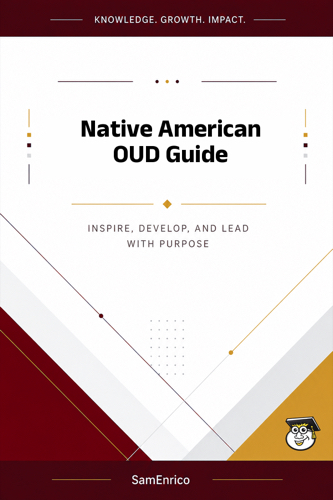
Non-FictionHealth & WellnessIndigenous Health
Native American OUD Guide eBook
Provide culturally competent MAT in tribal communi
Provide culturally competent MAT in tribal communities.
Formats
Free sample
Chapter 1: The Unspoken Wound--The first time I realized that our pain had a history, I was twelve years old, sitting on the cracked vinyl floor of my grandmother’s HUD house in a small reservation town that no interstate had ever bothered to reach. She was making fry bread, her hands moving with the muscle memory of decades, and she was crying. Not the loud kind of crying that demands attention. The quiet kind. The kind where tears fall into the hot oil and hiss like secrets.I asked her what was wrong.
She said nothing. I asked again. She said, “Some things don’t have words.” Then she handed me a piece of bread, hot and golden and dusted with sugar, and we ate in silence.I did not understand that moment for another twenty years. I did not understand that my grandmother’s tears were not hers alone—that they belonged to her mother, who had been taken from her family at age six and sent to a boarding school three hundred miles away, where they washed her mouth out with soap for speaking Lakota and made her kneel on dried corn for praying in the old way. I did not understand that those tears belonged to her grandmother, who had watched her children be pulled from her arms by Indian agents while her husband was away hunting.
I did not understand that those tears belonged to a people who had been told, for generations, that they were less than human, and who had somehow survived that lie but never fully recovered from it.I understand now. And what I understand is this: the opioid crisis in Native communities is not a failure of individual will. It is not a moral weakness. It is not a choice. It is a wound—a wound that was inflicted deliberately, maintained systematically, and passed down through families like a piece of tarnished silver, each generation adding its own tarnish to the heirloom before handing it to the next.This book is about that wound.
It is also about the medicine.The Lie of the Fresh Start America loves the myth of the fresh start. The idea that anyone can pull themselves up by their bootstraps, leave the past behind, and build something new. This myth is seductive because it offers hope. It is also, for Native people, a form of violence.You cannot have a fresh start when the starting line is not the same for everyone. You cannot leave the past behind when the past is still happening—when your children are still being removed at disproportionate rates, when your land is still being taken, when your language is still dying, when your sacred sites are still being desecrated.
The fresh start myth assumes that history is over. For Native people, history is a wound that has never been allowed to heal.Consider the boarding schools. Between 1860 and 1970, the United States government operated more than 350 boarding schools for Native children. The stated goal, in the words of Captain Richard Pratt, founder of the Carlisle Indian Industrial School, was to “kill the Indian and save the man.” The methods included forced haircuts, forced Christianization, forced labor, and the systematic suppression of Native languages and ceremonies. The consequences included physical abuse, sexual abuse, malnutrition, disease, and death.
Thousands of children died at those schools. Thousands more ran away. Those who survived returned home strangers—unable to speak their parents’ language, unable to participate in ceremonies, unable to form the attachments that make human life bearable.That was not ancient history. The last boarding school did not close until 1996. There are people alive today who attended those schools.
There are many more who are the children and grandchildren of survivors. The trauma did not end when the schools closed. It was passed down, through epigenetics and parenting and community disintegration, to people who have never set foot in a boarding school but carry its effects in their bodies and their families and their neighborhoods.Now add the Indian Health Service. Established in 1955 as a successor to the Bureau of Indian Affairs’ health division, the IHS has been chronically underfunded from the beginning. It receives roughly half the per-capita funding of the federal prison system.
Its facilities are outdated. Its staffing is inadequate. Its wait times are measured in months, sometimes years. Native people die from preventable conditions that would be treated immediately in any non-Native community. And when Native people seek care elsewhere, they face racism, miscommunication, and a system that does not understand their cultural context.The opioid crisis did not create these conditions.
It revealed them.The Pharmacological Poison Let me be clear about something that is often muddled in discussions of addiction. There is a difference between the underlying vulnerability to substance use disorders and the specific crisis we are facing right now. The underlying vulnerability is historical and structural—the wound I have been describing. The specific crisis is pharmacological and economic.In the 1990s and early 2000s, pharmaceutical companies launched an unprecedented marketing campaign for prescription opioids. They told doctors that opioids were not addictive for patients with chronic pain.
They funded professional societies and patient advocacy groups. They showered physicians with gifts and speaking fees. And they targeted Native communities aggressively, because Native communities had high rates of chronic pain from conditions like diabetes and arthritis, and because the IHS had limited capacity to monitor prescribing practices.The result was predictable. Prescription opioid use skyrocketed. So did addiction.
So did overdose deaths. When the government finally cracked down on prescription opioids, many people who were already addicted turned to heroin, which was cheaper and more available. Then the drug supply shifted again, and fentanyl—a synthetic opioid fifty times more potent than heroin—flooded the market. Fentanyl is not a drug you can use recreationally and walk away from. It kills people.
It has killed tens of thousands of Native people over the past decade.This is not a story of moral failure. It is a story of corporate greed, regulatory capture, and a healthcare system that prioritized profit over people. The same pharmaceutical companies that caused this crisis have paid billions in settlements. None of that money has brought back the dead.The War on Drugs as a Continuation of Colonization While pharmaceutical companies were flooding Native communities with opioids, the federal government was waging a War on Drugs that targeted those same communities for arrest and imprisonment. The hypocrisy is staggering.
On one hand, the government enabled the distribution of addictive substances. On the other hand, it criminalized the people who became addicted to those substances.The War on Drugs was never a public health campaign. It was a law enforcement campaign, rooted in the same logic that produced the boarding schools and the reservation system. The goal was control. The methods were surveillance, policing, and incarceration.
The consequences for Native communities have been devastating.Native people are arrested for drug offenses at higher rates than white people, despite similar rates of drug use. They receive longer sentences. They are less likely to be offered diversion or treatment. Tribal jails, which are already underfunded and overcrowded…
This is the end of the free sample. Get the eBook to keep going. Buy now
About this book
Details
- Author
- Sheffield Brain
- Publisher
- SamEnrico
- Language
- English
- Genre
- Non-Fiction, Health & Wellness, Indigenous Health
- Released
- 2026-06-06
- Pages (approx.)
- 132
- Available as
- eBook, Audiobook

Read better in the ZLOADR app
Your eBooks on your phone or tablet. Sign in with your SamEnrico account and start reading.
More by Sheffield Brain
 TM Practice CheckingSheffield Brain$11.99
 Night Stalker Trial TranscriptsSheffield Brain$11.99
 Imposter Syndrome in Nonprofit SectorSheffield Brain$11.99
 Dealing With Parental DisappointmentSheffield Brain$11.99
 The Great Bitcoin Heist: How a Rogue Insider Stole $80 Million in a Single NightSheffield Brain$11.99
 Understanding Cranios–craniotSheffield Brain$17.99
 Infrastructure ArchitectSheffield Brain$11.99
 How to Become a Treating-plant SupervisorSheffield Brain$11.99
 World Bank Junior ProfessionalSheffield Brain$12.99
 Green Lease Provisions UpdateSheffield Brain$12.99
You may also like
 Hong Kong Handover 1997Dunn Johnnie$11.99
 Zumba For Postnatal Recovery CourseNeal Christian$11.99
 Zumba for BeginnersLadner Nikia$11.99
 YouTube Comment Mining GuideHumes Pandora$12.99
 Worry Box MeditationCarlin Rudy$11.99
 Workplace Stress MeditationNguyen Lynn$11.99
 Workplace Stress and Sleep RepairHawley Ivory$11.99
 Workplace Perfectionism CureDelaney Jeffry$11.99
 Workplace Injustice Anger GuideWallen Isabelle$11.99
 Work Addiction and Burnout LinkGreenwood Ester$11.99
 Women in Yoga and WellnessBeattie Galina$11.99
 Women in Stand Up ComedyChun Evangeline$11.99