
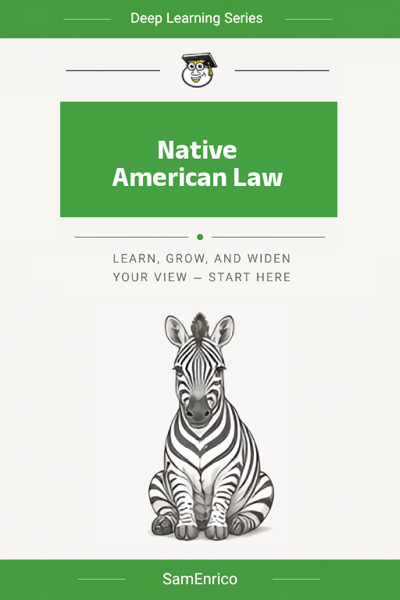
Non-FictionInformativeEducational
Native American Law Audiobook
A Coursebook on Native American Law
A Coursebook on Native American Law
Formats
Free sample
Chapter 1: The Laws Before Law--Before the Mayflower, before the Declaration of Independence, before the Magna Carta, there was the Great Law of Peace. Before Blackstone wrote his Commentaries, before Montesquieu articulated separation of powers, before the Federalist Papers argued for checks and balances, the Haudenosaunee Confederacy had already built a constitutional democracy that would outlive empires. Their legal order did not borrow from Rome or Athens. It emerged from the soil of North America, from the mouths of clan mothers, from the wampum belts strung with shell beads that encoded binding agreements between nations. And when European settlers arrived, they encountered not a "legal void" but a continent crowded with sophisticated legal systems—systems that the colonizers would spend centuries attempting to erase, only to find that law, unlike land, cannot be conquered.This chapter dismantles the foundational myth that has justified five centuries of Indigenous dispossession: the myth that North America was a "wilderness" without law, without government, without civilization.
That myth served a purpose. If the land was empty of legal order, then the Doctrine of Discovery (Chapter 2) could treat it as terra nullius—land belonging to no one. If Native peoples had no governments, then the United States could claim a monopoly on legitimate authority. If there were no pre-existing legal systems, then federal Indian law could present itself as a gift, a grant of rights to people who had none.None of that is true. The truth is the opposite.The Indigenous nations of North America possessed legal orders that were, by any measure, as sophisticated as any in Europe.
They had treaties, constitutions, criminal codes, property systems, family law, environmental regulations, and international agreements. They had courts, mediators, councils, and consensus-building processes. They had separation of powers, impeachment, women's political authority, and rights of recall. They had law, not as a command from above, but as a living web of relationships among humans, land, animals, plants, water, and the spiritual world. To understand Native American law—the law that exists today in tribal courts, federal statutes, and Supreme Court decisions—we must begin here.
Because federal Indian law did not create tribal sovereignty. Tribal sovereignty created federal Indian law.The Myth of the Legal Void The colonial myth is remarkably persistent. In 1823, Chief Justice John Marshall opened his opinion in Johnson v. Mc Intosh with a statement that would shape American property law for two…
This is the end of the free sample. Get the Audiobook to keep going. Buy now
About this book
Details
- Author
- Marquez Bonny
- Publisher
- SamEnrico
- Language
- English
- Genre
- Non-Fiction, Informative, Educational
- Released
- 2026-06-02
- Pages (approx.)
- 155
- Available as
- eBook, Audiobook

Listen in the VoxFlicks app
Audiobooks and audio dramas wherever you go. Sign in with your SamEnrico account and press play.
More by Marquez Bonny
 The Body Image ConversationMarquez Bonny$11.99
 Leech Therapy Bloodletting HistoryMarquez Bonny$11.99
 Remote Retreats Cultural SensitivityMarquez Bonny$11.99
 Etsy Digital Planner Bulk Listing CourseMarquez Bonny$11.99
 The Desert Coders: Bedouin Guides and the Lost Genes of ArabiaMarquez Bonny$11.99
 The Last Whisper of the Titanic: A Sonar Love StoryMarquez Bonny$11.99
 Understanding Chondrodysplasia, Grebe TypeMarquez Bonny$17.99
 Budget Presentation To LeadershipMarquez Bonny$12.99
 Board Retreat for Mental HealthMarquez Bonny$12.99
 How to Start a Potassium Salts Business (Beginners Guide)Marquez Bonny$11.99
You may also like
 Hong Kong Handover 1997Dunn Johnnie$11.99
 Zumba For Postnatal Recovery CourseNeal Christian$11.99
 Zumba for BeginnersLadner Nikia$11.99
 YouTube Comment Mining GuideHumes Pandora$12.99
 Worry Box MeditationCarlin Rudy$11.99
 Workplace Stress MeditationNguyen Lynn$11.99
 Workplace Stress and Sleep RepairHawley Ivory$11.99
 Workplace Perfectionism CureDelaney Jeffry$11.99
 Workplace Injustice Anger GuideWallen Isabelle$11.99
 Work Addiction and Burnout LinkGreenwood Ester$11.99
 Women in Yoga and WellnessBeattie Galina$11.99
 Women in Stand Up ComedyChun Evangeline$11.99