
Non-FictionAnnual CheckupNational Security
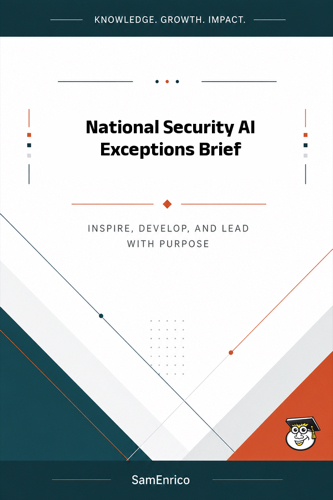
National Security AI Exceptions Brief
Interpret military and national security exemption
by Boyce Tawna
Interpret military and national security exemptions in both frameworks.
Formats
About this book
Free sample
Chapter 1: The Secrecy Stack...--–- The first lie in military artificial intelligence is not the lie of omission or the lie of commission. It is the lie of the solvable problem—the technocratic fantasy that if we just build better explainability tools, if we just train more auditors, if we just add another compliance checkbox, the opacity will fade. This lie is comforting because it postpones the hard question: What happens when a government that thrives on secrecy deploys a technology that defies explanation, and no one—no court, no legislature, no public—can verify whether the outcome was lawful, let alone just?This book is about that question. It is about the legal architecture that allows states to hide their AI-driven decisions behind two walls: the classified national security apparatus and the algorithmic black box. And it is about the exceptions—the loopholes, carve-outs, and deliberate ambiguities—that turn these walls into fortresses.
The title, National Security AI Exceptions Brief, is deliberately double-edged. A "brief" can be a legal document submitted to a court, an attempt to persuade. It can also mean short, fleeting, temporary. Both meanings apply. The exceptions that shield military and intelligence AI from normal legal scrutiny are argued for in briefs filed before courts and legislatures.
And they are brief in the temporal sense as well—politically unsustainable, legally fragile, and likely to collapse when the first mass-casualty AI error makes headlines.This chapter introduces the central analytical framework of the book: the Secrecy Stack. The Secrecy Stack is the layered combination of two distinct forms of opacity. The first layer is classified national security decision-making—the legal, procedural, and cultural secrecy that surrounds military and intelligence operations. The second layer is algorithmic opacity—the technical reality that even expert developers cannot fully explain why a deep neural network produced a specific output, given its non-linear, emergent behavior across millions or billions of parameters. When these two layers stack—when a secret government uses an opaque AI for a classified purpose—traditional mechanisms of democratic accountability collapse.
Courts cannot review classified AI logic without compromising sources and methods. Legislatures cannot audit real-time targeting algorithms without security clearances…
This is the end of the free sample. Get the eBook to keep going. Buy now
Contents
- Chapter 1
- Chapter 2
- Chapter 3
- Chapter 4
- Chapter 5
- Chapter 6
- Chapter 7
- Chapter 8
- Chapter 9
- Chapter 10
- Chapter 11
- Chapter 12
Details
- Author
- Boyce Tawna
- Publisher
- SamEnrico
- Language
- English
- Genre
- Non-Fiction, Annual Checkup, National Security
- Released
- 2026-06-06
- Pages (approx.)
- 158
- Available as
- eBook, Audiobook

Read better in the ZLOADR app
Your eBooks on your phone or tablet. Sign in with your SamEnrico account and start reading.
More by Boyce Tawna
 Earle's Tektite Habitat LifeBoyce Tawna$11.99
 Mindful Breathing MBSR Foundation GuideBoyce Tawna$11.99
 Estate Plan For High Net Worth Individuals CourseBoyce Tawna$11.99
 The Augmentation Prevention GuideBoyce Tawna$11.99
 Qaitbay: The Sultan Who Defied the OttomansBoyce Tawna$11.99
 Understanding Kawasaki SyndromeBoyce Tawna$17.99
 How to Start a Bush for Bearing Business (Beginners Guide)Boyce Tawna$11.99
 AI and Data Science MigrationBoyce Tawna$12.99
 Repatriation Anxiety ProtocolBoyce Tawna$12.99
 Sales and Marketing LeadershipBoyce Tawna$11.99
You may also like
 Hong Kong Handover 1997Dunn Johnnie$11.99
 Zumba For Postnatal Recovery CourseNeal Christian$11.99
 Zumba for BeginnersLadner Nikia$11.99
 YouTube Comment Mining GuideHumes Pandora$12.99
 Worry Box MeditationCarlin Rudy$11.99
 Workplace Stress MeditationNguyen Lynn$11.99
 Workplace Stress and Sleep RepairHawley Ivory$11.99
 Workplace Perfectionism CureDelaney Jeffry$11.99
 Workplace Injustice Anger GuideWallen Isabelle$11.99
 Work Addiction and Burnout LinkGreenwood Ester$11.99
 Women in Yoga and WellnessBeattie Galina$11.99
 Women in Stand Up ComedyChun Evangeline$11.99