
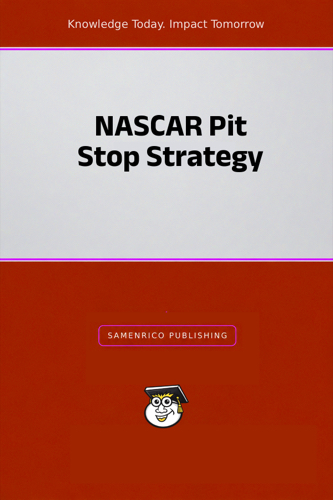
Non-FictionBiographyPit Strategy
NASCAR Pit Stop Strategy eBook
Time green flag stops and fuel strategy to win.
by Keys Shanel
Time green flag stops and fuel strategy to win.
Formats
Free sample
Chapter 1: The Fourteen-Second War...--–- The green flag drops at Daytona. Seventy thousand fans roar as forty cars thunder into Turn 1 at 180 miles per hour. But here is the secret that separates champions from the rest of the field: the race you are watching on television is only half the competition. The other half—the quieter, faster, more brutal half—happens in a narrow concrete alley where forty-three men in fire suits will execute over three hundred pit stops before the checkered flag falls.Welcome to the fourteen-second war.Every NASCAR fan knows the thrill of a last-lap pass. The drama of a bump-and-run at Martinsville.
The photo finish at Talladega. These moments dominate highlight reels and water-cooler conversations. But the data tells a different story. Since the introduction of the Next Gen car in 2022, over ninety percent of meaningful position changes in Cup Series races now occur not on the racing surface but on pit road. Think about that for a moment.
The moments that decide championships—the passes that separate victory from defeat—are happening while the cars are technically stopped.Kyle Busch, a two-time Cup Series champion, put it bluntly: "The best and easiest way to pass someone is to do it when they are standing still."This chapter reframes everything you think you know about NASCAR racing. The pit stop is not a break from the action. It is not a necessary inconvenience between green-flag runs. The pit stop is the most intense, most decisive, most underappreciated phase of modern motorsport. It is where crew chiefs earn their salaries, where drivers lose their composure, and where championships are won and lost in the span of time it takes you to read this paragraph.The Invisible Battlefield To understand why pit strategy has become the sport's primary weapon, you must first understand what the Next Gen car changed.
Introduced in 2022, the seventh generation of NASCAR's Cup Series car was designed with noble intentions: closer competition, lower costs for teams, and greater manufacturer parity. In many ways, it succeeded brilliantly. The racing is tighter than ever. The days of a dominant car lapping half the field are largely over.But there is a catch. The Next Gen car is significantly harder to pass with on track.
The underbody diffuser that creates cleaner airflow for the following car also creates "dirty air" that disrupts the car ahead's handling. The cars are more evenly matched aerodynamically, meaning the raw speed differential that once allowed a faster car to simply drive around a slower one has largely disappeared. The tires are harder and more durable, reducing the advantage of fresh rubber compared to previous generations.The result is simple mathematics: if you cannot pass on the track, you must pass on pit road.Consider a typical green-flag run at a 1.5-mile intermediate track like Charlotte or Atlanta. The leader might hold a two-second advantage over second place. The second-place driver, even if marginally faster, often cannot close that gap because the aerodynamic wake from the leader makes the car push (understeer) in the corners.
The solution? Pit one lap earlier than the leader, take fresh tires or less fuel, and emerge from pit road ahead of them when they finally come in.This is the fundamental logic that drives every strategic decision in modern NASCAR. The race is not won by the fastest car. It is won by the team that best manipulates the pit cycle.The Anatomy of a Modern Stop Before we dive deeper into strategy, you need to understand exactly what happens during those fourteen seconds. The modern NASCAR pit stop is a symphony of controlled violence involving five highly specialized athletes.
They are, in order of operation:The jackman initiates the stop by sliding a hydraulic jack under the front-left chassis rail and pumping it twice, lifting the car approximately six inches off the ground. The entire motion takes less than one second. A good jackman can execute this maneuver blindfolded, which is fortunate because he is often dodging the rear tires of the car entering the adjacent stall.The tire changers attack simultaneously. Each changer carries a titanium-impact wrench that delivers over 1,200 foot-pounds of torque. The single center-lug nut that secures each wheel—a dramatic departure from the five-lug system that defined NASCAR for seven decades—can be removed and retightened in approximately one second per wheel.
The left-side changer handles both left-side tires; the right-side changer handles both right-side tires. They move in a choreographed sequence: remove the lug, remove the old tire, the carrier hands them a new tire, seat it, tighten the lug. The entire four-tire change takes six to eight seconds from jack engagement to the final lug being torqued.The tire carrier is the workhorse. He carries two tires at a time—one under each arm, each weighing approximately fifty pounds. He must anticipate which side his changers will finish first and position himself accordingly.
A fumbled tire costs two seconds. Two fumbled tires can end a race.The fueler operates the most dangerous position. He carries a dump can weighing ninety-five pounds when full, containing approximately twelve gallons of Sunoco Green E15 racing fuel. He inserts the nozzle into the fuel port located on the rear quarter-panel, opens the valve, and waits. The fuel flows at a rate of approximately one gallon per second under ideal conditions.
The fueling operation typically takes eight to twelve seconds, depending on how much fuel the car needs.Here is the critical insight that changes everything: because the tire changes now finish in six to eight seconds, the fueling operation is almost always the slowest part of a full-service stop. The car cannot leave the stall until the fueler pulls the nozzle and signals completion. Every extra gallon of fuel required adds approximately one second to the stop time.This is not merely a technical detail. It is the single most important strategic constraint in modern NASCAR. It means that fuel strategy is not about fuel—it is about time.
And time on pit road translates directly to track position.The Strategic Triangle Every crew chief who has ever called a race works within an immutable constraint that we will call the Strategic Triangle. At any given moment, a team can optimize for only two of the following three variables:Track Position – Where your car is physically located on the track relative to competitors. Leading is better than following. Clear air is better than dirty air. The pit stall closest to the exit is better than the stall closest to the entrance.Fresh Tires – New rubber provides grip, which translates to lap time.
Four fresh tires are worth approximately 0.3 to 0.7 seconds per lap depending on the track. Two fresh tires (right-side only) are worth approximately 0.15 to 0.3 seconds per lap. No fresh tires are worth zero time gain but save the pit stop seconds required to change them.Fuel Load – More fuel allows longer runs between stops but adds weight (approximately six pounds per gallon) that slows the car slightly. Less fuel reduces weight and improves handling but requires more frequent stops.You cannot have all three at maximum. If you…
This is the end of the free sample. Get the eBook to keep going. Buy now
About this book
Details
- Author
- Keys Shanel
- Publisher
- SamEnrico
- Language
- English
- Genre
- Non-Fiction, Biography, Pit Strategy
- Released
- 2026-06-07
- Pages (approx.)
- 124
- Available as
- eBook, Audiobook

Read better in the ZLOADR app
Your eBooks on your phone or tablet. Sign in with your SamEnrico account and start reading.
More by Keys Shanel
 Emotional Resentment ReleaseKeys Shanel$11.99
 Body Image for Cleft LipKeys Shanel$11.99
 Divorce Bucket ListKeys Shanel$11.99
 Tobacco Free Month OneKeys Shanel$11.99
 Vigil Every YearKeys Shanel$11.99
 Mendeleev Education ReformerKeys Shanel$11.99
 Legal Persuasion PrinciplesKeys Shanel$11.99
 Gawain's Dragon: The Green Knight's SecretKeys Shanel$11.99
 The Phantom of Melbourne: How a Broken Runner Defied the OddsKeys Shanel$11.99
 Understanding Alzheimer's DiseaseKeys Shanel$11.99
 How to Produce a ShichirinKeys Shanel$11.99
 A Collector's Handbook to the BMW 3.0siKeys Shanel$11.99
You may also like
 Hong Kong Handover 1997Dunn Johnnie$11.99
 Zumba For Postnatal Recovery CourseNeal Christian$11.99
 Zumba for BeginnersLadner Nikia$11.99
 YouTube Comment Mining GuideHumes Pandora$12.99
 Worry Box MeditationCarlin Rudy$11.99
 Workplace Stress MeditationNguyen Lynn$11.99
 Workplace Stress and Sleep RepairHawley Ivory$11.99
 Workplace Perfectionism CureDelaney Jeffry$11.99
 Workplace Injustice Anger GuideWallen Isabelle$11.99
 Work Addiction and Burnout LinkGreenwood Ester$11.99
 Women in Yoga and WellnessBeattie Galina$11.99
 Women in Stand Up ComedyChun Evangeline$11.99