

Non-FictionInformativeEducational
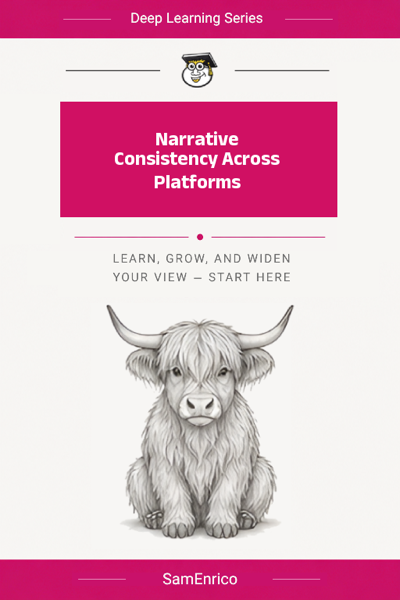
Narrative Consistency Across Platforms eBook
A Coursebook on Narrative Consistency Across Platf
A Coursebook on Narrative Consistency Across Platforms
Formats
Free sample
Chapter 1: The Shape-Shifter Principle...–- Every great story is a liar. Not because it deceives, but because it pretends to be one thing while secretly being another. A novel pretends to be a sequence of ink marks on dead trees. A film pretends to be twenty-four still images flickering past a projector bulb each second. A video game pretends to be electricity rearranging silicon.
And yet, when these liars tell the truth—when they make you laugh, cry, or throw your phone across the room—you forget the medium entirely. You fall into the world behind the interface.But here is the problem that haunts every writer, showrunner, and content creator in the 2020s: that world behind the interface is no longer confined to a single interface. Your audience encounters your story on a movie screen, then on a phone screen, then on a laptop, then on a gaming console, then through a pair of earbuds during their commute. The medium changes every hour. The world must not.
And yet, most stories shatter when they try to jump from one container to another.This chapter is about why that shattering happens—and how to prevent it.The Netflix Wake-Up Call In 2020, a quiet experiment became a seismic industry shift. Netflix released The Queen's Gambit, a limited series about a chess prodigy, based on a 1983 novel by Walter Tevis that had sold modestly and faded from print. Within twenty-eight days, the series had been watched by sixty-two million households. The novel promptly returned to the New York Times bestseller list—forty years after its original publication. The same phenomenon repeated with Bridgerton (which drove readers to Julia Quinn's backlist so aggressively that her publisher printed 500,000 additional copies), His & Hers (which tripled Alice Feeney's sales overnight), and Remarkably Bright Creatures (which sat on the Times list for nearly a year after its Netflix option was announced).The lesson was not new, but the scale was unprecedented.
A story that succeeds on one platform does not merely survive translation to another—it expands. The audience for the film becomes the audience for the book. The audience for the book becomes the audience for the podcast. But this expansion only works when the story remains recognizably itself across every border it crosses.The inverse is also true. When a story contradicts itself across platforms, the audience does not merely lose interest.
They feel betrayed. The fan who spots a continuity error between a film and its tie-in novel is not being pedantic. They are experiencing a violation of trust. You promised them a world. You gave them a world.
Then you changed the rules without telling them. That is not a mistake. That is a broken promise.The Death of the Linear Pipeline For most of the twentieth century, stories moved through a linear pipeline. An author wrote a book. If the book succeeded, a studio might option it for a film.
If the film succeeded, a network might adapt it for television. If the television series succeeded, a toy company might license the characters for action figures. Each step was downstream from the previous one. Each step was optional. And crucially, each step could ignore the previous one with minimal consequence.
The film did not need to match the book beat-for-beat. The television series did not need to match the film. The action figures certainly did not need to match anything except the marketing department's concept art.That era is over.We now live in the age of radial expansion. A story is no longer a pipeline; it is a seed. From that seed, multiple branches grow simultaneously: a film, a companion podcast, a social media account for the protagonist, a video game side-quest, a novelization that reveals backstory never shown on screen, a wiki maintained by the studio, and a hundred thousand fan theories debated on Reddit.
These branches do not grow in sequence. They grow in parallel. A writer's room might be developing season two of a television series while a game studio builds a level set between season one and season two while a novelist writes a prequel about a character who dies in episode three. All of these creators must agree on the same set of facts. If they do not, the branches grow in different directions—and the audience watches the story tear itself apart.This is not a hypothetical worry.
In 2019, Game of Thrones released its final season. The showrunners, David Benioff and D.B. Weiss, made a series of narrative choices that contradicted established character arcs, world rules, and—in the case of Daenerys Targaryen's sudden turn toward mass violence—the previous seven seasons of evidence. The backlash was immediate and enduring. But here is what is less discussed: the Game of Thrones expanded universe (prequel novels, companion books, behind-the-scenes content, and the subsequently released House of the Dragon) spent years trying to retroactively justify or ignore those final-season contradictions.
The inconsistency did not just hurt the finale. It infected the entire franchise.Convergence Culture and the Active Audience In 2006, media scholar Henry Jenkins published Convergence Culture, a book that predicted much of what we are now living through. Jenkins argued that we had entered an era where old and new media would collide, where audiences would no longer be passive consumers but active participants, and where the flow of stories across multiple media platforms would become the dominant mode of entertainment.Jenkins coined two terms that are essential for this chapter. The first is convergence: the technological, industrial, cultural, and social changes that allow the same story to move across different media while remaining recognizable. Convergence is not just about having a phone that plays movies.
It is about the expectation that the movie you watch on that phone is the same movie you would watch in a theater—and that the podcast you listen to on that same phone extends that movie, rather than contradicting it.The second term is participatory culture: the shift from an audience that simply watches to an audience that actively engages, discusses, remixes, and enforces. Jenkins observed that fans had become "knowledge communities"—groups that pool their collective expertise to track continuity, identify errors, and fill gaps. A single viewer might miss a minor inconsistency between episode four and episode seven. A thousand viewers working together on Reddit will find it within hours. And they will not keep it to themselves.This participatory culture is not your enemy.
It is your unpaid quality control department. But it will only work for you if you give it consistent material to work with. If you contradict yourself, the knowledge community will document that contradiction, amplify it, and demand an explanation. If you cannot provide one, the community will provide its own—and you will not like it.Cross-Media vs. Transmedia: The Crucial Distinction Before we go any further, we must establish a distinction that will appear throughout this book.
Most people use the terms "cross-media" and "transmedia" interchangeably. They should not.Cross-media means one story, distributed across many channels. A film released in theaters, then on DVD, then on streaming, then on broadcast television—that is cross-media. The story does not change. The…
This is the end of the free sample. Get the eBook to keep going. Buy now
About this book
Details
- Author
- Sams Angelena
- Publisher
- SamEnrico
- Language
- English
- Genre
- Non-Fiction, Informative, Educational
- Released
- 2026-05-11
- Pages (approx.)
- 141
- Available as
- eBook, Audiobook

Read better in the ZLOADR app
Your eBooks on your phone or tablet. Sign in with your SamEnrico account and start reading.
More by Sams Angelena
 Will Repository And Notice GuideSams Angelena$11.99
 TikTok Beauty ComparisonSams Angelena$11.99
 Self Talk for First RespondersSams Angelena$11.99
 Two List Strategy GuideSams Angelena$11.99
 Menopause and Autoimmune Disease GuideSams Angelena$11.99
 The Divine Veena: Saraswati's Forgotten MelodySams Angelena$11.99
 Physical Tension AuditSams Angelena$12.99
 Private Credit Investment GuideSams Angelena$12.99
 Understanding Juvenile GoutSams Angelena$17.99
 How to Become a Nozzle-and-sleeve WorkerSams Angelena$11.99
You may also like
 Hong Kong Handover 1997Dunn Johnnie$11.99
 Zumba For Postnatal Recovery CourseNeal Christian$11.99
 Zumba for BeginnersLadner Nikia$11.99
 YouTube Comment Mining GuideHumes Pandora$12.99
 Worry Box MeditationCarlin Rudy$11.99
 Workplace Stress MeditationNguyen Lynn$11.99
 Workplace Stress and Sleep RepairHawley Ivory$11.99
 Workplace Perfectionism CureDelaney Jeffry$11.99
 Workplace Injustice Anger GuideWallen Isabelle$11.99
 Work Addiction and Burnout LinkGreenwood Ester$11.99
 Women in Yoga and WellnessBeattie Galina$11.99
 Women in Stand Up ComedyChun Evangeline$11.99