
Non-FictionHealth & WellnessRemote Work
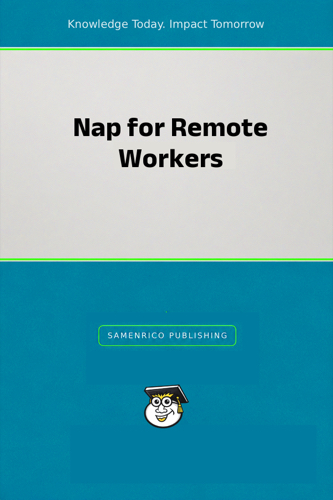
Nap for Remote Workers eBook
Use lunch break naps to boost afternoon focus.
by Hermann Alba
Use lunch break naps to boost afternoon focus.
Formats
Free sample
Chapter 1: The 2 PM Graveyard--–- At 2:17 PM on a Tuesday, Sarah closed her laptop, walked to her bedroom, and cried for eleven minutes. She wasn't sad. She wasn't burned out—not yet. She was simply empty. Her morning had been four hours of back-to-back Zoom calls.
Her Slack had forty-seven unread messages. Her to-do list had grown, not shrunk. And she still had four hours left in her workday.Sarah is a senior marketing manager at a Fortune 500 company. She works from home. She is not lazy.
She is not weak. She is a victim of the single greatest unacknowledged productivity crisis of the remote work era: the 2 PM cognitive crash.If you are reading this book, you have likely been there. Perhaps not crying, but certainly staring blankly at a screen, reading the same email three times without comprehending it. Perhaps reaching for a third cup of coffee that you know will only make things worse. Perhaps lying to yourself that you are "taking a quick break" while scrolling social media for forty-five minutes.
You are not alone. In fact, you are part of a silent epidemic affecting an estimated fifty-eight million remote workers in the United States alone. The symptoms are always the same: a predictable, almost clockwork collapse of mental energy somewhere between 1:00 PM and 3:00 PM, followed by a slow, grinding afternoon of guilt, procrastination, and diminished output.The corporate world has a name for people who admit to this. They call them lazy. Unmotivated.
"Not cut out for remote work." But here is the truth that no manager will tell you, that no productivity guru wants you to hear, and that this entire book is built upon: you do not have an afternoon energy problem. You have a neurobiological reality problem. And the solution is not more caffeine, more discipline, or more guilt. The solution is a nap.The Great Illusion of the 9-to-5 Mindset Before we can understand why the nap works, we must understand why you are crashing in the first place. And to do that, we need to talk about the structural mismatch between the way humans are designed to work and the way remote work has evolved.For generations, the traditional office forced artificial boundaries upon us.
The commute forced a natural ramp-up and ramp-down period. The visible lunch hour—that sacred, unchallenged block of time when you could leave your desk without explanation—provided a genuine mental reset. The walk to a colleague's desk, the water cooler conversation, the simple act of moving your body through physical space—these were not distractions. They were cognitive punctuation marks. They told your brain, "This task is over.
A new one is beginning."Then remote work arrived. For all its benefits—no commute, flexible hours, the ability to wear sweatpants—remote work dissolved those boundaries entirely. The result is what I call "scope creep": the unspoken, often unconscious expectation that you are always available, always responding, and always producing. Without a commute, your workday starts the moment you open your laptop. Without a visible lunch break, you eat at your desk while answering emails.
Without a physical separation between home and office, your work follows you into the evening.And here is the cruel irony: because you are saving time on commuting and office rituals, you are expected to be more productive. Not equally productive. More productive. This is the remote work productivity paradox. You have fewer boundaries, so you must produce more output.
But the human brain does not work that way. The human brain requires boundaries. It requires punctuation. It requires rest.By 2:00 PM, your prefrontal cortex—the part of your brain responsible for decision-making, impulse control, and focused attention—has been running nonstop since you woke up. It is not a muscle that gets stronger with continuous use.
It is a battery that drains. And without the natural punctuation marks of office life, it drains faster.The Concept of Attention Residue Let me introduce you to a concept that changed the way I think about productivity. It comes from Cal Newport's seminal book Deep Work, and it is called "attention residue."Here is how it works. When you switch from Task A to Task B, your attention does not fully transfer. A portion of your cognitive resources remains stuck on Task A, like a shadow or an echo.
Sophie Leroy, the researcher who first identified this phenomenon, found that even a brief, five-second distraction can leave attention residue that lasts for up to twenty minutes. Now multiply that by the average remote worker's morning. You check email. You respond to a Slack message. You join a Zoom call.
You switch to a spreadsheet. You answer a text from your partner. You return to the spreadsheet. Each switch leaves a residue. By noon, your brain is coated in a thick layer of half-finished thoughts.The traditional office mitigated this through forced breaks.
The commute to a meeting room. The walk to the coffee machine. The simple act of standing up and stretching. These micro-breaks allowed attention residue to dissipate. Remote work has eliminated most of them.
You switch from Zoom to Slack to email without ever leaving your chair. The residue accumulates. And by 2:00 PM, your cognitive load is so high that even simple tasks feel overwhelming.Here is the kicker: attention residue does not just make you slower. It makes you dumber. Research suggests that high attention residue can temporarily lower your effective IQ by up to ten points.
That is the difference between solving a complex problem and staring at it blankly. That is the difference between a witty email and a confusing one. That is the difference between a promotion and a performance improvement plan.You are not lazy. You are cognitively clogged.The Grind Culture Lie Somewhere along the way, we started believing that rest is something you earn after work. That productivity is measured in hours logged, not output generated.
That the people who succeed are the ones who grind the hardest, sleep the least, and push through every obstacle with sheer willpower.This is a lie.I want to be clear about something. I am not attacking hard work. I am attacking the misapplication of hard work. Tim Ferriss's *The 4-Hour Workweek* is often cited as the Bible of the anti-grind movement, but its core message has been widely misinterpreted. Ferriss did not argue that work is bad.
He argued that ineffective work is bad. He argued for leverage, for systems, for working smarter, not just harder. But somewhere along the way, the productivity industrial complex twisted that message into something else entirely: "Work less by hacking your biology."You cannot hack your biology. You can only work with it.The human brain evolved over hundreds of thousands of years to operate in a specific way. It requires sleep, rest, and recovery.
It is not a machine. It is an organ. And like every other organ, it has limits. The idea that you can simply "push through" the 2 PM crash is not just ineffective. It is actively harmful.
When you push through fatigue, you are not increasing your output. You are increasing your error rate. You are increasing…
This is the end of the free sample. Get the eBook to keep going. Buy now
About this book
Details
- Author
- Hermann Alba
- Publisher
- SamEnrico
- Language
- English
- Genre
- Non-Fiction, Health & Wellness, Remote Work
- Released
- 2026-06-08
- Pages (approx.)
- 130
- Available as
- eBook, Audiobook

Read better in the ZLOADR app
Your eBooks on your phone or tablet. Sign in with your SamEnrico account and start reading.
More by Hermann Alba
 Complicated Grief Recovery GuideHermann Alba$11.99Complicated Grief Recovery GuideHermann Alba$11.99
 Working Memory AppsHermann Alba$11.99
 Benzodiazepine Emotional Blunting GuideHermann Alba$11.99
 Statue Dream MeaningHermann Alba$11.99
 Morning Routine For EntrepreneursHermann Alba$11.99
 Exercise Block CommitmentHermann Alba$11.99
 NVC For Customer ServiceHermann Alba$11.99
 Wings of the Arctic: The Great Goose UprisingHermann Alba$11.99
 The Silent Codebreakers of WWII: The Women Who Cracked the UnbreakableHermann Alba$11.99
 Letters Across the Wire: The Secret Love Story of a Spy and a NurseHermann Alba$11.99
 Venture Debt Vs Equity RecapHermann Alba$12.99
You may also like
 Hong Kong Handover 1997Dunn Johnnie$11.99
 Zumba For Postnatal Recovery CourseNeal Christian$11.99
 Zumba for BeginnersLadner Nikia$11.99
 YouTube Comment Mining GuideHumes Pandora$12.99
 Worry Box MeditationCarlin Rudy$11.99
 Workplace Stress MeditationNguyen Lynn$11.99
 Workplace Stress and Sleep RepairHawley Ivory$11.99
 Workplace Perfectionism CureDelaney Jeffry$11.99
 Workplace Injustice Anger GuideWallen Isabelle$11.99
 Work Addiction and Burnout LinkGreenwood Ester$11.99
 Women in Yoga and WellnessBeattie Galina$11.99
 Women in Stand Up ComedyChun Evangeline$11.99