
Non-FictionHealth & WellnessHypertension
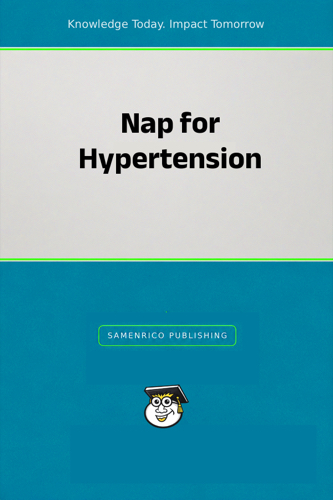
Nap for Hypertension
Lowers blood pressure through midday rest.
by TRUE Aiko
Lowers blood pressure through midday rest.
Formats
About this book
Free sample
Chapter 1: The Forbidden Nap--It is 2:17 on a Tuesday afternoon, and you are fighting a war you were never meant to win.Your eyelids have become lead weights. The words on your screen have blurred into a gray soup. A colleague is speaking to you, and you are nodding, but you have no idea what they just said. Your coffee cup, drained two hours ago, sits like a tiny tombstone on your desk. You consider another cup, then calculate the time—if you drink it now, you will not sleep until midnight.
So you do what you have been trained to do. You sit up straighter. You squint. You tell yourself to push through.This, right here, is the single most damaging habit in the life of a person with high blood pressure. And no one has ever told you why.Welcome to the forbidden nap.
Forbidden not by medicine, not by science, but by a 300-year-old accident of industrial history that has convinced you—and your boss, and your doctor, and your spouse—that afternoon sleepiness is a moral failure. You are not lazy. You are not weak. You are not broken. You are, in fact, fighting against three hundred thousand years of human evolution with nothing but willpower and caffeine.
And you are losing.But here is what no one has told you: that 2:00 PM crash is not your enemy. It is your invitation.The Myth of the Monophasic Human Let us travel backward in time. Way back.Before the light bulb, before the factory whistle, before the invention of the eight-hour workday, humans did not sleep like you do. They slept in two shifts. The anthropologists call it biphasic sleep—a long nocturnal sleep of about six to seven hours, followed by a shorter daytime rest of thirty to sixty minutes.
This pattern appears in every pre-industrial culture studied. The ancient Romans called it meridie (from which we get "siesta"). The Chinese called it wu shui. The Greeks, mesimeri anapavsi. In every language, in every climate, on every continent, humans napped.Why?
Because your brain is not designed to stay alert for sixteen consecutive hours.Your internal clock, the circadian rhythm, operates on…
This is the end of the free sample. Get the eBook to keep going. Buy now
Contents
- Chapter 1
- Chapter 2
- Chapter 3
- Chapter 4
- Chapter 5
- Chapter 6
- Chapter 7
- Chapter 8
- Chapter 9
- Chapter 10
- Chapter 11
- Chapter 12
Details
- Author
- TRUE Aiko
- Publisher
- SamEnrico
- Language
- English
- Genre
- Non-Fiction, Health & Wellness, Hypertension
- Released
- 2026-06-08
- Pages (approx.)
- 137
- Available as
- eBook, Audiobook

Read better in the ZLOADR app
Your eBooks on your phone or tablet. Sign in with your SamEnrico account and start reading.
More by TRUE Aiko
 Name Sound AssociationTRUE Aiko$11.99
 Workplace Criticism RecoveryTRUE Aiko$11.99
 Shopping Sobriety Second MonthTRUE Aiko$11.99
 OKRs for EducationTRUE Aiko$11.99
 The Senior Move Management BriefTRUE Aiko$11.99
 The Coding Club FounderTRUE Aiko$11.99
 Meth Psychosis Symptom GuideTRUE Aiko$11.99Meth Psychosis Symptom GuideTRUE Aiko$11.99
 Beneath the Waves: The Lost Submarine of the Bermuda TriangleTRUE Aiko$11.99
 The Siege of Osaka: The Fall of the Last Samurai StrongholdTRUE Aiko$11.99
 Service Providers Guide to Cellular Phone ServiceTRUE Aiko$11.99
 How to Start a Antibiotics Business (Beginners Guide)TRUE Aiko$11.99
You may also like
 Hong Kong Handover 1997Dunn Johnnie$11.99
 Zumba For Postnatal Recovery CourseNeal Christian$11.99
 Zumba for BeginnersLadner Nikia$11.99
 YouTube Comment Mining GuideHumes Pandora$12.99
 Worry Box MeditationCarlin Rudy$11.99
 Workplace Stress MeditationNguyen Lynn$11.99
 Workplace Stress and Sleep RepairHawley Ivory$11.99
 Workplace Perfectionism CureDelaney Jeffry$11.99
 Workplace Injustice Anger GuideWallen Isabelle$11.99
 Work Addiction and Burnout LinkGreenwood Ester$11.99
 Women in Yoga and WellnessBeattie Galina$11.99
 Women in Stand Up ComedyChun Evangeline$11.99