
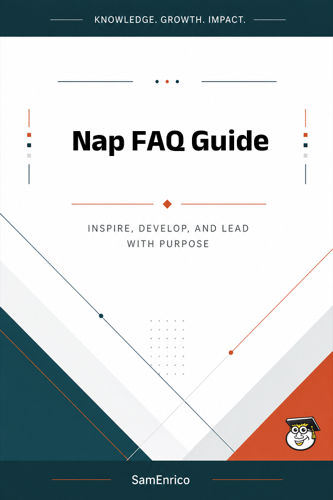
Non-FictionHealth & WellnessReference
Nap FAQ Guide eBook
Answers to common questions about napping.
Answers to common questions about napping.
Formats
Free sample
Chapter 1: The Afternoon Ambush--–- The clock on your computer screen reads 2:17 PM. You have three unread emails, a report due by 5:00, and a meeting that was supposed to end ten minutes ago. Your coffee mug, which you refilled at noon, sits empty beside a stack of sticky notes you don’t remember writing. Your eyelids feel like lead curtains slowly descending over a stage you were supposed to be performing on. You blink hard.
You sit up straighter. You take a deep breath. None of it works. The fog rolls in anyway, thick and indifferent, and you realize with a sinking certainty that for the next forty-five minutes, you will accomplish exactly nothing of value.If this scene feels familiar, you are in excellent company. Across time zones and industries, in office cubicles and construction trailers, in elementary school faculty rooms and hospital nurses’ stations, the 2:00 PM crash is one of the most reliably predictable events in human biology.
It is not a personal failing. It is not evidence of laziness, moral weakness, or a secret need for more espresso. It is, quite simply, your brain following an ancient rhythm that has not yet received the memo about modern work schedules. This chapter will answer the single most common question in sleep medicine—Is it normal to feel sleepy every afternoon?—and then arm you with the knowledge to stop fighting your biology and start working with it.The Circadian Dip: Your Brain’s Built-In Afternoon Slump To understand why you crash at 2:00 PM, you must first understand the circadian rhythm. This is not a vague wellness term or a marketing gimmick for expensive light bulbs.
The circadian rhythm is a genuine, measurable, molecular clock ticking inside nearly every cell of your body. It is generated by a cluster of approximately 20,000 neurons in your brain’s suprachiasmatic nucleus, a tiny region no larger than a grain of rice located just above the optic nerve. These neurons fire in a roughly 24-hour cycle, sending signals to the rest of your body that regulate body temperature, hormone release, metabolism, and—most relevant to this chapter—alertness.The circadian rhythm does not produce a flat line of steady wakefulness throughout the day. It produces a wave. Most people experience two natural peaks of alertness (one in the mid-morning, around 9:00 to 11:00 AM, and another in the early evening, around 7:00 to 9:00 PM) and two natural dips.
The first dip occurs in the early afternoon, roughly eight hours after your natural wake-up time. This is the circadian dip. The second, deeper dip occurs in the middle of the night during your core sleep period.Here is what makes the circadian dip so frustrating and, simultaneously, so fascinating: it happens regardless of how much you slept the night before. You could have slept a perfect nine hours, followed every sleep hygiene rule in the appendix of this book, and woken up feeling like a golden god of productivity. By 2:15 PM, that dip will still arrive.
It is not a debt repayment schedule. It is a rhythmic trough, as predictable as the tide. Research using forced desynchrony protocols—studies where volunteers live on 28-hour or 20-hour days in underground laboratory suites—has demonstrated that the afternoon dip persists even when sleep timing and duration are completely controlled. You cannot outrun it. You cannot out-coffee it.
You can only understand it and plan around it.The evolutionary explanation for the circadian dip is straightforward. Human beings evolved in equatorial Africa, where midday temperatures regularly exceed 100 degrees Fahrenheit. For a hunter-gatherer on the savanna, the period between 1:00 PM and 4:00 PM was the most dangerous time to be active. Heat stroke, dehydration, and predation risk all peaked during these hours. The biology that survived—your biology—was the biology that sought shade, rested, and conserved energy during the hottest part of the day.
The afternoon nap, or the siesta, is not a cultural invention. It is a biological adaptation dressed in cultural clothing. Societies that stigmatize napping are not more evolved; they are simply living in climates or economic systems that have temporarily overridden a million years of evolutionary programming.The Two Types of Afternoon Fatigue: Planned Versus Necessary Not all afternoon sleepiness is created equal. One of the most useful distinctions you can make—and one that will inform every nap decision you make after reading this book—is the difference between planned napping and necessary napping.Planned napping is proactive. It is the nap you take because you know the circadian dip is coming at 2:00 PM, and you want to arrive at that dip already rested.
Think of it as an insurance policy against the fog. A planned nap is typically short (10 to 20 minutes), timed to end just before the dip would normally hit, and taken with the specific goal of maintaining or improving performance during the afternoon hours. Elite athletes use planned napping to improve reaction time. Airline pilots use planned napping during long-haul flights (a practice known as "controlled rest on the flight deck"). Surgeons in training have been shown to reduce technical errors by 20 percent following a planned nap.
This is not rest for the sake of rest. This is strategic rest for the sake of superior performance.Necessary napping is reactive. It is the nap you take because you are already in the fog and cannot function. Your eyes are closing at a red light. You have read the same sentence six times.
You are making errors that will require rework. A necessary nap is not an optimization tool; it is a rescue tool. It is the nap you take when sleep debt—the accumulated difference between the sleep you need and the sleep you get—has reached a level that impairs safety or basic cognitive function. Unlike planned naps, necessary naps are often longer (60 to 90 minutes) because the body is trying to repay that debt. And unlike planned naps, necessary naps frequently produce sleep inertia (the groggy, disoriented feeling upon waking) because the brain has entered deep sleep.How do you tell the difference?
The Stanford Sleepiness Scale provides a simple, validated method. Rate your current state on a scale from 1 to 7:1: Feeling active, vital, alert, wide awake (peak performance)2: Functioning at a high level but not at peak; able to concentrate (normal daytime state)3: Relaxed, awake, not at full alertness but responsive (mild fatigue)4: A little foggy, let down (moderate fatigue—consider a planned nap)5: Foggy, losing interest in staying awake, slowed reactions (necessary nap territory)6: Sleepy, woozy, fighting sleep, prefer to lie down (necessary nap strongly recommended)7: No longer fighting sleep, sleep onset soon, dream-like thoughts appearing (emergency nap required immediately)If you score a 3 or 4 on this scale, you are in planned nap territory. A 10-to-20-minute power nap will restore you to a 2 or even a 1. If you score a 5 or higher, you are in necessary nap territory. Your sleep debt is high enough that you need to address it.
A 20-minute nap will help temporarily, but you will likely need a longer recovery period—either a 90-minute nap or an early bedtime.The Caffeine Trap: Why Fighting the Dip Often Backfires When the 2:00 PM crash hits, the most common…
This is the end of the free sample. Get the eBook to keep going. Buy now
About this book
Details
- Author
- Waggoner Fausto
- Publisher
- SamEnrico
- Language
- English
- Genre
- Non-Fiction, Health & Wellness, Reference
- Released
- 2026-06-08
- Pages (approx.)
- 152
- Available as
- eBook, Audiobook

Read better in the ZLOADR app
Your eBooks on your phone or tablet. Sign in with your SamEnrico account and start reading.
More by Waggoner Fausto
 Morning Decision Fatigue ShieldWaggoner Fausto$11.99
 Cocaine Relapse Dream ManagementWaggoner Fausto$11.99
 Road Rage and Rental CarsWaggoner Fausto$11.99
 The Stress Pelvic PainWaggoner Fausto$11.99
 Ninety Minute Ultradian CycleWaggoner Fausto$11.99
 Memory Palace TrainingWaggoner Fausto$11.99
 NVC For DivorceWaggoner Fausto$11.99
 Immigrant Wedding Photography SuccessWaggoner Fausto$11.99
 The Last Shot: The Miracle of the 1992 Dream Team's RedemptionWaggoner Fausto$11.99
 Shadows of the Silk Road: The Lost Legion of the Han DynastyWaggoner Fausto$11.99
 Fenrir's Howl: The Wolf That Shattered the SkyWaggoner Fausto$11.99
 Understanding Albright's SyndromeWaggoner Fausto$17.99
You may also like
 Hong Kong Handover 1997Dunn Johnnie$11.99
 Zumba For Postnatal Recovery CourseNeal Christian$11.99
 Zumba for BeginnersLadner Nikia$11.99
 YouTube Comment Mining GuideHumes Pandora$12.99
 Worry Box MeditationCarlin Rudy$11.99
 Workplace Stress MeditationNguyen Lynn$11.99
 Workplace Stress and Sleep RepairHawley Ivory$11.99
 Workplace Perfectionism CureDelaney Jeffry$11.99
 Workplace Injustice Anger GuideWallen Isabelle$11.99
 Work Addiction and Burnout LinkGreenwood Ester$11.99
 Women in Yoga and WellnessBeattie Galina$11.99
 Women in Stand Up ComedyChun Evangeline$11.99