
Non-FictionHealth & WellnessMedical
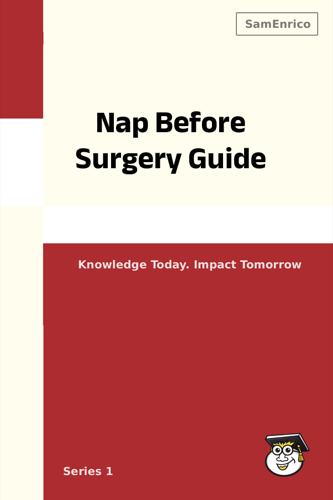
Nap Before Surgery Guide eBook
Calm pre operative anxiety.
Calm pre operative anxiety.
Formats
Free sample
Chapter 1: The Energy Heist--–- You are about to undergo surgery, and somewhere in the back of your mind, a quiet voice keeps whispering the same two words: What if?What if something goes wrong? What if the anesthesia doesn't work? What if the pain is unbearable? What if I don't wake up? These questions arrive without invitation, often in the middle of the night, often when you are already exhausted, often when you have finally managed to stop scrolling through Web MD for the fifth time.
They loop and repeat like a song you cannot turn off. This is pre-operative anxiety, and if you are reading this book, you almost certainly have it. The good news is that you have picked up the right book. The better news is that there is nothing wrong with you. The best news is that you are about to learn why your anxiety is not just uncomfortable—it is actively stealing from you.
And once you understand the theft, you can stop it.Let us begin with a question that no surgeon will ask you and no anesthesiologist will measure. How much energy are you burning on worry right now? Not the energy you use to walk, to breathe, to digest food. That energy is automatic. The energy we are talking about is the energy of the stressed mind—the constant, humming, low-grade electrical storm of anticipation, catastrophizing, and dread.
This energy has a cost. It is measured in calories burned, hormones released, immune cells diverted, and healing potential squandered. Every hour you spend in a state of high anxiety before surgery is an hour your body spends preparing to fight a bear instead of preparing to heal a wound. And here is the cruel irony: the bear is not coming. The surgery is coming.
But your body does not know the difference between a real threat and an imagined one.The Body’s Ancient Alarm System To understand why pre-operative anxiety is so damaging, you need to understand something your body has known for millions of years. The human stress response—often called the fight-or-flight response—is one of the most elegant and powerful survival mechanisms ever evolved. When your ancestors saw a predator, when they heard a rustle in the grass, when they smelled smoke on the wind, their bodies executed a perfect sequence of physiological changes. The adrenal glands released cortisol and adrenaline. The heart rate accelerated.
Blood flow was redirected from the digestive system to the large muscles of the legs and arms. Breathing became shallow and rapid to maximize oxygen intake. The immune system temporarily stood down because fighting an infection could wait if you were about to be eaten. The digestive system shut down because digesting lunch was not a priority during a life-threatening encounter. The body became a perfect machine for one purpose and one purpose only: survival in the next sixty seconds.This system worked brilliantly for your ancestors.
The ones who could not mount a proper stress response were eaten. You are descended from the worriers, the jumpy ones, the people who heard a branch snap and ran first and asked questions later. Your anxiety is not a flaw. It is an inheritance. It is a gift from every ancestor who survived long enough to reproduce.But here is the problem.
That ancient alarm system was designed for acute threats that lasted minutes, not days or weeks. The saber-toothed tiger was either going to eat you or wander away within a very short period of time. Your upcoming surgery, however, is different. It is a predictable threat. You know it is coming.
You have a date on the calendar. And for the seven, fourteen, or twenty-one days leading up to that date, your ancient alarm system is doing what it was designed to do: sounding the alarm. The problem is that the alarm was never meant to ring for three weeks straight.The Metabolic Cost of Fear Let me give you a number that might shock you. Every hour of severe anxiety consumes approximately fifty to one hundred calories of energy that could otherwise be used for healing. This is not a metaphor.
This is biochemistry. Cortisol and adrenaline are expensive hormones to produce and maintain. The physiological changes they trigger—increased heart rate, elevated blood pressure, redirected blood flow, suppressed digestion—all require energy. That energy comes from the same pool your body will need after surgery to repair tissue, fight infection, and recover from anesthesia.Think of your body as having a limited budget of healing resources. Call it the Healing Bucket.
In the days before surgery, your Healing Bucket is full of protein, glucose, oxygen, immune cells, and other essential resources. After surgery, your body will dip into that bucket constantly to rebuild what was cut, removed, or rearranged. The deeper the bucket, the faster you heal. The shallower the bucket, the longer and harder the recovery.Now imagine that every anxious thought is a small hole in the bottom of your Healing Bucket. Every sleepless night spent worrying is a crack.
Every catastrophic prediction you make is a leak. And all of those leaks add up. By the time you are wheeled into the operating room, your Healing Bucket may be half empty—not because of anything the surgeon did, but because of everything your mind did in the weeks before.This is what I call the Metabolic Cost of Fear. It is real. It is measurable.
And it is completely reversible.A study published in the journal Annals of Surgery in 2025 followed four hundred patients undergoing major abdominal surgery. Half received standard pre-operative care. The other half received psychological prehabilitation—essentially, the kind of preparation this book teaches. The results were striking. The patients who received psychological preparation had hospital stays that were 1.6 days shorter on average.
They required significantly less pain medication. They had fewer complications. And when researchers asked them about their experience, they reported feeling more in control, less afraid, and more optimistic about their recovery.What these patients learned is what you are about to learn: that anxiety is not a feeling to endure. It is a resource to redirect. The energy you are currently burning on worry can be harvested and redirected toward preparation, toward calm, toward healing.
But first, you have to see the theft for what it is.The Three Faces of Pre-Operative Anxiety Before we can stop the energy leak, we need to understand where it is coming from. Pre-operative anxiety is not a single thing. It is a cluster of fears that tend to travel together. Research has identified three primary sources of pre-operative distress, and chances are good that you are experiencing at least two of them right now.The Fear of Pain This is the most straightforward fear. Surgery hurts.
You know this. Everyone knows this. And the anticipation of pain is often worse than the pain itself. Your brain has a remarkable ability to simulate unpleasant experiences, and it uses that ability liberally in the days before surgery. You imagine the incision.
You imagine the waking moment. You imagine the recovery room. And each of these imaginings triggers a small stress response…
This is the end of the free sample. Get the eBook to keep going. Buy now
About this book
Details
- Author
- Keeton Denita
- Publisher
- SamEnrico
- Language
- English
- Genre
- Non-Fiction, Health & Wellness, Medical
- Released
- 2026-06-07
- Pages (approx.)
- 152
- Available as
- eBook, Audiobook

Read better in the ZLOADR app
Your eBooks on your phone or tablet. Sign in with your SamEnrico account and start reading.
More by Keeton Denita
 Self Hypnosis for Complex Regional PainKeeton Denita$11.99
 Environment Flow DesignKeeton Denita$11.99
 Claustrophobia Treatment GuideKeeton Denita$11.99
 Group Creativity For Non ProfitsKeeton Denita$11.99
 Business Card Template CanvaKeeton Denita$11.99
 Acupuncture for SciaticaKeeton Denita$11.99
 Remote Client CommunicationKeeton Denita$11.99
 The Golden Quill of Timbuktu: Africa's Renaissance ScholarsKeeton Denita$11.99
 The Fox at Thermopylae: The Brilliant Tactics of EpaminondasKeeton Denita$11.99
 Starfish: EchinodermKeeton Denita$11.99
 A Collector's Handbook to the Willys Light Four WhippetKeeton Denita$11.99
 How to Produce PineapplesKeeton Denita$11.99
You may also like
 Hong Kong Handover 1997Dunn Johnnie$11.99
 Zumba For Postnatal Recovery CourseNeal Christian$11.99
 Zumba for BeginnersLadner Nikia$11.99
 YouTube Comment Mining GuideHumes Pandora$12.99
 Worry Box MeditationCarlin Rudy$11.99
 Workplace Stress MeditationNguyen Lynn$11.99
 Workplace Stress and Sleep RepairHawley Ivory$11.99
 Workplace Perfectionism CureDelaney Jeffry$11.99
 Workplace Injustice Anger GuideWallen Isabelle$11.99
 Work Addiction and Burnout LinkGreenwood Ester$11.99
 Women in Yoga and WellnessBeattie Galina$11.99
 Women in Stand Up ComedyChun Evangeline$11.99