
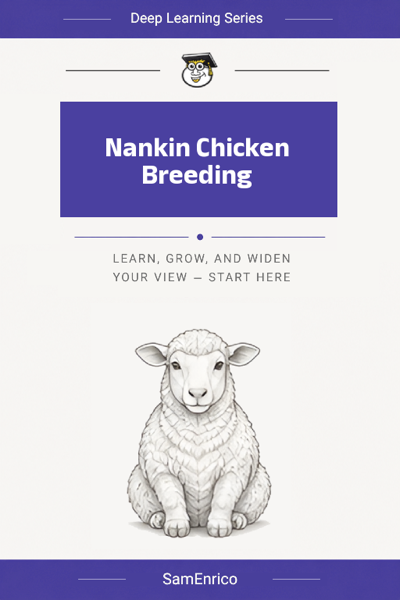
Non-FictionInformativeEducational
Nankin Chicken Breeding
A Coursebook on Nankin Chicken Breeding
A Coursebook on Nankin Chicken Breeding
Formats
About this book
Free sample
Chapter 1: The Ancient Mariner...–- The crate arrived at JFK Airport on a grey November morning in 1963, stamped “Live Poultry – Handle with Care.” Inside, two small chickens shifted on their wooden slats, their chestnut feathers dulled by weeks of transatlantic travel. They were Nankins—specifically, a single breeding pair sent from a British conservationist to a New York poultry fancier named Mrs. Dempsey. At the time, no one understood that these two unremarkable birds represented a genetic lifeline. Without them, the Nankin breed would be functionally extinct in the United States today.
Every Nankin you see in America, from the dusty coops of Oklahoma to the manicured runs of New England show grounds, descends from that single 1963 importation. This is not hyperbole. It is the uncomfortable reality of a breed that has survived on the knife’s edge of oblivion for over a century.The Oldest of the True Bantams Before we can understand the Nankin’s precarious present, we must travel backward—not decades but centuries. The Nankin is widely considered one of the oldest true bantam breeds in existence. Unlike “miniaturized” bantams (which are small versions of large fowl), true bantams have no large counterpart.
They are their own distinct genetic lineage, and the Nankin may be the oldest of them all. Poultry historians debate the precise origin, but the consensus points to Southeast Asia, specifically the port city of Nanjing (formerly romanized as Nankin) in China. During the Ming Dynasty, European sailors and traders encountered small, lively chickens with striking chestnut-and-black plumage. These birds were compact, excellent foragers, and surprisingly fearless—traits that endeared them to sailors who needed fresh eggs and meat on long voyages.The name “Nankin” likely derives from the distinctive yellowish-buff cotton cloth called “nankeen” that was exported from Nanjing. Early observers noted that the hen’s body color matched the fabric almost exactly—a warm, dusty buff that was neither gold nor brown but somewhere in between.
This color, now known as “Nankeen” in poultry literature, remains the breed’s defining characteristic. By the early 1700s, Nankins had arrived in Britain, where they…
This is the end of the free sample. Get the eBook to keep going. Buy now
Contents
- Chapter 1
- Chapter 2
- Chapter 3
- Chapter 4
- Chapter 5
- Chapter 6
- Chapter 7
- Chapter 8
- Chapter 9
- Chapter 10
- Chapter 11
- Chapter 12
Details
- Author
- Wooldridge Raguel
- Publisher
- SamEnrico
- Language
- English
- Genre
- Non-Fiction, Informative, Educational
- Released
- 2026-05-11
- Pages (approx.)
- 145
- Available as
- eBook, Audiobook

Read better in the ZLOADR app
Your eBooks on your phone or tablet. Sign in with your SamEnrico account and start reading.
More by Wooldridge Raguel
 English Proficiency Wellness GapWooldridge Raguel$11.99
 Metta for WritersWooldridge Raguel$11.99
 Floating on WaterWooldridge Raguel$11.99
 Congo Brazzaville Youlou GuideWooldridge Raguel$11.99
 Overcoming Self Doubt for ChefsWooldridge Raguel$11.99
 The Last Dance of the Titanic: How One Legal Battle Saved the Ship’s LegacyWooldridge Raguel$11.99
 How to Become a ClownWooldridge Raguel$11.99
 Remote Team Accountability FrameworkWooldridge Raguel$12.99
 Automated Video TranscriptionWooldridge Raguel$12.99
 Understanding Mps Iii-cWooldridge Raguel$17.99
You may also like
 Hong Kong Handover 1997Dunn Johnnie$11.99
 Zumba For Postnatal Recovery CourseNeal Christian$11.99
 Zumba for BeginnersLadner Nikia$11.99
 YouTube Comment Mining GuideHumes Pandora$12.99
 Worry Box MeditationCarlin Rudy$11.99
 Workplace Stress MeditationNguyen Lynn$11.99
 Workplace Stress and Sleep RepairHawley Ivory$11.99
 Workplace Perfectionism CureDelaney Jeffry$11.99
 Workplace Injustice Anger GuideWallen Isabelle$11.99
 Work Addiction and Burnout LinkGreenwood Ester$11.99
 Women in Yoga and WellnessBeattie Galina$11.99
 Women in Stand Up ComedyChun Evangeline$11.99