
Non-FictionSelf-HelpSocial Memory
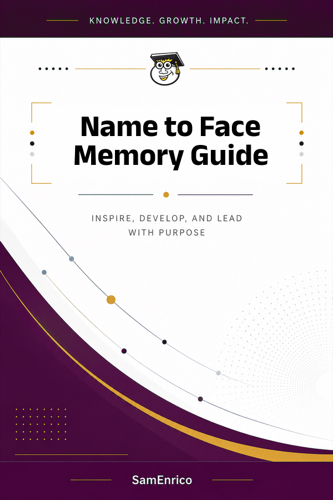
Name to Face Memory Guide eBook
Remember names at networking events using associat
Remember names at networking events using association and repetition strategies.
Formats
Free sample
Chapter 1: The Cognitive Cliff--–- The man in the navy blazer extended his hand with practiced ease. “Great to meet you—I’m David.” I shook his hand, smiled, and said, “I’m sorry, what was your name again?” It had been exactly four seconds.The man’s expression flickered—just for a moment—from warmth to mild offense. He repeated, “David,” this time slower, as if speaking to someone with a hearing impairment. I laughed nervously, mumbled something about being tired from travel, and promptly forgot his name again thirty seconds later. David and I spoke for another seven minutes.
I nodded, asked questions, and made what I thought was a decent impression. But I never used his name again because I couldn’t. It had simply vanished.That night, I scrolled through Linked In, trying to find “David” among the fifty people I had met. I couldn’t. I had no company name, no unique spelling, no memory of his job title.
He was just a face—friendly, forgettable, and now forever lost. A week later, I received an email from a colleague: “Hey, David from Acme Corp said he met you at the conference. He was interested in partnering. Why didn’t you follow up?”I hadn’t followed up because I couldn’t remember who he was. And that silence cost me a $40,000 contract.This is not a story about a weak memory.
This is a story about a predictable cognitive failure that happens to nearly every human being under specific conditions. And this book exists because that failure is entirely preventable.The Anatomy of an Embarrassment Let’s replay what happened in those first four seconds—not as a story, but as a neurological event. When David said his name, your brain was performing a high-wire act. You were simultaneously: processing his face (holistically, emotionally), listening to the sound of his voice, preparing your own name to say next, managing anxiety about first impressions, scanning the room for other threats or opportunities, and deciding what to say after “I’m [your name].”This is what cognitive psychologists call cognitive load—the total amount of mental effort being used in working memory. And during an introduction, your cognitive load spikes to near-maximum capacity.
Something has to give. Almost always, that something is the name.Here is the cruel trick biology plays on you: your brain prioritizes faces over names because faces carry survival information (friend or foe? familiar or stranger?) while names are arbitrary labels invented by humans. You have specialized neural architecture for face recognition—the fusiform face area—but no equivalent “name area.” Your brain treats names like random data: a string of sounds attached to a person with no inherent meaning.This is why you can recognize a face instantly but struggle to recall the name. The face is stored in a rich, visual, emotional network.
The name is stored in a dry, linguistic, abstract file. Without deliberate effort, those two files never connect.But here is what most people get wrong: they interpret this neurological reality as a character flaw. “I’m bad with names” becomes an identity, a fixed trait, a source of shame. In reality, “I’m bad with names” is equivalent to “I’ve never been taught how to encode names.” No one is born knowing how to read. You were taught.
No one is born knowing how to remember names. You simply haven’t taken the class yet. This chapter is that class.The Next-in-Line Effect: Why You Forget Right After Hearing There is a specific, maddening pattern to name forgetting that nearly everyone has experienced but few understand. You are at a networking event. A person says, “Hi, I’m Sarah.” You say, “Hi, Sarah, I’m John.” And then—immediately—you forget that her name is Sarah.
Not thirty seconds later. Immediately.This is called the next-in-line effect, first documented by researchers Brenner and Hirtle in the 1980s. In their experiments, participants remembered significantly less information presented immediately before they had to perform or speak. The reason is simple: when you know you are about to say your own name or deliver your own pitch, your brain shifts attention inward. You stop listening to the other person and start rehearsing your own response.The next-in-line effect is not a memory failure.
It is an attention failure. You never encoded the name in the first place because your brain was busy preparing “I’m John, I work in marketing, nice to meet you.” By the time you finish your sentence, the name “Sarah” has already evaporated from your working memory buffer.Here is the solution, which we will return to throughout this book: you must separate the acts of listening and speaking. When someone says their name, your only job for that half-second is to listen. Not to prepare your response. Not to think about what you look like.
Not to scan the room. Just listen. The pause between their name and your name can be a full beat. That beat is where memory lives.Faces vs. Names: The Brain’s Unequal Treatment To understand why name memory requires training, you must understand how your brain treats faces versus names.
Faces are processed holistically—you see the entire face at once, not as a collection of parts. This is why you can recognize a friend’s face even if they change their hairstyle or wear sunglasses. The brain builds a composite, three-dimensional model that is remarkably resilient.Names, by contrast, are processed sequentially and arbitrarily. The sound “Sarah” has no inherent relationship to the shape of a face, the color of eyes, or the curve of a smile. Names are what linguists call “arbitrary signifiers”—a social convention agreed upon by a community but devoid of intrinsic meaning.Consider this: if you meet a dog named “Fluffy,” you might remember the name because it describes the dog’s appearance.
But human names rarely describe appearance. “David” doesn’t look like anything. “Jennifer” doesn’t smell or sound like its referent. This arbitrariness is the fundamental challenge of name memory. You cannot rely on meaning.
You must create it.That is where association comes in. The most powerful memory systems in the world—used by memory champions, polyglots, and medical students—rely on transforming arbitrary information into meaningful, visual, exaggerated images. A name like “Baker” becomes a rolling pin. “Miller” becomes a windmill. “Fisher” becomes a fish hook.
These are not random. They convert abstract sounds into concrete pictures.By the end of this book, you will be able to do this transformation in less than two seconds. But first, you must accept a foundational truth: your brain’s natural tendency is to forget names. Forgetting is the default. Remembering requires deliberate intervention.
You are not broken. You are just running on default settings.The Data Point Mindset One of the most liberating shifts you can make is how you think about names themselves. Most people treat names as identities—loaded with social significance, emotional weight, and relational history. Forgetting a name feels like forgetting a person. That emotional charge creates anxiety.
Anxiety impairs memory. It is a vicious cycle.Memory athletes—people who compete in events like memorizing 200 random names in fifteen…
This is the end of the free sample. Get the eBook to keep going. Buy now
About this book
Details
- Author
- Janssen Collin
- Publisher
- SamEnrico
- Language
- English
- Genre
- Non-Fiction, Self-Help, Social Memory
- Released
- 2026-06-09
- Pages (approx.)
- 141
- Available as
- eBook, Audiobook

Read better in the ZLOADR app
Your eBooks on your phone or tablet. Sign in with your SamEnrico account and start reading.
More by Janssen Collin
 Yellow Fever Vaccine Gruesome HistoryJanssen Collin$11.99
 Empty Nest Housing Transition BriefJanssen Collin$11.99
 Sleep Temperature MemoryJanssen Collin$11.99
 Etsy Digital Planner Review GenerationJanssen Collin$11.99
 The Last Whisper of Mu: Secrets of the Lost Pacific ContinentJanssen Collin$11.99
 LandboardingJanssen Collin$11.99
 Understanding Chlamydial and Gonococcal ConjunctivitisJanssen Collin$17.99
 Board Diversity for Mental HealthJanssen Collin$12.99
 Global Newsletter Metrics GuideJanssen Collin$12.99
 How to Start a Residential Buildings and Dwellings Lessors BusinessJanssen Collin$11.99
You may also like
 Hong Kong Handover 1997Dunn Johnnie$11.99
 Zumba For Postnatal Recovery CourseNeal Christian$11.99
 Zumba for BeginnersLadner Nikia$11.99
 YouTube Comment Mining GuideHumes Pandora$12.99
 Worry Box MeditationCarlin Rudy$11.99
 Workplace Stress MeditationNguyen Lynn$11.99
 Workplace Stress and Sleep RepairHawley Ivory$11.99
 Workplace Perfectionism CureDelaney Jeffry$11.99
 Workplace Injustice Anger GuideWallen Isabelle$11.99
 Work Addiction and Burnout LinkGreenwood Ester$11.99
 Women in Yoga and WellnessBeattie Galina$11.99
 Women in Stand Up ComedyChun Evangeline$11.99