
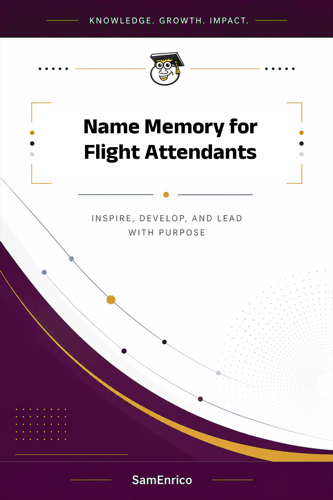
Name Memory for Flight Attendants eBook
Passenger name recall for service excellence.
Passenger name recall for service excellence.
Formats
Free sample
Chapter 1: Beyond the Boarding Pass--The moment a passenger crosses the aircraft threshold, they make a silent calculation that has nothing to do with seat pitch, overhead bin space, or even the departure time. They are asking themselves a question so fundamental that most are not consciously aware of it: Will I be seen as a person, or processed as a unit of cargo?For the flight attendant standing in the galley, welcoming two hundred strangers in twelve minutes, the answer to that question hangs on a single, deceptively simple act. It is not the warmth of your smile, though that matters. It is not the precision of your uniform, though that signals competence. It is whether, when you hand that passenger a glass of water or point them toward row twenty-two, you use their name.
Or whether you say "Sir" or "Ma'am" or, worst of all, nothing at all.This chapter is not about memory techniques. Those will come in the pages that follow. This chapter is about something that must come first: the unassailable business case for why a passenger’s name is the most valuable piece of data you will ever carry in your working memory. Because before you invest the mental energy to learn the systems, the hacks, and the neuroscience that make name recall possible, you need to understand what is at stake. And what is at stake is nothing less than the commercial survival of your airline, the trajectory of your career, and the quiet dignity of every person who trusts you with their safety at thirty-five thousand feet.The Commoditization Trap Let us begin with an uncomfortable truth that every airline executive knows but few will say aloud: the modern flying experience has been stripped of virtually everything that once distinguished one carrier from another.
Seat width has converged to industry standards. Meal quality across economy cabins is functionally indistinguishable. In-flight entertainment systems, once a point of competitive pride, are now nearly identical touchscreens running the same licensed content. Even loyalty programs, the holy grail of customer retention, have been so aggressively copied that a frequent flyer cannot reliably differentiate between a Gold status on Airline A versus Airline B.This is the commoditization trap. When every product feature is replicable, price becomes the only remaining battlefield.
And price wars have a single destination: the bottom.Yet in this landscape of sameness, one variable remains stubbornly, gloriously, irreducibly human. It cannot be outsourced to a kiosk. It cannot be automated by a chatbot. It cannot be mimicked by a prerecorded announcement. That variable is recognition.
Specifically, the recognition of a passenger as an individual with a name, a history, and a preference.Consider the following experiment, conducted across multiple service industries including hospitality and airline travel. Researchers presented customers with two identical service experiences—same wait time, same product quality, same price. In one experience, the service provider addressed the customer by name exactly once. In the other, the provider used generic terms like "Sir," "Ma'am," or "next in line." The result? Customers who were addressed by name rated the entire experience as twenty-three percent higher in quality, reported stronger emotional loyalty to the brand, and were thirty-one percent more likely to make an additional purchase during the same interaction.Twenty-three percent.
For the cost of remembering a single word.The Neuroscience of Being Seen Why does a name carry such disproportionate weight? The answer lies deep within the brain’s architecture, in a region called the ventral striatum. This small cluster of neurons is part of the brain’s reward circuit, the same system that lights up when you receive money, eat delicious food, or see a loved one’s face. Remarkably, hearing your own name activates this reward circuit more powerfully than hearing the name of a stranger, a celebrity, or even a close friend who is not present.From an evolutionary perspective, this makes perfect sense. In our ancestral environment, being recognized by name signaled that you were part of a tribe, that your presence was noted, that your survival mattered to others.
Being ignored or addressed generically signaled the opposite: anonymity, invisibility, expendability. The brain did not evolve to distinguish between a saber-toothed tiger and a indifferent flight attendant. The threat model is the same. They do not see me. I am not safe here.This is not hyperbole.
When researchers measure cortisol levels—the stress hormone—in passengers before and after being addressed by name, they find a measurable decrease. Names lower stress. Names signal safety. Names tell the passenger that the person in the uniform is not a robot executing a script but a fellow human who has bothered to learn something personal about them.Conversely, the absence of a name triggers a low-grade threat response. The passenger’s amygdala, the brain’s alarm system, remains slightly activated.
They will not feel actively afraid, but they will feel off. They will not be able to articulate why they prefer Airline A over Airline B, but their limbic system will have already voted. And the limbic system never forgets.The Economics of a Single Syllable Let us move from neuroscience to the balance sheet, because the argument for name memory is not merely sentimental. It is mathematical.The average full-service carrier earns approximately one hundred and seventy dollars in revenue per passenger per flight. This breaks down into the base fare, baggage fees, onboard food and beverage, duty-free purchases, Wi-Fi access, and seat selection charges.
Of that one hundred and seventy dollars, approximately fifteen to twenty percent is discretionary spending—purchases that the passenger did not pre-plan but decided to make based on their in-flight experience.Now consider the difference between a passenger who feels recognized and one who feels processed. Data from airline loyalty programs shows that recognized passengers are sixty-eight percent more likely to purchase an onboard meal. They are fifty-three percent more likely to buy duty-free goods. They are forty-one percent more likely to upgrade their seat on a future flight. And they are seventy-two percent less likely to file a complaint, even when something goes wrong.These numbers compound over time.
A single flight attendant who consistently remembers names on a route with two hundred passengers per flight, flying two hundred flights per year, touches forty thousand passengers annually. If even ten percent of those passengers increase their discretionary spending by a modest ten dollars per flight due to improved recognition, that flight attendant generates forty thousand dollars in incremental revenue per year. Over a twenty-year career, that is eight hundred thousand dollars.And that is only the direct spending. The indirect value is larger still. A passenger who feels recognized is fifty-seven percent more likely to recommend the airline to a friend, and those word-of-mouth referrals have an acquisition cost of zero dollars.
By contrast, the airline spends an average of forty-two dollars in marketing to acquire a single new customer.The math is inescapable. Name memory is not a soft skill. It is a revenue-generating asset.The Loyalty Ladder To understand why names drive loyalty, we must understand how loyalty itself is structured. Most airlines think of loyalty as a program: earn miles, achieve status…
This is the end of the free sample. Get the eBook to keep going. Buy now
About this book
Details
- Author
- Esparza Zonia
- Publisher
- SamEnrico
- Language
- English
- Genre
- Non-Fiction, Self-Help, Aviation
- Released
- 2026-06-10
- Pages (approx.)
- 153
- Available as
- eBook, Audiobook

Read better in the ZLOADR app
Your eBooks on your phone or tablet. Sign in with your SamEnrico account and start reading.
More by Esparza Zonia
 Buck Owens Act NaturallyEsparza Zonia$11.99
 Ethiopia Therapy Access GuideEsparza Zonia$11.99
 Cat Litter Auto-ship ChurnEsparza Zonia$11.99
 Chunking for Working MemoryEsparza Zonia$11.99
 The De-Stress Date NightEsparza Zonia$11.99
 Pat Nixon First LadyEsparza Zonia$11.99
 Detox Agitation ControlEsparza Zonia$11.99
 The Sky Whisperers: How the Maya Predicted the End of the World (And Why They Were Wrong)Esparza Zonia$11.99
 Simon Stevin: The Mathematician Who Armed the Dutch RevoltEsparza Zonia$11.99
 How to Produce a Shrink TunnelEsparza Zonia$11.99
 A Collector's Handbook to the Bsa Scout Series 6Esparza Zonia$11.99
 Evidence Integration AI PromptsEsparza Zonia$12.99
You may also like
 Hong Kong Handover 1997Dunn Johnnie$11.99
 Zumba For Postnatal Recovery CourseNeal Christian$11.99
 Zumba for BeginnersLadner Nikia$11.99
 YouTube Comment Mining GuideHumes Pandora$12.99
 Worry Box MeditationCarlin Rudy$11.99
 Workplace Stress MeditationNguyen Lynn$11.99
 Workplace Stress and Sleep RepairHawley Ivory$11.99
 Workplace Perfectionism CureDelaney Jeffry$11.99
 Workplace Injustice Anger GuideWallen Isabelle$11.99
 Work Addiction and Burnout LinkGreenwood Ester$11.99
 Women in Yoga and WellnessBeattie Galina$11.99
 Women in Stand Up ComedyChun Evangeline$11.99