
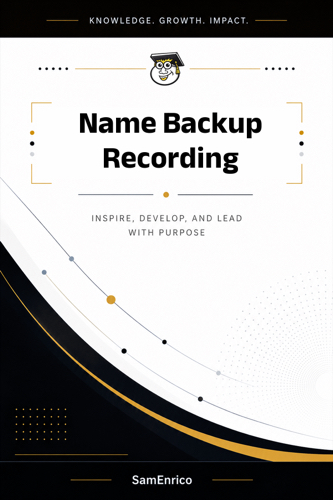
Non-FictionSelf-HelpNote Taking
Name Backup Recording eBook
Discreetly jot names after introductions for later
by Burton Barry
Discreetly jot names after introductions for later review.
Formats
Free sample
Chapter 1: The Forgetting Tax--–- The first time I forgot a name that cost me money, I was twenty-seven years old, standing in a hotel lobby in Chicago, holding a cup of coffee that had gone cold thirty minutes earlier.The man in front of me was smiling. He had a firm handshake, a navy blue suit, and the kind of confident posture that said "I sign checks, not receive them." We had met exactly forty-seven days before at a industry conference in Atlanta. I remembered his face perfectly. I remembered that he loved bourbon and hated small talk. I remembered that his daughter was applying to colleges and that he had flown in from Dallas that morning.I could not remember his name.Not even the first letter.
Not even a sound. It was as if someone had reached into my brain and erased a single file while leaving every other document intact. He stood there, hand extended, waiting for me to speak. The silence stretched past the point of politeness and into the territory of active discomfort. I saw his smile flicker.
I saw him recalibrate his opinion of me in real time."Good to see you again," I said, because I had to say something.He nodded slowly. "You too."We both knew. He knew that I had forgotten. I knew that he knew. And in that moment, whatever warmth had existed between us at that conference in Atlanta cooled by several degrees.
We chatted for another ninety seconds—about the weather, about the venue, about nothing—and then he excused himself to find someone who actually remembered who he was.Six months later, I learned that he had taken a meeting with my competitor. The deal was worth roughly two hundred thousand dollars in commission. Not all of that loss was attributable to my memory failure, of course. Relationships are complex. But I had sent a clear signal: You were not important enough for me to remember.That signal is expensive.The Hidden Cost of Forgetting We do not talk enough about what forgetting a name actually costs.
The self-help literature focuses on the embarrassment—the hot flush of shame when you see someone approaching and you cannot recall their name. But embarrassment is temporary. The real cost is cumulative, relational, and deeply financial.Let me give you a number: forty-seven percent.According to a 2019 study published in the Journal of Experimental Social Psychology, people who feel their name has been forgotten are forty-seven percent less likely to trust the person who forgot them. Not slightly less likely. Nearly half.
Trust is the currency of business, friendship, and romance. When you forget a name, you are not committing a minor social faux pas. You are actively devaluing the relationship in the other person's mind.The study asked participants to engage in a simulated networking exercise. Half of the participants were "remembered" by their conversation partner; half were "forgotten" (the partner deliberately used the wrong name or hesitated). Afterwards, participants rated their willingness to share contact information, make an introduction, or pursue a business opportunity with the person who had forgotten them.
The results were brutal. Forgotten participants were not merely annoyed. They were wounded. They described feeling invisible, disrespected, and unimportant.Consider the implications for your career. The average professional attends twelve networking events per year, meets approximately two hundred new people annually, and relies on those connections for referrals, partnerships, and opportunities.
If you forget even ten percent of those names—a very conservative estimate, as we will see—you are damaging twenty relationships per year. Over a decade, that is two hundred relationships impaired before they ever had a chance to develop.This is what I call the Forgetting Tax. It is the sum total of opportunities lost, deals delayed, and trust eroded because you could not retrieve a name at the moment it mattered most.Most people never calculate this tax. They chalk up name forgetting to "bad memory" or "being tired" or "it was a loud room." They accept it as an inevitable part of being human. But here is the truth that will transform how you think about this problem: forgetting names is not a memory problem.
It is a system problem.The Myth You Have Been Sold For the past fifty years, the self-help industry has sold you a beautiful lie. The lie is this: You can train your brain to remember every name, every time, using mental tricks and visualization techniques.Books like The Memory Book by Harry Lorayne and Jerry Lucas, Moonwalking with Einstein by Joshua Foer, and Unlimited Memory by Kevin Horsley have built entire franchises on this promise. They teach you to create "memory palaces," to associate names with ridiculous images (Mike with a microphone, Susan with a snooze button), and to rehearse those images until they stick.These techniques work. I want to be clear about that. They absolutely work.
Memory athletes—people who can memorize the order of ten shuffled decks of cards or recite pi to ten thousand digits—use these methods. They are real, replicable, and powerful.But they are also impractical for most people in most social situations.Here is why. To remember a name using a memory palace, you need to do three things in real time, while also maintaining a conversation, making eye contact, and managing your body language. First, you must hear the name clearly. Second, you must immediately generate a visual image that connects that name to something memorable about the person's appearance.
Third, you must place that image in a familiar mental location (your childhood home, your office, etc.). All of this must happen in the three to five seconds between the introduction and your response.Now consider what else is happening in those three to five seconds. You are shaking a hand. You are smiling. You are processing the person's facial features.
You are thinking about what to say next. Your brain is also filtering background noise, monitoring for threats, and regulating your breathing. The cognitive load is enormous.This is why even memory athletes do not use their mental palaces for everyday name recall. In 2016, I had the opportunity to interview Nelson Dellis, a four-time USA Memory Champion. Dellis can memorize the names of one hundred strangers in fifteen minutes—a feat that seems superhuman.
But when I asked him how he handles names at cocktail parties, his answer surprised me."I use a notebook," he said. "The mental palace is for competition or for memorizing a presentation. For real life, I write things down. It's faster, it's more reliable, and it doesn't require me to stop listening to the other person."Let me repeat that. A four-time USA Memory Champion, a man with a brain trained to perform feats of recall that most of us cannot imagine, uses a notebook at parties.
If the best memory in the country does not rely solely on his brain, why do you?What Your Brain Is Actually For To understand why trying to remember every name mentally is a losing battle, you need to understand what your brain is designed to do. And it is not designed…
This is the end of the free sample. Get the eBook to keep going. Buy now
About this book
Details
- Author
- Burton Barry
- Publisher
- SamEnrico
- Language
- English
- Genre
- Non-Fiction, Self-Help, Note Taking
- Released
- 2026-06-09
- Pages (approx.)
- 143
- Available as
- eBook, Audiobook

Read better in the ZLOADR app
Your eBooks on your phone or tablet. Sign in with your SamEnrico account and start reading.
More by Burton Barry
 Price Testing A/B GuideBurton Barry$11.99
 Nap Alarm StrategiesBurton Barry$11.99
 Contempt In Relationships GuideBurton Barry$11.99
 Spotify Wrapped ObsessionBurton Barry$11.99
 Shopping Relapse PreventionBurton Barry$11.99
 OKRs for EntrepreneursBurton Barry$11.99
 The Vision Screening VolunteerBurton Barry$11.99
 The Star Maps of the Dogon: Decoding the Cosmos in Ancient MaliBurton Barry$11.99
 The Cursed Gaze of Medusa's SistersBurton Barry$11.99
 Service Providers Guide to Leather & Vinyl RepairBurton Barry$11.99
 How to Produce UndergroundBurton Barry$11.99
 AI Working Capital OptimizationBurton Barry$12.99
You may also like
 Hong Kong Handover 1997Dunn Johnnie$11.99
 Zumba For Postnatal Recovery CourseNeal Christian$11.99
 Zumba for BeginnersLadner Nikia$11.99
 YouTube Comment Mining GuideHumes Pandora$12.99
 Worry Box MeditationCarlin Rudy$11.99
 Workplace Stress MeditationNguyen Lynn$11.99
 Workplace Stress and Sleep RepairHawley Ivory$11.99
 Workplace Perfectionism CureDelaney Jeffry$11.99
 Workplace Injustice Anger GuideWallen Isabelle$11.99
 Work Addiction and Burnout LinkGreenwood Ester$11.99
 Women in Yoga and WellnessBeattie Galina$11.99
 Women in Stand Up ComedyChun Evangeline$11.99