
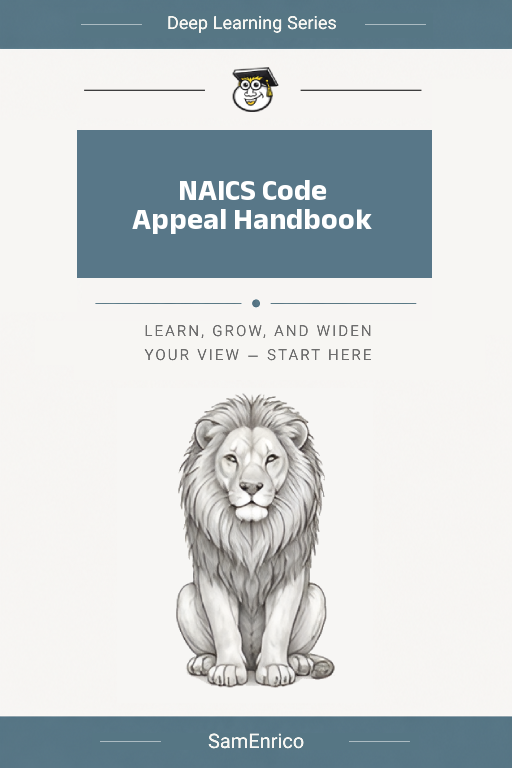
Non-FictionBusiness BriefNAICS Appeal
NAICS Code Appeal Handbook eBook
Challenge incorrect NAICS assignments that limit y
by Carey Sydney
Challenge incorrect NAICS assignments that limit your minority contracting opportunities.
Formats
Free sample
Chapter 1: The $3 Billion Blindspot--–- The rejection email arrived at 9:47 AM on a Tuesday. You had been certified as a Minority Business Enterprise (MBE) for three years. Your 8(a) application was pending. You had the bonding capacity, the past performance, and a team ready to mobilize. But the email didn't say "your price was too high" or "your technical approach was insufficient." It said something far more maddening: "Your firm is not eligible for this set-aside because your NAICS code does not match the solicitation."You read it again.
Then a third time. Your company had performed nearly identical work for other agencies. You had the resumes, the references, the equipment. But none of that mattered because a Contracting Officer (CO) sitting in a windowless office had typed a six-digit number into a box, and that number excluded you from a $5 million contract reserved specifically for minority-owned businesses.This is not a hypothetical. This happens every single day across the federal procurement system.
And the worst part? Most minority business owners never fight back. They assume the CO must be right. They assume the rules are fair. They assume there is nothing they can do.They are wrong on all three counts.This chapter is not an introduction.
It is a wake-up call. By the time you finish these pages, you will understand exactly how a single NAICS code can destroy years of certification work, why the system is stacked against minority firms in ways most owners never see, and—most importantly—why you have far more power to challenge a bad code assignment than the government wants you to know.The Silent Disqualifier The North American Industry Classification System (NAICS) was designed for data collection, not contract exclusion. The Census Bureau created it to track economic activity across the United States, Canada, and Mexico. Every business receives a NAICS code based on its primary line of business. That is the benign origin story.But in the world of federal contracting, NAICS codes have become weapons.Here is how the weapon works.
When a federal agency issues a solicitation for goods or services, the CO must assign a single NAICS code to that solicitation. That code determines two critical things: (1) which industries can bid, and (2) the size standard that defines whether a business is "small" for that contract. For a minority-owned firm certified as an MBE, DBE, or 8(a) participant, the assigned NAICS code is the gatekeeper. If your firm's primary NAICS code (the one on your SAM.gov registration) does not match or relate to the solicitation's code, you cannot bid. It does not matter if you have performed the exact scope of work a hundred times.
It does not matter if you have a team of employees with decades of experience. The mismatch alone is fatal.Consider the case of a real construction firm we will call Riverside Builders, a fictionalized composite based on actual OHA appeals. Riverside was a general contractor with 12millioninannualrevenue,certifiedasa DBEinthreestates.Forfiveyears,ithadsuccessfullycompletedschoolrenovations,municipalbuildingrepairs,andcommunitycenterconstruction.Itsprimary NAICScodewas236220(Commercialand Institutional Building Construction),whichcarrieda12 million in annual revenue, certified as a DBE in three states. For five years, it had successfully completed school renovations, municipal building repairs, and community center construction. Its primary NAICS code was 236220 (Commercial and Institutional Building Construction), which carried a 12millioninannualrevenue,certifiedasa DBEinthreestates.Forfiveyears,ithadsuccessfullycompletedschoolrenovations,municipalbuildingrepairs,andcommunitycenterconstruction.Itsprimary NAICScodewas236220(Commercialand Institutional Building Construction),whichcarrieda45 million size standard.Then a solicitation appeared for a high school gymnasium renovation.
The scope included general construction, but also specialized flooring, locker room plumbing, and HVAC work. The CO assigned NAICS code 238340 (Tile and Terrazzo Contractors), which carried a 19millionsizestandard.Riversidewassuddenly"toolarge"fortheset−asidebecauseitsrevenueexceededthe19 million size standard. Riverside was suddenly "too large" for the set-aside because its revenue exceeded the 19millionsizestandard.Riversidewassuddenly"toolarge"fortheset−asidebecauseitsrevenueexceededthe19 million threshold. Never mind that Riverside had never self-identified as a tile contractor. Never mind that the gymnasium renovation was 70% general construction and only 30% specialty work.
The CO's code assignment disqualified Riverside from a $5 million contract.Riverside had three options. It could walk away, which is what 90% of minority firms do. It could file a bid protest after losing, which is almost always too late. Or it could file a NAICS code appeal with the SBA Office of Hearings and Appeals (OHA) within ten calendar days. Riverside chose the third option.
It won. The OHA ruled that the CO had committed clear error by focusing on the tile component while ignoring the predominantly general construction nature of the work. The solicitation was amended to 236220, and Riverside won the contract.But here is the statistic that should terrify every minority business owner: For every Riverside that fights back, nine others simply accept the disqualification and move on. They never learn about the ten-day appeal window. They never see the OHA case law that would have given them a path to victory.
They internalize the rejection as their own failure rather than the CO's error.The Anatomy of a Miscoding How do NAICS code errors happen in the first place? The answer reveals a procurement system that is far less rigorous than most contractors assume.First, COs are overworked and under-trained. The federal procurement workforce has been shrinking for decades, while the volume and complexity of contracts have grown. A typical CO manages hundreds of active solicitations simultaneously. NAICS code assignment is often a matter of clicking a dropdown menu based on a quick scan of the Statement of Work.
There is no mandatory NAICS certification for COs. There is no quality control check before a solicitation is published. Mistakes are not just possible; they are inevitable.Second, the NAICS manual itself is ambiguous. Many codes have overlapping scopes of work. For example, NAICS 541330 (Engineering Services) and NAICS 541380 (Testing Laboratories) both cover certain types of environmental assessment work.
NAICS 236220 (General Construction) and NAICS 238990 (All Other Specialty Trade Contractors) both cover aspects of building renovation. When the manual is ambiguous, COs tend to default to the most restrictive code—the one with the smallest size standard—because that reduces the risk of protests from large businesses. This default disproportionately harms minority-owned firms, which are statistically smaller and more likely to be pushed over a lowered size threshold.Third, there is a hidden incentive to miscode downward. If a CO assigns a code with a small size standard, only genuinely small businesses can bid. Large businesses cannot protest being excluded from a small business set-aside.
But if a CO assigns a code with a large size standard, large businesses can enter the competition, and small businesses may protest that the agency failed to set aside the contract properly. The path of least resistance for a CO is always the narrower code.The New York State utilization data tells a disturbing story. In 2022, New York reported that minority-owned businesses received only 31.86% of contracts for which they were certified, despite representing over 40% of certified firms in certain categories. A deeper analysis by the state's Inspector General found that NAICS code mismatches accounted for nearly 25% of all disqualifications. In other words, thousands of minority firms were deemed ineligible not because they lacked capability, but because a CO typed the wrong six-digit number.National data is harder…
This is the end of the free sample. Get the eBook to keep going. Buy now
About this book
Details
- Author
- Carey Sydney
- Publisher
- SamEnrico
- Language
- English
- Genre
- Non-Fiction, Business Brief, NAICS Appeal
- Released
- 2026-05-30
- Pages (approx.)
- 141
- Available as
- eBook, Audiobook

Read better in the ZLOADR app
Your eBooks on your phone or tablet. Sign in with your SamEnrico account and start reading.
More by Carey Sydney
 Chakra Balancing VisualizationCarey Sydney$11.99
 Jarvis Masters Death RowCarey Sydney$11.99
 CH 47 Chinook PilotCarey Sydney$11.99
 Fear of Failure for DoctorsCarey Sydney$11.99
 The Asylee Angel InvestorCarey Sydney$11.99
 Art Therapy for NumbnessCarey Sydney$11.99
 OCD Contamination Fears GuideCarey Sydney$11.99
 Family Interruption At HomeCarey Sydney$11.99
 The Wool Barons: Australia’s Golden Fleece EmpireCarey Sydney$11.99
 The Battle of Shiroyama: Saigo Takamori's Last Stand (1877)Carey Sydney$11.99
 Service Providers Guide to Computer ConsultantsCarey Sydney$11.99
 How to Produce Vehicle Ski and Snowboard RacksCarey Sydney$11.99
You may also like
 Hong Kong Handover 1997Dunn Johnnie$11.99
 Zumba For Postnatal Recovery CourseNeal Christian$11.99
 Zumba for BeginnersLadner Nikia$11.99
 YouTube Comment Mining GuideHumes Pandora$12.99
 Worry Box MeditationCarlin Rudy$11.99
 Workplace Stress MeditationNguyen Lynn$11.99
 Workplace Stress and Sleep RepairHawley Ivory$11.99
 Workplace Perfectionism CureDelaney Jeffry$11.99
 Workplace Injustice Anger GuideWallen Isabelle$11.99
 Work Addiction and Burnout LinkGreenwood Ester$11.99
 Women in Yoga and WellnessBeattie Galina$11.99
 Women in Stand Up ComedyChun Evangeline$11.99