
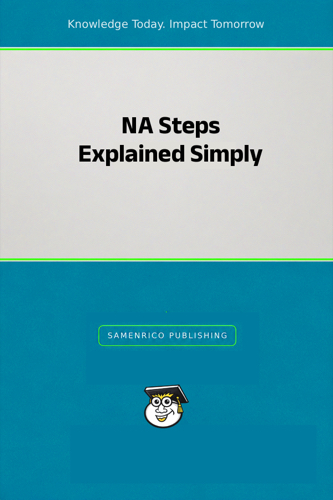
NA Steps Explained Simply eBook
Break down Narcotics Anonymous twelve steps into c
Break down Narcotics Anonymous twelve steps into clear, actionable language for those new to recovery.
Formats
Free sample
Chapter 1: The White Flag...--Before you read another word, I need you to answer one question honestly. Not for me. For you.Have you ever woken up in the morning, looked at the ceiling, and promised yourself that today would be different? That today you would only use a little? That today you would wait until after work?
That today you would stick to just weed or just alcohol or just pills—anything except the one thing that really has you by the throat?And then, by noon, you broke that promise.If that has happened to you more times than you can count, you are not weak. You are not morally defective. You are not a bad person who deserves to suffer. You are someone who has been trying to win a war that cannot be won—and no one ever gave you permission to stop fighting.This chapter is that permission.This chapter is called "The White Flag" not because surrender is weakness, but because in every war ever fought, the white flag is the signal for ceasefire. It is the moment when both sides agree to stop killing each other long enough to negotiate peace.
You have been at war with your addiction for years—maybe decades. You have tried to outsmart it, outrun it, bargain with it, hide it from the people you love, and hide it from yourself. You have lost jobs, relationships, money, health, and self-respect. And still, you have not stopped fighting.Step One of Narcotics Anonymous says this: "We admitted we were powerless over our addiction—that our lives had become unmanageable."In plain English: The war is over. You lost.
But losing the fight means you finally get to win your life back.This chapter is going to walk you through exactly what that means, why it is the most hopeful thing you will ever read, and how to do it without feeling like a failure. By the end of this chapter, you will have completed the first Step of NA. You will have a clear, written record of what you tried to control—and what actually happened instead. And you will have a sponsor check-in script to take the next step.Let us begin.The Myth of "Just This Once"Every person who has ever struggled with addiction shares one thing in common: a long, embarrassing, heartbreaking list of rules they made for themselves that did not work.You know this list. It lives in the back of your mind, and it sounds something like this:I will only use on weekends.Then you used on Wednesday.I will only use after 5 PM.Then you called in sick on Tuesday.I will switch from heroin to pills—that is safer.Then you overdosed on pills.I will only drink beer, not liquor.Then you drank twelve beers.I will never inject.Then you found a needle.I will only use when I am alone so no one gets hurt.Then you drove to pick up and crashed into a mailbox.I will take a week off to prove I am not addicted.Then you made it three days and spent the next four in withdrawal, convincing yourself that the withdrawal proved you needed to use "just one more time" to feel normal.Here is the painful truth that Step One asks you to face: None of those rules worked.
Not one. You did not fail at following the rules because you were lazy or stupid. You failed because addiction does not care about your rules. Addiction is a disease that hijacks the part of your brain responsible for self-control. When you are in active addiction, you are trying to use a broken tool to fix a broken machine.
It is like trying to hammer a nail with a banana. The banana is not weak. It is just the wrong tool.Step One is not about blaming yourself for using the wrong tool. Step One is about admitting that the tool is broken and that you need a different approach.Why "Powerless" Is Not a Dirty Word If you are like most people new to NA, the word "powerless" makes your skin crawl. It sounds like giving up.
It sounds like admitting you are a victim. It sounds like something weak people say to excuse their bad behavior.I need you to hold that thought for a moment and consider a different perspective.Imagine you have a broken leg. You try to walk on it. It hurts. You try to run on it.
You fall. You try to climb stairs. You collapse. At what point do you admit that you are "powerless" over the broken leg? Is that weakness?
Or is it simply reality?When you admit you cannot walk on a broken leg, you are not giving up. You are acknowledging the truth so you can get a cast, use crutches, and eventually heal. The same is true for addiction. Admitting powerlessness is not surrender to defeat. It is surrender to reality.
And reality is the only place where recovery can begin.Here is what powerlessness actually means in the context of Step One:You cannot control your use once you start. If you take one drink, one hit, one pill, one line, one injection, you do not know where it will end. Maybe it ends after one. Maybe it ends after a week-long binge. Maybe it ends in a hospital.
The fact that you do not know—and cannot guarantee—is the definition of powerlessness.You cannot guarantee abstinence on your own willpower. You have tried. You have promised yourself, your partner, your parents, your children, your boss, and your judge. And you have broken those promises. That is not a character flaw.
That is the nature of the disease.Your best thinking got you here. You are reading a book about addiction recovery. That means your own efforts have not worked. That is not an insult. That is a diagnosis.The relief of Step One comes when you stop pretending.
You stop pretending you can moderate. You stop pretending you have it under control. You stop pretending that this time will be different. You lay down the weapons you have been using to fight a war you cannot win. And in that moment of surrender, something unexpected happens: you feel light.Not because you have given up.
But because you have finally stopped lying.The Two Lists Exercise Now we are going to do the single most important exercise in this chapter. It is simple. It takes about twenty minutes. And it will change the way you see your addiction forever.Take out a piece of paper or open a blank document. Draw a vertical line down the middle.
At the top of the left column, write: "What I tried to control." At the top of the right column, write: "What actually happened."Then start filling it out. Be honest. Be specific. Do not skip the embarrassing ones.Here are examples from real people who have done this exercise. Read them to get your brain warmed up.Example 1:Left column: "I tried to only use on payday so I would run…
This is the end of the free sample. Get the eBook to keep going. Buy now
About this book
Details
- Author
- Buckingham Marcy
- Publisher
- SamEnrico
- Language
- English
- Genre
- Non-Fiction, Self-Help, Substance Abuse, NA
- Released
- 2026-06-10
- Pages (approx.)
- 155
- Available as
- eBook, Audiobook

Read better in the ZLOADR app
Your eBooks on your phone or tablet. Sign in with your SamEnrico account and start reading.
More by Buckingham Marcy
 Short Answer Exam TechniqueBuckingham Marcy$11.99
 Citation Rules for Personal CommunicationsBuckingham Marcy$11.99
 Career Transition for TeachersBuckingham Marcy$11.99
 Blue Angels Pilot MemoirBuckingham Marcy$11.99
 Geriatric Depression GuideBuckingham Marcy$11.99
 Resentment At GodBuckingham Marcy$11.99
 Side Hustle Sanity GuideBuckingham Marcy$11.99
 Jet Age Dawns: Me 262 and Gloster MeteorBuckingham Marcy$11.99
 The Last Dance of the Red Baron: A Sky Warrior’s Final FlightBuckingham Marcy$11.99
 Whispers of the Ziggurat: The Lost Code of EnkiBuckingham Marcy$11.99
 Silicon Shadows: The Hidden War for Your DataBuckingham Marcy$11.99
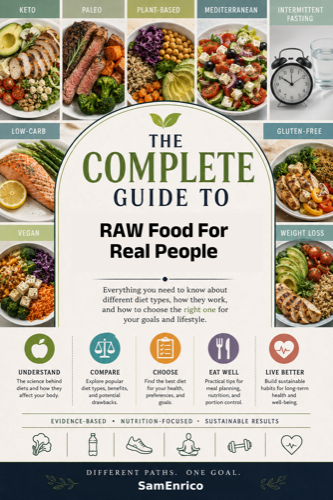 The Complete Guide to RAW Food For Real PeopleBuckingham Marcy$11.99