
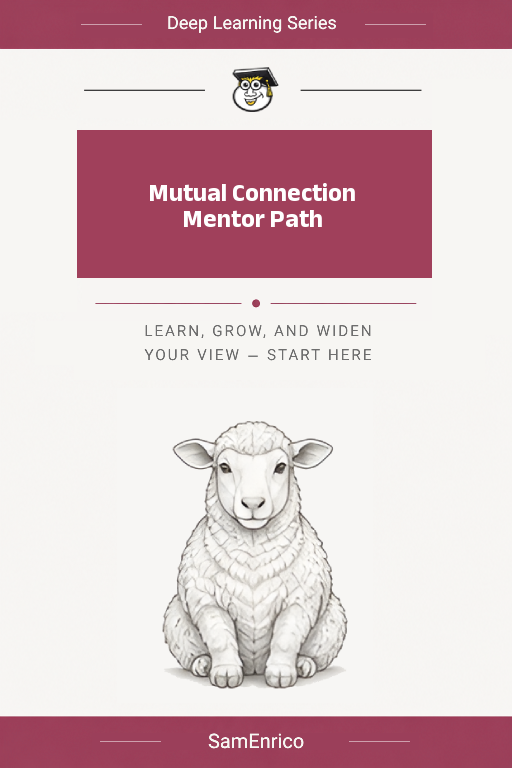
Non-FictionFirst 30 DaysWarm Intros
Mutual Connection Mentor Path eBook
Leverage shared connections for warm introductions
Leverage shared connections for warm introductions. Identify key mutual contacts and request strategic intros.
Formats
Free sample
Chapter 1: The 5% Lie--–- The email landed in Sarah’s inbox at 7:43 AM on a Tuesday. She didn’t recognize the sender’s name, the company, or the subject line. She deleted it in 1.2 seconds. That was the 847th cold email she had sent in six months. The open rate was 18 percent.
The reply rate was 3 percent. The meeting rate was less than 1 percent. She had closed exactly zero deals from those 847 emails. Her boss was angry. Her pipeline was empty.
She was exhausted.Then her college roommate, someone she hadn’t spoken to in three years, sent her a text. “Hey, my neighbor runs sales at that company you’ve been trying to reach. Want me to text him?” Sarah said yes. Twenty-four hours later, she was on a video call. Eleven days after that, she closed a six-figure deal.
Eight hundred and forty-seven cold emails: zero meetings. One warm text from a mutual connection: one deal.This is not a story about luck. This is a story about math. And the math is telling you something your boss, your CRM, and every sales guru is hiding from you.The Data They Don’t Want You to See Let’s start with the numbers that matter. According to recent industry-wide studies across B2B sales, marketing, and recruiting:The average cold email open rate has fallen below 5 percent.The average cold email reply rate is 1.2 percent.The average cold call connection rate is 8 percent.The average cold call to meeting conversion rate is less than 2 percent.Now look at warm introductions.
When someone who knows and trusts you introduces you to someone they know and trust:The email open rate exceeds 80 percent.The reply rate exceeds 30 percent.The meeting conversion rate exceeds 40 percent.Let me say that differently. One warm introduction is worth roughly twenty-eight cold emails. One warm introduction is worth twenty cold calls. One warm introduction is worth an entire week of “prospecting” that could have been spent doing literally anything else.Yet most professionals still spend 80 percent of their outreach time on cold methods that generate 20 percent of their results. This is not a productivity problem.
This is a math problem that everyone is choosing to ignore.Why? Because cold outreach is controllable. You can decide to send one hundred emails today. You can measure them. You can report them to your manager.
Warm introductions feel uncontrollable. They depend on other people. They depend on trust. They depend on something you cannot simply “do more of.”This book exists because that feeling of uncontrollability is a lie. Warm introductions are not random.
They are not luck. They are a system. And like any system, they can be learned, practiced, and mastered.The Real Problem Isn’t the Medium. It’s the Relevance Gap.Cold outreach fails for a specific, predictable reason. It is not because you are bad at writing emails.
It is not because your subject lines are weak. It is not because you haven’t personalized enough.Cold outreach fails because it interrupts.Imagine you are sitting at your desk. You are focused. You have three priorities for the day. An email arrives from someone you do not know.
Their name means nothing. Their company means nothing. Their offer is generic. Your brain does a single calculation: “Is this relevant to my current priorities?” The answer is almost always no. Delete.Now imagine a different scenario.
A colleague you respect forwards you an email. “Hey, I thought you should talk to this person. They’re working on something relevant to what you mentioned last week.” Your brain does a different calculation: “My colleague trusted this person enough to forward this. They did the filtering for me. I should at least read it.”This is the relevance gap.
A cold message has to convince you of its relevance in under three seconds. A warm message arrives with relevance pre-attached. The connector did the work of establishing credibility before you ever saw the message.The Mentor Path is built on this simple insight. You are not looking for a name. You are looking for a path of shared trust.
That path is what turns a stranger into a conversation.Sponsorship vs. Mentorship: The Distinction That Changes Everything Before we go further, we need to clarify a distinction that will appear throughout this book. It comes from the research of Rosalind Chow, a social psychologist who studies power, status, and networks.A mentor gives you advice. A mentor tells you what you are doing wrong. A mentor helps you improve internally.
Mentorship is about your skills, your habits, your blind spots. It is valuable. It is necessary. It is not enough.A sponsor uses their social capital to open doors for you. A sponsor does not tell you how to improve.
A sponsor tells other people that you are worth betting on. Sponsorship is external. It is about your reputation, your access, your opportunities.Here is the painful truth that most networking books avoid. You can have ten mentors and still go nowhere if you have zero sponsors. Mentors help you climb the ladder.
Sponsors put the ladder against the right wall.Most people ask for mentorship when they need sponsorship. “Can you give me advice?” is a low-risk ask for the other person. “Can you introduce me to your partner at the firm?” is a high-risk ask that requires trust, reputation, and social capital.The Mutual Connection Mentor Path trains you to find sponsors, not just mentors. It trains you to become the kind of person that sponsors want to bet on. And it trains you to make the ask in a way that removes the sponsor’s fear.The Mentor Path Distinction: Referral vs.
Path Here is another distinction that will anchor everything that follows.Most people ask: “Who do you know?”This is a referral question. It asks for a name. It treats the other person as a directory. It is low-effort and low-return. When you ask “Who do you know?” you are asking the other person to do the work of scanning their memory, finding a match, and hoping it is relevant.The Mentor Path asks: “Who do we both trust?”This is a path question.
It asks for a route. It treats the other person as a bridge. It is higher-effort but exponentially higher-return. When you ask “Who do we both trust?” you are doing three things simultaneously:First, you are acknowledging that trust is the currency. You are not asking for a favor based on convenience.
You are asking for a favor based on shared values and shared relationships.Second, you are limiting the scope. “Who do we both trust” is a smaller, more specific question than “Who do you know?” It is easier for the other person to answer because it includes you in the equation.Third, you are signaling that you understand social debt. People who understand social debt are safe to introduce. People who do not understand social debt are risks.A referral is a name on a list. A path is a shared trust bridge.
This book is about building bridges, not collecting names.The Radical Redefinition of Success Here is where most people get stuck.…
This is the end of the free sample. Get the eBook to keep going. Buy now
About this book
Details
- Author
- Mccracken Porsha
- Publisher
- SamEnrico
- Language
- English
- Genre
- Non-Fiction, First 30 Days, Warm Intros
- Released
- 2026-05-30
- Pages (approx.)
- 122
- Available as
- eBook, Audiobook

Read better in the ZLOADR app
Your eBooks on your phone or tablet. Sign in with your SamEnrico account and start reading.
More by Mccracken Porsha
 Size Loci TechniqueMccracken Porsha$11.99
 The DBT Ride the Wave SkillMccracken Porsha$11.99
 Stress And PCOS ManagementMccracken Porsha$11.99
 Remote Review Translation GuideMccracken Porsha$11.99
 Trigger Prevention LifestyleMccracken Porsha$11.99
 The Great Spruce Moose Mystery: How a Fake Animal Fooled the WorldMccracken Porsha$11.99
 How to Start a Paint Brush Business (Beginners Guide)Mccracken Porsha$11.99
 Environmental Performance Among Public FirmsMccracken Porsha$12.99
 Discord Community ManagerMccracken Porsha$11.99
 Understanding Papillon–lefèvre SyndromeMccracken Porsha$17.99
You may also like
 Hong Kong Handover 1997Dunn Johnnie$11.99
 Zumba For Postnatal Recovery CourseNeal Christian$11.99
 Zumba for BeginnersLadner Nikia$11.99
 YouTube Comment Mining GuideHumes Pandora$12.99
 Worry Box MeditationCarlin Rudy$11.99
 Workplace Stress MeditationNguyen Lynn$11.99
 Workplace Stress and Sleep RepairHawley Ivory$11.99
 Workplace Perfectionism CureDelaney Jeffry$11.99
 Workplace Injustice Anger GuideWallen Isabelle$11.99
 Work Addiction and Burnout LinkGreenwood Ester$11.99
 Women in Yoga and WellnessBeattie Galina$11.99
 Women in Stand Up ComedyChun Evangeline$11.99