
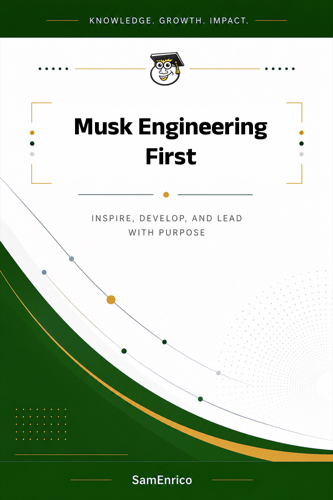
Non-FictionBiographyEngineering
Musk Engineering First eBook
Prioritize technical solutions over management mee
by Acuna Janeth
Prioritize technical solutions over management meetings.
Formats
Free sample
Chapter 1: The Algorithm Awakens--–- In the harsh, fluorescent-lit conference room of a failing electric vehicle startup in 2004, a young engineer named Elon Musk did something that would have gotten most people fired. He stood up fifteen minutes into a scheduled two-hour “cross-functional alignment meeting,” looked at the twelve attendees, and said: “This meeting is over. Everyone go back to your desks and fix the battery thermal issue. If you need to talk, send a one-paragraph email. If you can’t solve it with three emails, come find me in the factory.
I’ll be welding.”The room sat in stunned silence. The meeting organizer, a senior program manager with twenty years of automotive experience, sputtered something about “process” and “stakeholder alignment.” Musk was already walking out the door.That meeting never reconvened. The battery thermal issue was solved in six days by two engineers who stopped talking about the problem and started building prototypes. The car shipped. And a quiet revolution in engineering management began—not with a memo, not with a presentation, but with the realization that most meetings are not merely unproductive.
They are actively destructive.This chapter introduces the core operating system that emerged from that realization: The Algorithm. It is a five-step framework for deciding what to build, what to delete, and how to work. It is not a theory. It is not a best practice. It is a brute-force weapon against the natural entropy of organizations.
And it is the foundation of everything that follows in this book.The Algorithm has been refined over two decades at Space X, Tesla, and The Boring Company. It has been used to design rockets that land themselves, electric cars that out-accelerate supercars, and tunnels that move people faster than subways. It has also been used to cancel thousands of meetings, delete tens of thousands of requirements, and accelerate product timelines by factors of two, three, or ten. It works. But only if you have the courage to use it.The Five Steps of The Algorithm The Algorithm consists of five steps, executed in a strict sequence.
Skipping steps is the most common cause of failure. Engineers and managers who jump directly to optimization or automation—the sexy steps—inevitably end up optimizing processes that should have been deleted. The sequence is the secret.Step One: Question every requirement, process, and meeting.Every rule in your organization, no matter how sacred, began as someone’s answer to a specific problem. That problem may no longer exist. The person who created the rule may no longer be with the company.
The technology that justified the rule may be obsolete. But the rule remains, enforced by inertia and fear.Questioning does not mean rejecting. It means asking: “What physical or business constraint does this requirement serve?” If the answer is “I don’t know” or “That’s how we’ve always done it,” the requirement is a candidate for deletion. If the answer is a specific physical law (gravity, thermodynamics, material strength) or a binding business commitment (a contract, a regulation with teeth), the requirement survives—for now.The most dangerous requirements are the ones that were once justified but are no longer. A safety rule written after a specific incident in 1998 may still be on the books, even though the incident was caused by a component that no longer exists.
A reporting requirement created for a manager who left the company three years ago may still consume twenty engineer-hours per week. These are ghosts. They haunt your calendar and your backlog. Exorcise them.Step Two: Delete any part, step, or agenda item not strictly necessary.This is the most difficult step, because deletion feels risky. What if we need that part?
What if that process step catches a real error? What if that meeting actually serves a purpose we don’t understand?The answer is the 10% Rule, which we will explore in depth in Chapter 3: If you delete something and you do not end up adding back at least 10% of what you deleted, you did not delete enough. In other words, you should be uncomfortable with your deletions. You should feel like you might have gone too far. That feeling is the signal that you are actually deleting waste, not trimming around the edges.Deletion applies to physical parts (remove unnecessary screws, brackets, and wires), process steps (eliminate approval loops and status updates), and meeting agenda items (cut everything that is not a binary decision).
At Space X, the deletion step is so aggressive that engineers joke that the first prototype is always missing something important. The second prototype puts it back. The third prototype is perfect. This is faster than keeping everything from the start.Step Three: Optimize the remaining essential elements.Once you have deleted everything that can be deleted, you may optimize what remains. Note the sequence: optimize only after deletion.
Optimizing a process that should not exist is like polishing a turd. It remains a turd, now shiny.Optimization means making something faster, cheaper, or more reliable without changing its fundamental function. It includes things like reducing cycle time, increasing automation, simplifying interfaces, and standardizing components. But it is always secondary to deletion. A slow essential process that has been deleted and then added back is better than a fast non-essential process that never should have existed.Step Four: Accelerate cycle time aggressively.After optimization comes acceleration.
This is the domain of deadlines, schedules, and cadence. Most organizations set timelines based on historical precedent or “realistic” estimates. The Algorithm inverts this: set timelines based on what is physically possible, then compress them until they break.If a process takes ten days today, ask: what would it take to do it in five? Not “is it realistic?” but “what physical constraints prevent five?” Remove those constraints. If the process takes five days, ask for two and a half.
Continue until the process fails. Then back off slightly. This is how Space X reduced the time to build a Raptor engine from months to days. They did not slowly improve. They aggressively compressed until the process broke, then redesigned the broken parts, then compressed again.Step Five: Automate only after the first four steps are complete.This is the most violated step in The Algorithm.
Organizations love automation. It feels modern. It feels efficient. It creates impressive dashboards. But automating a process that should have been deleted is a catastrophe.
You do not get faster waste. You get automated waste—harder to see, harder to change, and harder to delete.At Tesla, the infamous “production hell” of 2018 was largely caused by automating processes that had not been properly questioned, deleted, and optimized. Robots were welding brackets that should not have existed. Conveyors were moving parts that should have been designed out. The result was a factory that could produce cars but could not produce them reliably.
The solution was not more automation. It was going back to Steps One through Four, deleting half the parts, and then re-automating.The Algorithm is not a one-time exercise. It is a continuous loop. Every quarter, you return to Step One and question again. Requirements creep back in.
Meetings reschedule themselves. Process debt accumulates. The only defense is relentless, repeated application of The Algorithm.Why The Algorithm Works The…
This is the end of the free sample. Get the eBook to keep going. Buy now
About this book
Details
- Author
- Acuna Janeth
- Publisher
- SamEnrico
- Language
- English
- Genre
- Non-Fiction, Biography, Engineering
- Released
- 2026-06-11
- Pages (approx.)
- 138
- Available as
- eBook, Audiobook

Read better in the ZLOADR app
Your eBooks on your phone or tablet. Sign in with your SamEnrico account and start reading.
More by Acuna Janeth
 Non 24 Hour Sleep WakeAcuna Janeth$11.99
 Meal Prep for Theme NightsAcuna Janeth$11.99
 YouTube Personal Brand GuideAcuna Janeth$11.99
 Request Conversation GuideAcuna Janeth$11.99
 Quartermaster Supply Chain WarAcuna Janeth$11.99
 Cyber Insurance OverviewAcuna Janeth$11.99
 Auditory Memory Training MethodAcuna Janeth$11.99
 The Case of the Phantom Killer: The Trial That Defined Forensic ScienceAcuna Janeth$11.99
 The Clown Killer of Phoenix: A Carnival of Terror (2005-2007)Acuna Janeth$11.99
 How to Trade MilkAcuna Janeth$11.99
 How to Produce Fingerboards and Fingerboard SetsAcuna Janeth$11.99
 A Collector's Handbook to the Arrol-aster 23-70Acuna Janeth$11.99
You may also like
 Hong Kong Handover 1997Dunn Johnnie$11.99
 Zumba For Postnatal Recovery CourseNeal Christian$11.99
 Zumba for BeginnersLadner Nikia$11.99
 YouTube Comment Mining GuideHumes Pandora$12.99
 Worry Box MeditationCarlin Rudy$11.99
 Workplace Stress MeditationNguyen Lynn$11.99
 Workplace Stress and Sleep RepairHawley Ivory$11.99
 Workplace Perfectionism CureDelaney Jeffry$11.99
 Workplace Injustice Anger GuideWallen Isabelle$11.99
 Work Addiction and Burnout LinkGreenwood Ester$11.99
 Women in Yoga and WellnessBeattie Galina$11.99
 Women in Stand Up ComedyChun Evangeline$11.99