
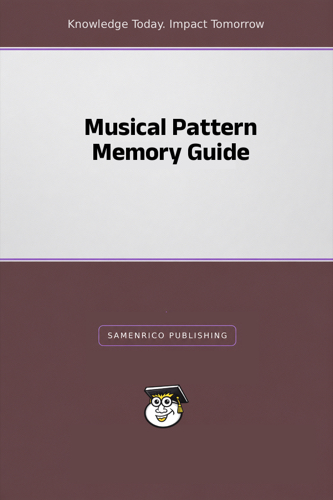
Musical Pattern Memory Guide eBook
Recognize chord progressions and rhythmic structur
Recognize chord progressions and rhythmic structures for faster learning.
Formats
Free sample
Chapter 1: The Chunking Illusion--–- Close your eyes for a moment. Listen to the room around you. The hum of a refrigerator, the distant murmur of traffic, the click of a keyboard. Your ears are not passive microphones. They are prediction engines, constantly guessing what comes next and correcting themselves with every new sound.
Now imagine listening to a piece of music you have never heard before. A jazz solo flies by at sixteen notes per second. A chord progression shifts every two beats. A drummer plays syncopation that seems to float above the pulse. Most people hear this and think: "I could never learn that.
My ears are not good enough."That belief is wrong. And it is the single greatest obstacle to musical fluency.You do not need better ears. You need a better pattern vocabulary. The difference between a musician who struggles to learn songs by ear and one who transcribes a solo in real time is not magical talent or perfect pitch. It is the ability to hear in chunks rather than individual notes.
This chapter will dismantle the myth of the "magic ear" and replace it with a cognitive framework that will serve as the foundation for every subsequent chapter in this book.The Illusion of the Magic Ear Every musician has heard someone described as having "natural talent" or "god-given ears." Perhaps you have said it yourself about a bandmate or a You Tuber who seems to hear a song once and play it back flawlessly. This attribution is comforting because it lets the rest of us off the hook. If ear training is a gift, then its absence is not a failure. It is just bad luck.Cognitive science tells a different story. Dozens of studies on expert performance across domains—chess, medicine, programming, sports, and music—have converged on a single conclusion.
What experts possess is not superior raw processing power. They possess superior pattern libraries. A chess grandmaster does not calculate every possible move. He recognizes the board configuration as a pattern he has seen thousands of times before. A radiologist does not scan an X-ray pixel by pixel.
She sees the shadow of a tumor because she has memorized the pattern of normal tissue. A musician does not decode every note in isolation. He hears "ii-V-I" and knows exactly what is coming.This is called the chunking principle, and it is the most important concept in this entire book. Your working memory can hold approximately five to nine items at once. That is a hard biological limit, like the number of cars a bridge can support.
You cannot expand working memory. What you can expand is the size of each item. A beginner hears a ii-V-I progression as three separate chords: D minor, G dominant, C major. That is three items, consuming nearly half of working memory before anything else happens. An expert hears the same three chords as a single item: a ii-V-I, a complete grammatical sentence in the language of harmony.
That leaves six or seven free slots for melody, rhythm, dynamics, and emotion.The difference is not ear quality. It is chunk size.Why You Already Know How to Chunk (You Just Did Not Know It)Consider how you learned to read. As a child, you stared at individual letters. C. A.
T. Three separate symbols with no meaning until you sounded them out. Then something shifted. You stopped seeing C-A-T and started seeing CAT—a single shape that meant "furry animal that meows." Then you stopped seeing CAT as three letters and started seeing it as a word that could be part of a sentence. Then you stopped seeing sentences as collections of words and started seeing paragraphs as units of meaning.
At each level, you chunked smaller units into larger ones, freeing your attention for higher-level comprehension.You did the same thing when you learned to drive. At first, every action was conscious: check mirror, signal, turn wheel, check blind spot, accelerate. Overwhelming. After a few months, you chunked those micro-actions into "changing lanes"—a single intention that triggered a cascade of automatic behaviors. Your conscious mind was then free to navigate traffic, listen to the radio, and carry on a conversation.Music works exactly the same way.
The only reason you do not yet hear chord progressions as chunks is that you have not built the library. This book is that library.The Novice Listener Versus the Expert Listener Let us make this concrete with a listening experiment you can perform right now, using only your imagination.Imagine hearing fifteen random notes played on a piano: C, E, G, C, A, C, E, G, B, D, F, A, C, E, G. If you have not studied music theory, that sequence sounds like noise. Your working memory is overwhelmed. You cannot possibly hold fifteen pitches in your mind long enough to find a pattern.
You give up and conclude that your ear is not good enough.Now imagine hearing the same fifteen notes labeled differently: "C major arpeggio followed by a C major scale followed by a C major 7th arpeggio." Suddenly, the fifteen notes compress into three chunks. You can hold three chunks in working memory effortlessly. The notes themselves have not changed. Your pattern vocabulary has changed.This is not a metaphor. This is how expert listeners actually process sound.
Neuroscientists have measured it. When a novice listens to music, the auditory cortex lights up diffusely. When an expert listens to the same passage, the brain activates pattern recognition networks in the prefrontal cortex and basal ganglia. The expert is not hearing harder. The expert is recognizing faster.The Vocabulary of Patterns If ear training is vocabulary building, then we need to define the vocabulary.
This book organizes musical patterns into four families that correspond to the four dimensions of music: rhythm, harmony, melody, and form.Rhythmic patterns are the temporal grids that give music its pulse and groove. A syncopation pattern like "short-short-long" is a chunk. A clave rhythm is a chunk. The difference between a straight eighth feel and a swing feel is a chunk. Once you learn these patterns, you will never need to count subdivisions again.
You will just feel the pattern and know where the beat falls.Harmonic patterns are the chord progressions that give music its emotional architecture. A I-IV-V is a chunk. A ii-V-I is a chunk. A 12-bar blues is a chunk. A Rhythm Changes is a chunk.
When you hear a new song, you will not listen chord by chord. You will match the song's harmonic rhythm to one of your stored patterns and guess the progression before the second chorus.Melodic patterns are the shapes that melodies trace through harmonic space. A scale run is a chunk. An arpeggio is a chunk. A neighbor tone figure is a chunk.
When you hear a melody, you will not transcribe note by note. You will recognize the underlying pattern and fill in the details.Formal patterns are the large-scale architectures that organize verses, choruses, bridges, and solos. AABA is a chunk. Verse-chorus-bridge is a chunk. The 12-bar blues cycle is a chunk.
When you hear a new song, you will know where it is going before it gets there because you have…
This is the end of the free sample. Get the eBook to keep going. Buy now
About this book
Details
- Author
- Turnbull Joel
- Publisher
- SamEnrico
- Language
- English
- Genre
- Non-Fiction, Self-Help, Music
- Released
- 2026-06-07
- Pages (approx.)
- 135
- Available as
- eBook, Audiobook

Read better in the ZLOADR app
Your eBooks on your phone or tablet. Sign in with your SamEnrico account and start reading.
More by Turnbull Joel
 Haitian Revolution 1791Turnbull Joel$11.99
 Czechoslovak Legionnaire TaleTurnbull Joel$11.99
 Walton's Buy American PledgeTurnbull Joel$11.99
 Capturing the Unseen: The Revolutionary Lens of Argentina's Grete SternTurnbull Joel$11.99
 How to Produce Boxing and Martial Arts EquipmentTurnbull Joel$11.99
 Franchise Financial ReportingTurnbull Joel$12.99
 Collie BreedingTurnbull Joel$11.99
You may also like
 Hong Kong Handover 1997Dunn Johnnie$11.99
 Zumba For Postnatal Recovery CourseNeal Christian$11.99
 Zumba for BeginnersLadner Nikia$11.99
 YouTube Comment Mining GuideHumes Pandora$12.99
 Worry Box MeditationCarlin Rudy$11.99
 Workplace Stress MeditationNguyen Lynn$11.99
 Workplace Stress and Sleep RepairHawley Ivory$11.99
 Workplace Perfectionism CureDelaney Jeffry$11.99
 Workplace Injustice Anger GuideWallen Isabelle$11.99
 Work Addiction and Burnout LinkGreenwood Ester$11.99
 Women in Yoga and WellnessBeattie Galina$11.99
 Women in Stand Up ComedyChun Evangeline$11.99