
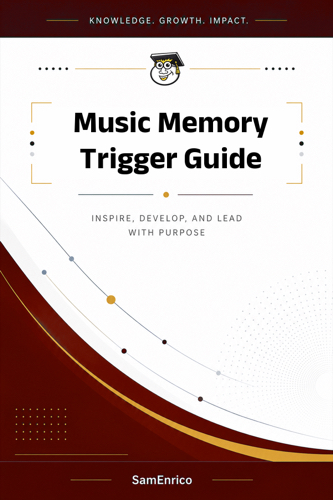
Music Memory Trigger Guide eBook
Use familiar songs to evoke memories and practice
Use familiar songs to evoke memories and practice singing lyrics for cognitive engagement.
Formats
Free sample
Chapter 1: The Seventeen-Year Flashbulb--–- On a rainy Tuesday afternoon in Seattle, a 68-year-old retired nurse named Margaret sat in her daughter’s living room, struggling to remember what she had eaten for breakfast. The morning’s meal had vanished entirely—no image, no taste, no sequence of events. Her daughter, accustomed to these gaps, did not press. Instead, she pressed play on an old i Pod. The first notes of “Unchained Melody” by the Righteous Brothers filled the quiet room.
Margaret’s eyes, which had been glassy and distant, suddenly focused. She turned to her daughter and said, “Your father wore a gray suit. Not black. Gray. And he couldn’t stop fidgeting with his cufflinks.” She paused, then added, “The flowers on the altar were wilting.
I was so nervous I almost dropped my bouquet.” Her daughter froze. Margaret had just described her 1978 wedding—a day she had not mentioned in over three years, a day the medical charts said she should no longer have access to. The song ended. Margaret went quiet again. But for three minutes and thirty-six seconds, a woman who could not remember breakfast had traveled four decades into the past with perfect clarity.
This is the power of the neural time machine. And it is already sitting in your pocket, on your phone, in your playlists, waiting to be activated.The Mystery That Everyone Knows But No One Explains You have experienced this yourself. Perhaps you were in a grocery store when a song from high school came over the speakers, and suddenly you were back in a specific car on a specific night, smelling cheap perfume or wet pavement. Perhaps you heard a jingle from your childhood and felt a wave of emotion so strong it stopped you mid-sentence. Perhaps you have wondered why music—more than photographs, more than stories, more than returning to a physical place—has this unique ability to unlock the past.This is not coincidence.
It is not merely nostalgia. It is not a quirk of sentimentality. This is neuroscience, and it is among the most reliable and replicable phenomena in the study of human memory. The reason a song from your teenage years can feel more real than a conversation you had three hours ago is not because your memory is failing. It is because your memory was built to work this way.
Music is not a pleasant accessory to your life story. It is one of the primary indexing systems your brain uses to file away experience.This chapter answers the question that Margaret’s experience raises: why does this happen, and how can you use it? By the end of this chapter, you will understand the three pillars of musical memory—the reminiscence bump, the direct neural pathway, and the hierarchy of listening. You will understand why your teenage playlist is not a collection of embarrassing old tracks but a master key to a vault of memories that your adult logic cannot access. And you will take the first concrete step toward turning that master key into a precision tool.The Science of Music-Evoked Autobiographical Memories The phenomenon Margaret experienced has a formal name in the cognitive neuroscience literature: Music-Evoked Autobiographical Memories, or MEAMs.
First systematically studied in the early 2000s by researchers like Petr Janata at the University of California, Davis, MEAMs are distinct from ordinary remembering in several critical ways.When you deliberately try to recall what you did on your last birthday, you engage in what scientists call voluntary memory retrieval. This is a slow, effortful, often incomplete process that involves the prefrontal cortex working hard to reconstruct a narrative from fragmented cues. You search. You strain. You often come up empty or with a vague outline that lacks sensory richness.
This is the kind of memory that frustrates you when you cannot remember a name, a date, or a face.But when a song triggers a memory, something different happens. The memory arrives involuntarily, quickly, and with startling sensory richness. It does not feel like reconstruction. It feels like time travel. Researchers call this involuntary autobiographical memory, and it is faster, more detailed, and more emotionally charged than voluntary recall.
Music is the single most reliable trigger of involuntary autobiographical memory—more reliable than smells, more reliable than photographs, more reliable than returning to a physical location.Why does music have this power? The answer lies in how the brain processes sound. Unlike visual information, which passes through multiple interpretive layers in the occipital cortex, musical information takes a more direct route through the brain. Sound waves enter your ear, are converted into electrical signals, and travel to the auditory cortex in your temporal lobe. But from there, music branches out to multiple brain regions simultaneously.The amygdala, your brain’s emotional alarm system and pleasure center, activates within milliseconds of a familiar melody.
The hippocampus, which consolidates short-term memories into long-term storage, lights up as it retrieves the contextual associations attached to that song. The nucleus accumbens, part of your brain’s reward circuitry, releases dopamine when you hear a song you love. The cerebellum, which coordinates movement and timing, begins to anticipate the beat. This distributed processing means that when you hear a familiar song, you are not just hearing sound. You are activating the entire network of associations that were present when you first encoded that song.
The emotion, the context, the physical sensations, the timing—all of it comes back because the song is a key that turns multiple locks simultaneously.The Critical Discovery of the Reminiscence Bump One of the most robust findings in the study of autobiographical memory is the phenomenon known as the reminiscence bump. When researchers ask people of all ages to recall their most vivid memories, a striking pattern emerges. The vast majority of these memories—roughly sixty percent—come from a specific period in life: between the ages of ten and thirty.This is not because nothing memorable happens after thirty. Major life events continue to occur—marriages, births, career achievements, losses, illnesses. But these later memories are encoded differently.
They are more likely to be semantic (facts and general knowledge) rather than episodic (specific events with sensory detail). They are less likely to be triggered involuntarily by music. They require more effort to retrieve.The period between ten and thirty is when the brain is most plastic, when identity is being formed, when emotional experiences are most intense, and when the hippocampus is particularly receptive to encoding. During these two decades, your brain is literally building the architecture of your adult self. The experiences you have, the relationships you form, the music you hear—all of it becomes structural.Within this ten-to-thirty window, there is an even more concentrated peak.
The years from seventeen to twenty-two—late adolescence and early emerging adulthood—consistently produce the most emotionally resonant and durable memories. Researchers sometimes call this the “reminiscence bump within the bump.” This is the period of first loves, first heartbreaks, first cars, first jobs, first experiences of independence. It is also the period when most people form their deepest attachments to popular music.Think about this for a moment. If you are…
This is the end of the free sample. Get the eBook to keep going. Buy now
About this book
Details
- Author
- Adame Andreas
- Publisher
- SamEnrico
- Language
- English
- Genre
- Non-Fiction, Self-Help, Music Therapy
- Released
- 2026-06-11
- Pages (approx.)
- 115
- Available as
- eBook, Audiobook

Read better in the ZLOADR app
Your eBooks on your phone or tablet. Sign in with your SamEnrico account and start reading.
More by Adame Andreas
 Letting Go of Outcome AttachmentAdame Andreas$11.99
 Indoor Walking Meditation CourseAdame Andreas$11.99
 Legal Careers Alcohol RecoveryAdame Andreas$11.99
 Body Scan for Entrepreneurs GuideAdame Andreas$11.99
 The Corsair of the Rio Grande: Jean Laffite's Shadow War for TexasAdame Andreas$11.99
 Staff NurseAdame Andreas$11.99
 Sealed Air SWOTAdame Andreas$12.99
 German Blocked Account GuideAdame Andreas$12.99
 How to Start a Chimney Liners Made of Clay Business (Beginners Guide)Adame Andreas$11.99
 Understanding Occult Spinal DysraphismAdame Andreas$17.99
You may also like
 Teen Music Therapy ConfidenceRife Gene$11.99
 Music Therapy for Parent LossMcgehee Suzan$11.99
 Music Therapy For Driving AngerCarr Frances$11.99
 Music Burnout ReliefJoyce Marivel$11.99
 Meth Recovery Music TherapyMadrigal Robbyn$11.99
 Metta for Music TherapyShrader Maxie$11.99
 Spouse Loss Music TherapyCorreia Eugena$11.99
 Loneliness And Music ConnectionBruns Danae$11.99
 Opioid Dependency Music Therapy Healing GuideLind Ellamae$11.99
 Music Therapy for Road RageGrimm Estell$11.99
 Calming Music for Angry DriversPosey Sade$11.99
 Senior Music Therapy GuideTurley Lauran$11.99