
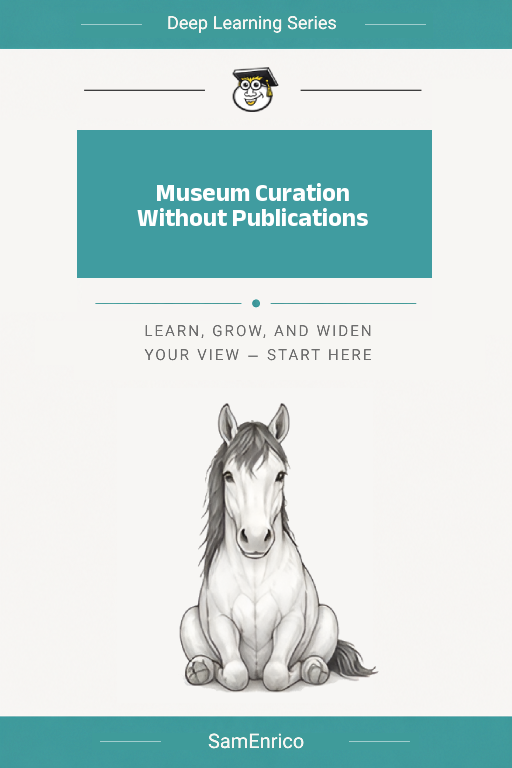
Museum Curation Without Publications eBook
List collection management or specimen preparation
List collection management or specimen preparation as evidence of hands-on research competence.
Formats
Free sample
Chapter 1: The Catalog Lie--Every museum curator has felt it: the quiet humiliation of spending six months cataloging a neglected collection, correcting generations of errors, building a searchable database that will serve researchers for decades—and then being told at their annual review that they haven’t produced enough “research” because they didn’t write a book about it.This is the Catalog Lie. And it is the single greatest barrier to recognizing hands-on curation as legitimate scholarship.The lie works like this: a well-researched print catalog or monograph—read by perhaps five hundred specialists worldwide—counts as a major research output. A well-structured online collection database—viewed by millions of students, artists, genealogists, and scientists—counts as “service” or “collection management.” The format determines the value, not the intellectual labor or the audience reach. A curator who spends two years writing a book that nobody reads is promoted. A curator who spends two years building a database that transforms access to a collection is told to “get back to research.”This chapter exposes the Catalog Lie by examining the existing literature on curation, analyzing the 2022 ICOM museum definition shift, and proposing a new framework for understanding what counts as research.
The argument is not that books are worthless. The argument is that primary data outputs—databases, specimen records, condition reports, preparation logs—have been systematically devalued because they don’t look like the publications that senior curators produced twenty years ago. It is time to name the lie and dismantle it.The Existing Literature: What the Bestsellers Get Wrong The top books on museum curation share a remarkable blind spot. The Curator’s Handbook (Adrian George, 2015) is the standard text for aspiring curators. It covers exhibitions, loans, acquisitions, and interpretation in meticulous detail.
It devotes exactly zero chapters to collection management as research. Museum Registration Methods (Buck & Gilmore, 6th edition, 2010) is the bible for collections management. It covers inventory, storage, and documentation as logistical tasks. It never asks whether the act of documenting a collection might itself be a form of knowledge production.These books are not bad books. They are excellent at what they set out to do: teach the mechanics of museum work.
But they reflect and reinforce a deeper assumption that has shaped the profession for a century: collection management is support work; interpretation is research.Let us be precise about what is missing. Neither book asks: What new knowledge is generated when a curator re-identifies a mislabeled specimen? What hypothesis is tested when a curator re-shelves a collection by geographic origin rather than acquisition date? What research question is answered when a curator documents the condition of an object before and after a loan?The absence of these questions is not accidental. It reflects a professional hierarchy that values the interpretation of objects over the care of objects.
Interpretation produces words. Care produces clean, organized, accessible collections. Words get cited. Collections get used. But only one counts for promotion.This hierarchy has a history.
In the nineteenth century, museum curators were often gentleman scholars who owned their own collections or received them as gifts. Their social status came from their knowledge, not their labor. The actual work of cleaning, labeling, and storing objects was done by assistants, preparators, and sometimes janitors. That division of labor—gentleman scholar above, manual worker below—has never been fully dismantled. It survives in the distinction between “curator” (who writes) and “collections manager” (who handles).
And it survives in the promotion criteria that reward writing while ignoring the primary data work that makes writing possible.The 2022 ICOM Definition: A Turning Point Ignored In 2022, the International Council of Museums (ICOM) adopted a new definition of what a museum is. The full text is worth quoting:“A museum is a not-for-profit, permanent institution in the service of society that researches, collects, conserves, interprets and exhibits tangible and intangible heritage. Open to the public, accessible and inclusive, museums foster diversity and sustainability.”This definition matters because it shifts emphasis. The previous definition (2007) prioritized “preservation” and “communication.” The new definition prioritizes “accessibility, inclusion, and sustainability.” Preservation remains, but it is no longer the sole purpose. Museums exist to make collections usable.Now consider what this means for the Catalog Lie.
If museums exist to make collections accessible, then the curator who builds a searchable, linked, error-free database has performed a core museum function. If museums exist to be inclusive, then the curator who opens storage to community members and documents their knowledge has performed research. If museums exist to be sustainable, then the curator who rehoused a collection in archival materials—preventing deterioration without travel or printing—has performed a more sustainable research act than the curator who flew to three archives to write an article.The ICOM definition is not a radical document. It is a consensus statement from the world’s largest museum professional organization. But it has radical implications for how we evaluate curatorial work.
If accessibility is a core function, then databases are research outputs. If inclusion is a core function, then community documentation is primary data. If sustainability is a core function, then preventative conservation is a research methodology.The problem is that most museums and universities have not updated their promotion criteria to reflect the 2022 ICOM definition. They still operate under the 2007 assumptions—or older. The Catalog Lie persists because the definition changed but the metrics did not.The Output Gap: 500 vs.
12,000Let us put numbers on the Catalog Lie.A typical museum monograph or scholarly catalog from a university press prints 300 to 500 copies. Most are purchased by libraries. A well-received monograph in a niche field might be read by 200 specialists and cited by 50 over a decade. A few become classics. Most gather dust.Now consider a well-structured online collection database.
The Smithsonian’s online collection receives over 12,000 unique visitors per day. The British Museum’s collection online has been viewed more than 100 million times since its launch. The Rijksmuseum’s open-access digital collection has been downloaded by artists, educators, and designers in over 200 countries.Twelve thousand per day. Not per decade. Per day.Yet when a curator spends two years building that database—cleaning the data, linking related objects, correcting provenances, writing clear descriptions—they are told that this work is “collection management,” not “research.” The monograph that reaches 500 people is scholarship.
The database that reaches millions is logistics.This is absurd on its face. But the absurdity is invisible to promotion committees because they have never had to quantify the reach of a database. They know how to count citations. They do not know how to count database views. They know how to assess the quality of an argument in a monograph.
They do not know how to assess the quality of a linked data structure in a collections management system.The output gap is not just a difference in audience size. It is a difference in epistemic value. A monograph presents an argument. A database presents primary data. Arguments can be wrong.
Primary data can be incomplete or erroneous. But a well-structured database allows other researchers to ask their own questions. A monograph can only answer the author’s questions.The nineteenth-century naturalist Albertus Seba understood this. His…
This is the end of the free sample. Get the eBook to keep going. Buy now
About this book
Details
- Author
- Frizzell Marlo
- Publisher
- SamEnrico
- Language
- English
- Genre
- Non-Fiction, Student's Shortcut
- Released
- 2026-05-29
- Pages (approx.)
- 134
- Available as
- eBook, Audiobook

Read better in the ZLOADR app
Your eBooks on your phone or tablet. Sign in with your SamEnrico account and start reading.
More by Frizzell Marlo
 Late Career Professional StressFrizzell Marlo$11.99
 Bipolar Neurobiology Understanding CourseFrizzell Marlo$11.99
 Rewiring Perfectionist Self TalkFrizzell Marlo$11.99
 Facebook Group Research GuideFrizzell Marlo$11.99
 Rachel Carson Silent SpringFrizzell Marlo$11.99
 Talking to Aging Parents About DrivingFrizzell Marlo$11.99
 Habit CourseFrizzell Marlo$11.99
 Elizabeth Warren NeverthelessFrizzell Marlo$11.99
 Teacher Burnout ReversalFrizzell Marlo$11.99
 Constantinople's Luminaries: The Byzantine Bridge to the Scientific RevolutionFrizzell Marlo$11.99
 The Quantum Leap: How a Teenager Solved a 300-Year-Old Math MysteryFrizzell Marlo$11.99
 Operation Black Ice: The Untold Hunt for the Sinaloa Cartel’s Ghost FleetFrizzell Marlo$11.99
You may also like
 Hong Kong Handover 1997Dunn Johnnie$11.99
 Zumba For Postnatal Recovery CourseNeal Christian$11.99
 Zumba for BeginnersLadner Nikia$11.99
 YouTube Comment Mining GuideHumes Pandora$12.99
 Worry Box MeditationCarlin Rudy$11.99
 Workplace Stress MeditationNguyen Lynn$11.99
 Workplace Stress and Sleep RepairHawley Ivory$11.99
 Workplace Perfectionism CureDelaney Jeffry$11.99
 Workplace Injustice Anger GuideWallen Isabelle$11.99
 Work Addiction and Burnout LinkGreenwood Ester$11.99
 Women in Yoga and WellnessBeattie Galina$11.99
 Women in Stand Up ComedyChun Evangeline$11.99