
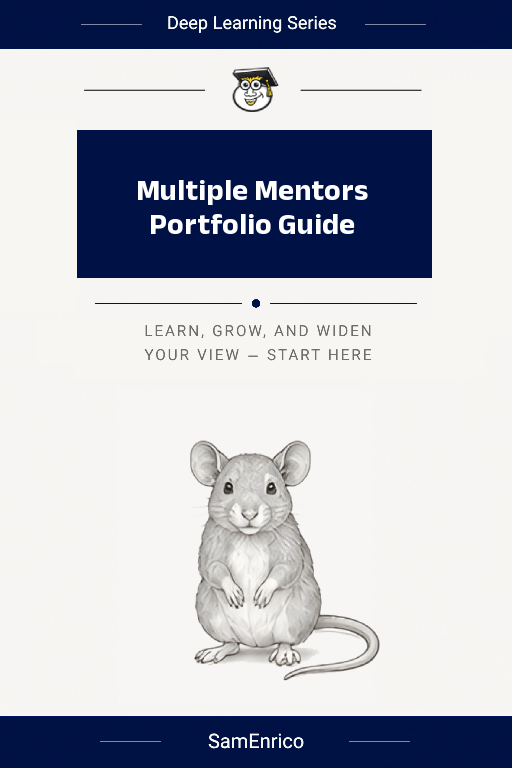
Non-FictionFirst 30 DaysPortfolio
Multiple Mentors Portfolio Guide eBook
Build a personal board of directors with multiple
Build a personal board of directors with multiple mentors. Different domains, career stages, and perspectives.
Formats
Free sample
Chapter 1: The Prestige Trap--–- It was 3:47 on a Tuesday afternoon when Maria’s career almost ended. Not with a dramatic explosion or a public firing, but with a two-sentence email from someone she had never met. The email read: “After careful consideration, we have decided to move forward with other candidates for the Director of Product position. We wish you the best in your future endeavors.”Maria had done everything right. She had graduated from a top-tier business school.
She had fifteen years of experience at respected companies. She had even secured what everyone told her was the ultimate career asset: a mentor. His name was Charles. He was a senior vice president at a Fortune 500 company. He had been featured in industry magazines.
He had a framed photograph with a former cabinet member on his office wall. Charles was, by every conventional measure, the perfect mentor.Except for one problem. Charles had never built a product from zero. He had never managed a team through a pivot. He had never negotiated a budget with a skeptical CFO.
Charles had risen through the ranks in the 1990s and early 2000s by mastering a very specific set of political maneuvers inside a single, stable, slow-moving corporation. His advice to Maria was always elegant, always confident, and always wrong for her context. “Wait your turn,” he told her. “Loyalty gets rewarded,” he assured her. “Don’t rock the boat,” he warned her.Maria waited.
She was loyal. She did not rock the boat. And then the boat sailed without her.The candidate who got the promotion was three years younger, had a less prestigious degree, and had never been featured in any magazine. But she had three mentors: a former startup founder who taught her rapid experimentation, a peer in sales who taught her how to frame product decisions as revenue opportunities, and a junior designer who taught her how the newest user research tools worked. Maria had one mentor – a prestigious, impressive, utterly useless one.This chapter is about why Maria’s story is not an exception but the rule.
It is about the single most damaging mistake professionals make when building their advisory relationships: chasing prestige instead of fit. And it is about the six domains of mentorship that will form the foundation of your Personal Board of Directors.The Mythology of the One Great Mentor We have been sold a fairy tale. The fairy tale goes like this: somewhere out there, a wiser, older, more accomplished person exists who can take you under their wing, share their secrets, and guide you to success. Find that person, the story goes, and your career will unfold like a predictable novel. The hero meets the sage.
The sage imparts wisdom. The hero overcomes obstacles. The hero wins.This narrative is as old as Western literature. Socrates mentored Plato. Plato mentored Aristotle.
Aristotle mentored Alexander the Great. In every generation, we retell this story with contemporary faces: a legendary CEO and their protégé, a famous author and the young writer they discovered, a master craftsman and the apprentice who carries on their legacy.The problem is that this narrative is not just simplified – it is actively harmful. The Socrates-Plato-Aristotle chain worked because those four men lived in a radically different world, one where knowledge changed slowly, where a single discipline (philosophy) could be mastered in a lifetime, and where the scale of human organizations was measured in dozens rather than thousands. In that world, one mentor might plausibly have all the answers.Your world is not that world. You live in a VUCA environment – volatile, uncertain, complex, ambiguous.
Industries that existed ten years ago have vanished. Jobs that were invented five years ago are now obsolete. The skills that earned you a promotion last year are table stakes this year. In this environment, a single mentor is not an asset. A single mentor is a single point of failure.Every mentor has blind spots.
Every mentor has a limited set of experiences. Every mentor achieved success in a specific context that may not match your context. When you rely on one mentor, you inherit all of their blind spots, their outdated assumptions, their industry myopia, and their generational biases. You do not get Socrates. You get Charles – confident, prestigious, and wrong.The Prestige Trap: Why Smart People Chase Bad Mentors The prestige trap operates like a optical illusion.
It makes the less valuable option appear more valuable because of surface-level signals: titles, company names, media mentions, age, credentials. When Maria chose Charles as her mentor, she was not being foolish. She was being human.Cognitive psychology research has documented the “halo effect” – our tendency to assume that people who excel in one area (say, achieving a senior title) must also excel in unrelated areas (say, mentoring someone from a different generation in a different type of company). We see the title and infer wisdom. We see the magazine profile and infer generosity.
We see the corner office and infer relevance.The halo effect is amplified by what behavioral economists call “social proof.” When others admire someone, we assume that person must be admirable. When a mentor is widely recognized, we assume their advice must be widely valuable. Maria’s peers envied her relationship with Charles. Her boss was impressed when Charles’s name came up in conversation. Every external signal said: you have won the mentoring lottery.But external signals are not internal value.
The only question that matters about a potential mentor is not “Are they impressive?” but “Does their specific expertise fill my specific gap?” This is the difference between mentor prestige and mentor fit.Prestige asks: “Who is the most accomplished person I can access?”Fit asks: “Who has solved the exact problem I am facing right now?”Prestige asks: “Who has the most impressive title?”Fit asks: “Who has recent, relevant experience in my domain of need?”Prestige asks: “Who would look good on my Linked In recommendations?”Fit asks: “Who will tell me what I need to hear, not what I want to hear?”Maria was suffering from a Domain B gap (Political/Social) – she did not understand how to navigate the internal politics of her product organization. Charles had Domain B expertise from 1998, in a different industry, at a different scale. His prestige blinded her to his irrelevance. She would have been better served by a mid-level product manager from a different company who had successfully navigated a similar political minefield last year. That person had less prestige.
They also had more fit.The Six Domains of Mentorship To escape the prestige trap, you must first understand what you actually need. This requires a framework for categorizing the different types of expertise that a mentor might provide. After synthesizing research from career development, organizational psychology, and adult learning theory, this book defines six distinct domains of mentorship. Every potential mentor should be evaluated against these domains. Every gap you identify should be mapped to one or more of them.Domain One: Career Strategy Career strategy mentors help you answer the long-term questions: Where should I be in five years?
Which jobs are stepping stones versus dead ends? How do I balance ambition with patience? When should I stay, and…
This is the end of the free sample. Get the eBook to keep going. Buy now
About this book
Details
- Author
- Merchant Nancey
- Publisher
- SamEnrico
- Language
- English
- Genre
- Non-Fiction, First 30 Days, Portfolio
- Released
- 2026-06-01
- Pages (approx.)
- 145
- Available as
- eBook, Audiobook

Read better in the ZLOADR app
Your eBooks on your phone or tablet. Sign in with your SamEnrico account and start reading.
More by Merchant Nancey
 Courtroom Body Language AnalystMerchant Nancey$11.99
 Affirmations For Purpose WorkbookMerchant Nancey$11.99
 Laci Peterson Victim Impact StudyMerchant Nancey$11.99
 Remote Review for Research TeamsMerchant Nancey$11.99
 Nanotechnology Investment ForecastMerchant Nancey$11.99
 Titian’s Brushstrokes: Painting the Soul of the RenaissanceMerchant Nancey$11.99
 Understanding Parkes Weber SyndromeMerchant Nancey$17.99
 How to Become a Sewage-disposal WorkerMerchant Nancey$11.99
 Human Rights Performance ComparisonMerchant Nancey$12.99
 Greenheart HarvestingMerchant Nancey$11.99
You may also like
 Hong Kong Handover 1997Dunn Johnnie$11.99
 Zumba For Postnatal Recovery CourseNeal Christian$11.99
 Zumba for BeginnersLadner Nikia$11.99
 YouTube Comment Mining GuideHumes Pandora$12.99
 Worry Box MeditationCarlin Rudy$11.99
 Workplace Stress MeditationNguyen Lynn$11.99
 Workplace Stress and Sleep RepairHawley Ivory$11.99
 Workplace Perfectionism CureDelaney Jeffry$11.99
 Workplace Injustice Anger GuideWallen Isabelle$11.99
 Work Addiction and Burnout LinkGreenwood Ester$11.99
 Women in Yoga and WellnessBeattie Galina$11.99
 Women in Stand Up ComedyChun Evangeline$11.99