
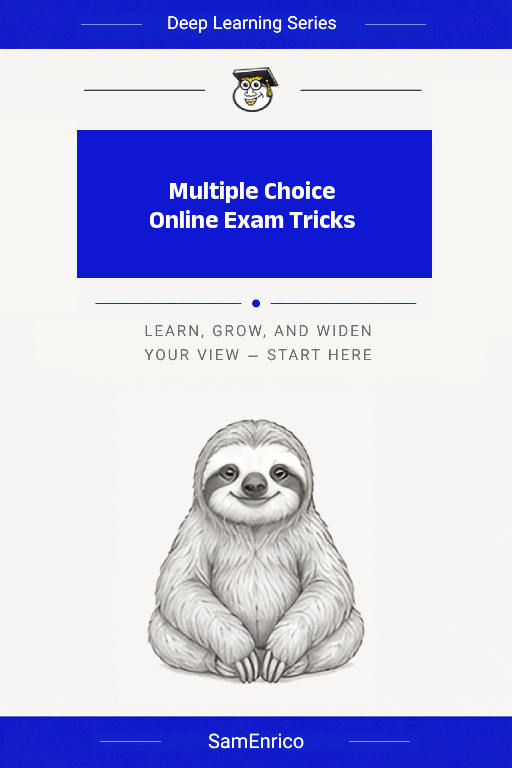
Non-FictionStudent's ShortcutMultiple Choice
Multiple Choice Online Exam Tricks eBook
Eliminate wrong answers, spot patterns, and make e
Eliminate wrong answers, spot patterns, and make educated guesses without leaving the screen.
Formats
Free sample
Chapter 1: The Enemy Within--–- You have probably opened this book because you have experienced a specific kind of frustration. You studied. You reviewed your notes. You even took practice tests. And then, sitting in front of a glowing screen with the clock ticking, you found yourself staring at four options that all looked equally plausible.
You eliminated one. Maybe two. And then you guessed. And you got it wrong.This is not a failure of knowledge. It is a failure of understanding how multiple-choice exams actually work.Most students believe that multiple-choice tests measure what you know.
That is only half true. In reality, these exams are behavioral tests designed to exploit predictable flaws in human decision-making. The test writer is not simply asking you for the correct answer. They are actively trying to lure you into picking the wrong one. Every distractor—the fancy term for a wrong answer—is deliberately engineered to appeal to a specific cognitive bias, a common mistake, or a moment of carelessness.This chapter reveals the hidden psychology behind every multiple-choice question you will ever face online.
You will learn why your brain betrays you when you are tired, why screen fatigue is a weapon used against you, and how to rewire your instinctive reactions to turn the test maker's traps into your advantages. By the end of this chapter, you will never look at a multiple-choice exam the same way again.The Great Misconception: Knowledge vs. Decision-Making Let us start with a simple experiment. Consider this question:Which of the following is a primary function of the human liver?A) Producing insulin B) Filtering blood and producing bile C) Pumping oxygenated blood to the body D) Storing short-term memories If you know anything about human biology, you know that B is correct. The pancreas produces insulin.
The heart pumps blood. The brain stores memories. This is a knowledge-based question. You either know it or you do not.Now consider this question:Which of the following is LEAST likely to be a function of the human liver?A) Producing bile B) Filtering toxins from the blood C) Regulating blood glucose levels D) Producing insulin This is the same topic, but the question type has changed. The word "LEAST" forces you to compare, evaluate, and eliminate.
You might know that the liver does A, B, and C. But if you are rushing, your eye might catch "producing insulin" as a vaguely familiar term from the endocrine system, and you might select it as a distractor. The test maker is no longer testing your knowledge. They are testing your attention to the word "LEAST."This distinction is the foundation of everything in this book. Multiple-choice exams are not pure knowledge tests.
They are decision-making under uncertainty with a hostile actor—the test maker—actively trying to mislead you.The Test Maker as Adversary Let us personify the test maker for a moment. Imagine them sitting at a desk with a stack of textbooks, a spreadsheet of common student errors, and a budget for writing "plausible but wrong" answers. Their job is not to fail you. Their job is to create a distribution of scores that distinguishes between levels of competence. To do that, they need questions that some students get right and others get wrong based on subtle differences in reasoning.The test maker has three primary weapons:The Familiarity Trap: Planting answer choices that look like terms you have seen before, even if they are incorrect.The Calculation Mirror: Placing the exact number you would get from a common mistake right next to the correct answer.The Plausibility Cascade: Writing three wrong answers that each appeal to a different cognitive bias, ensuring that nearly every unprepared student finds at least one attractive option.Your job is to recognize these weapons before they fire.
And that begins with understanding how your own brain works against you.The Familiarity Trap: Why Your Memory Lies In the 1960s, psychologist Robert Zajonc conducted a series of experiments on what he called the mere-exposure effect. He found that people developed a preference for things simply because they had seen them before—even if they could not remember seeing them. Repeated exposure, without any other reinforcement, increases liking.Test makers exploit this mercilessly.Imagine you are taking a psychology exam. You studied a chapter on classical conditioning, where you repeatedly encountered the name "Ivan Pavlov" and the word "salivation." Now you see this question:Which researcher is most closely associated with the concept of operant conditioning?A) Ivan Pavlov B) B.F. Skinner C) John Watson D) Sigmund Freud If you know the material, you know that B is correct.
But if you are tired, rushed, or uncertain, your brain will light up at the sight of "Pavlov." You have seen that name dozens of times recently. It feels familiar. It feels right. The test maker is counting on that feeling to pull you away from the correct answer.This is the Familiarity Trap. It is not a test of whether you know operant conditioning.
It is a test of whether you can override your brain's lazy preference for familiar-sounding terms.How to defeat it: When you encounter an option that feels "familiar" but you cannot immediately explain why it is correct, pause and ask yourself a specific question: "Did I study this as a correct fact, or did I just see it listed as a distractor in a practice question?" If you cannot answer with certainty, treat the familiar option as suspicious. Verify it against the stem before selecting.We will return to familiarity in Chapter 7, where we distinguish between the dangerous Familiarity Trap and the useful "Déjà Vu Rule"—because sometimes familiarity signals genuine correctness. The difference lies in the source of the familiarity.The Calculation Error Mirror: The Number That Betrays You This next trap is particularly cruel because it preys on your confidence.Suppose you are solving a math problem:A car travels 60 miles per hour for 2.5 hours. How many miles does it travel?You calculate: 60 × 2.5 = 150. You look at the options:A) 120B) 150C) 180D) 240You select B.
Correct.Now suppose you are tired, and you accidentally calculate 60 × 2 = 120 instead of 60 × 2.5 = 150. You look at the options. 120 is sitting right there as option A. You select it. Wrong.The test maker did not accidentally include 120.
They deliberately included the result of the most common mistake. This is the Calculation Error Mirror. For every calculation question, the test maker imagines the three most frequent student errors—forgetting to carry a decimal, misreading the operation, using the wrong formula—and plants those exact numbers as distractors.How to defeat it: When you see your calculated answer sitting among the options, do not celebrate immediately. Instead, ask: "Could this be the mistake answer?" Re-check your work using a different method. Estimate first.
Plug the answer back into the equation. If your answer is option A or D, treat it with particular suspicion—test makers often place the "mistake answer" first or last because those positions are visually prominent.Screen Fatigue: The Invisible Enemy Online exams introduce a weapon that paper exams do not have: the glowing rectangle.Staring at a monitor for extended…
This is the end of the free sample. Get the eBook to keep going. Buy now
About this book
Details
- Author
- Haskins Keiko
- Publisher
- SamEnrico
- Language
- English
- Genre
- Non-Fiction, Student's Shortcut, Multiple Choice
- Released
- 2026-06-01
- Pages (approx.)
- 125
- Available as
- eBook, Audiobook

Read better in the ZLOADR app
Your eBooks on your phone or tablet. Sign in with your SamEnrico account and start reading.
More by Haskins Keiko
 Mindfulness for Veterans GuideHaskins Keiko$11.99
 Postpartum Self Care Recovery PlanHaskins Keiko$11.99
 ABC Method for Customer SupportHaskins Keiko$11.99
 Profit and Loss for FoundersHaskins Keiko$11.99
 Uber Eats Lifestyle CompareHaskins Keiko$11.99
 The Priority and Time BlockingHaskins Keiko$11.99
 Design Thinking For LibrariesHaskins Keiko$11.99
 Depression NeurobiologyHaskins Keiko$11.99
 The Enlightenment Unchained: Voltaire’s Lost RepublicHaskins Keiko$11.99
 The Art of War and the Art of the Game: Sun Tzu’s Influence on Ancient Chinese SportsHaskins Keiko$11.99
 How to Produce Hard Drive DuplicatorsHaskins Keiko$11.99
 Mastering The Art of Musti-yuddhaHaskins Keiko$11.99
You may also like
 Hong Kong Handover 1997Dunn Johnnie$11.99
 Zumba For Postnatal Recovery CourseNeal Christian$11.99
 Zumba for BeginnersLadner Nikia$11.99
 YouTube Comment Mining GuideHumes Pandora$12.99
 Worry Box MeditationCarlin Rudy$11.99
 Workplace Stress MeditationNguyen Lynn$11.99
 Workplace Stress and Sleep RepairHawley Ivory$11.99
 Workplace Perfectionism CureDelaney Jeffry$11.99
 Workplace Injustice Anger GuideWallen Isabelle$11.99
 Work Addiction and Burnout LinkGreenwood Ester$11.99
 Women in Yoga and WellnessBeattie Galina$11.99
 Women in Stand Up ComedyChun Evangeline$11.99