
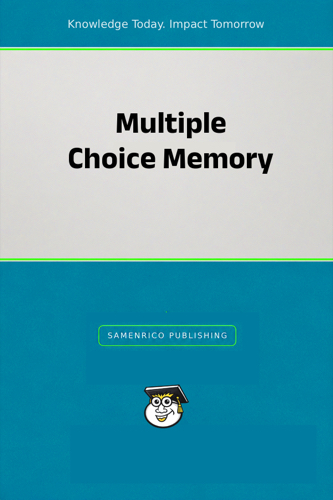
Multiple Choice Memory eBook
Recognize correct answers among distractors effect
Recognize correct answers among distractors effectively.
Formats
Free sample
Chapter 1: The Retrieval Paradox--–- Every student knows the feeling. You sit down for an exam, pencil in hand, heart rate climbing. You read the first multiple-choice question and your mind goes blank. The answer is somewhere in your brain—you studied for hours—but it won't come. Then you look at the four options.
One of them triggers a spark. "Oh yes," you whisper. "That's it." You circle it and move on. Later, you discover you got it right. But ask you to write that same answer from memory, without the options, and you would have stared at a blank page for ten minutes.This is not a flaw in your intelligence.
It is a feature of your brain's architecture. The human memory system operates through two distinct retrieval pathways, and understanding the difference between them is the single most important factor in mastering multiple-choice tests. Most students fail to recognize this distinction. They study as if every test were an essay exam, drilling themselves on recall when they should be training for recognition. They fight against their own brain's design.
And then they wonder why they freeze under pressure.This chapter dismantles the most common frustration students have: "I know it, but I can't think of it." We will explore the fundamental difference between recall and recognition, why your brain is actually better at one than the other, and how to stop fighting your memory and start working with it. By the end of this chapter, you will understand why your multiple-choice performance often exceeds your essay performance—and how to close the gap so that recognition becomes a reliable tool rather than a occasional lucky break.The Two Faces of Memory Retrieval To understand why multiple-choice tests feel different from essay tests, we must first understand how the brain stores and retrieves information. Memory is not a single thing. It is a collection of systems that work together, and retrieval—the act of pulling information back into conscious awareness—can happen in two fundamentally different ways.Recall is the process of generating information from memory with minimal external cues. When someone asks you, "What is the capital of South Dakota?" and you answer "Pierre," you have performed recall.
When an exam says, "List the three branches of the US government," and you write "Executive, Legislative, Judicial," you have performed recall. Recall is constructive, effortful, and sequential. Your brain must search through its neural networks, assemble fragments of information, and produce an answer from scratch. Think of recall as rebuilding a car engine from a pile of parts without a diagram.Recognition is the process of identifying information as familiar when you encounter it again. When you see a multiple-choice question with four options and you pick the correct one, you have performed recognition.
Recognition is comparative, pattern-matching, and parallel. Your brain does not need to generate the answer from nothing. It only needs to match the presented options against stored memory traces and identify which one feels correct. Think of recognition as picking your own car out of a police lineup. You do not need to rebuild the car.
You just need to spot it.The critical insight is this: recall and recognition rely on overlapping but distinct neural pathways. The hippocampus, which is crucial for memory formation, is heavily involved in both. But recall places much greater demands on the prefrontal cortex—the brain's executive control center—because it requires active search and reconstruction. Recognition relies more heavily on the perirhinal cortex, which specializes in detecting familiarity. This is why patients with certain types of brain damage can lose the ability to recall new information while still recognizing faces or objects they have seen before.
The two systems are separable, and they have different strengths and weaknesses.Why Recognition Feels Easier (And Why That Can Trap You)On the surface, recognition feels easier than recall. And for good reason: your brain is evolutionarily wired for recognition. Your ancient ancestors did not need to recall the exact coordinates of a lion's hiding spot. They needed to recognize the lion when they saw it again. They did not need to recall the precise shape of an edible berry from memory.
They needed to recognize it when they held it in their hand. Recognition is fast, automatic, and energy-efficient. It is the brain's default setting for survival.This evolutionary heritage means that you are naturally better at recognition than recall for the same material. Researchers have demonstrated this effect across countless experiments. In a typical study, participants study a list of words.
Later, some are asked to recall as many words as possible from memory. Others are shown a longer list and asked to recognize which words they saw before. Recognition performance is consistently higher—often dramatically so. This is called the recognition advantage, and it is one of the most robust findings in memory research.But here is where the trap lies. Because recognition feels easier, many students assume that recognition-based tests are easier overall.
They study less thoroughly, trusting that the answer choices will jog their memory. And sometimes this works. But when distractors are well-written—when the wrong answers are plausible and seductive—shallow recognition fails. You look at the four options and they all look somewhat familiar. You feel like you recognize all of them.
And you have no way to tell which one is correct.This is the Retrieval Paradox: recognition is evolutionarily easier than recall, but on well-designed multiple-choice tests, shallow recognition is a liability, not an asset. The students who succeed are not those who rely on the "familiarity feeling." They are those who have learned to elevate their recognition from a shallow, automatic process to a deep, analytical one. They have trained their brains to do more than just recognize. They have trained their brains to discriminate.Familiarity vs. Fluency: The Hidden Distinction To understand how to improve recognition, we must introduce a critical distinction that most test-takers never learn.
Psychologists separate recognition into two different experiences: familiarity and fluency.Familiarity is the vague sense that you have encountered something before. You see a term like "semantic encoding" on a multiple-choice test, and you think, "I've seen that word somewhere." But if someone asked you to define it, you could not. Familiarity is shallow. It relies on a simple signal from the perirhinal cortex: "This stimulus matches a stored pattern." There is no associated detail, no context, no meaning attached. Familiarity is like seeing a face on the street and knowing you have seen that person before but not remembering their name, where you met them, or anything about them.Fluency is the ease with which information comes to mind.
When you have true fluency with a concept, the answer feels obvious. You do not just recognize the word. You understand it. You can explain it. You can distinguish it from similar concepts.
Fluency is deep. It relies on rich connections between the perirhinal cortex and other brain regions—the hippocampus, the prefrontal cortex, and association areas throughout the neocortex. Fluency is like seeing a close friend on the street. You not only recognize their face. You know their name, their job…
This is the end of the free sample. Get the eBook to keep going. Buy now
About this book
Details
- Author
- Dickerson Pamella
- Publisher
- SamEnrico
- Language
- English
- Genre
- Non-Fiction, Self-Help, Test Taking
- Released
- 2026-06-08
- Pages (approx.)
- 150
- Available as
- eBook, Audiobook

Read better in the ZLOADR app
Your eBooks on your phone or tablet. Sign in with your SamEnrico account and start reading.
More by Dickerson Pamella
 The Grandmother's LoverDickerson Pamella$11.99
 Shift Work Sleep Disorder SymptomsDickerson Pamella$11.99
 Perfectionism Failure Cycle BreakDickerson Pamella$11.99
 Talking To Kids About Hard ThingsDickerson Pamella$11.99
 Ultra Runner HypnosisDickerson Pamella$11.99
 AED Use in OfficesDickerson Pamella$11.99
 Action Planning for Retail WorkersDickerson Pamella$11.99
 Blood and Jade: The Serpent Spy of TeotihuacanDickerson Pamella$11.99
 The Silk and Gold Weavers of the Kingdom of Kongo: A Royal Fashion LegacyDickerson Pamella$11.99
 How to Produce Printer MemoryDickerson Pamella$11.99
 Amazon Brand Registry vs Alibaba Brand ProtectionDickerson Pamella$12.99
 Export Documentation ChecklistDickerson Pamella$12.99
You may also like
 Short Answer Exam TechniqueBuckingham Marcy$11.99
 Self Hypnosis For Exam Preparation GuideMarlow Yu$11.99
 Meditation for Test AnxietyOlivares Usha$11.99
 Exam Simulation Practice GuideFarley Jenise$11.99
 Exam Day Recall BoosterTong Isela$11.99
 Post Hypnotic Suggestion for Exam SuccessCarvalho Columbus$11.99
 Test Anxiety TriggerWeir Sherril$11.99
 Self Talk for Test AnxietyDangelo Esmeralda$11.99
 Multiple Choice Exam TacticsHager Danilo$11.99
 Exam Strategy SimulationMarble Brittney$11.99
 Exam Anxiety Management WorkbookShields Theron$11.99
 Pre Exam Sleep StrategyTrahan Serafina$11.99