
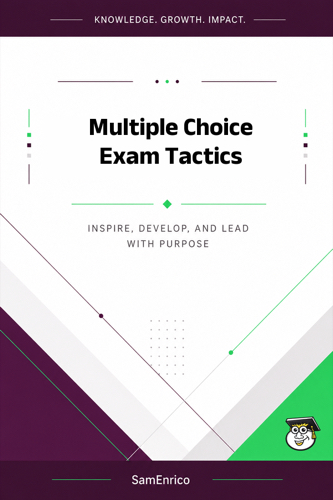
Non-FictionSelf-HelpTest Taking
Multiple Choice Exam Tactics eBook
Use process of elimination and strategic guessing
by Hager Danilo
Use process of elimination and strategic guessing to improve scores.
Formats
Free sample
Chapter 1: The Trap You’ve Already Fallen For...--This book begins with a confession you will not believe, followed immediately by a promise you will not forget.The confession is this: You have already taken this exam before. Not this specific test, not these exact questions, but the structure of the trap. The rhythm of the distraction. The cruel little satisfaction of reading a question, recognizing the topic, scanning the answers, and then—somehow, inexplicably—picking the wrong one while muttering, “I knew that. I actually knew that.”That feeling is not a failure of memory.
It is not a gap in your preparation. And it is certainly not a reflection of your intelligence.It is a design feature.The promise is this: By the time you finish this chapter, you will never look at a multiple-choice question the same way again. You will stop seeing a test. You will start seeing a game—one with predictable rules, exploitable patterns, and a human architect on the other side who is far less clever than they think they are.Let us begin.The Great Misunderstanding Most students believe that multiple-choice exams test knowledge. This is approximately 40 percent true, which means it is 60 percent false.
And that 60 percent is where the battle is won or lost.Here is what the test prep industry does not want you to know: A well-constructed multiple-choice question is not a measurement tool. It is a distraction engine. The test maker’s primary job is not to verify what you know. Their primary job is to create plausible wrong answers that feel right to the unprepared mind.These wrong answers have a technical name in the literature of educational measurement. They are called distractors.But a better name—the one used by professional exam writers in private—is bait.Every multiple-choice question follows an invisible architecture.
At the center is the key (the correct answer). Surrounding it are three or four distractors (the wrong answers). The test maker spends roughly 80 percent of their time crafting the distractors, because the key is usually obvious to anyone who knows the material. The challenge is making the wrong answers seductive.And seduction, as you already know from painful experience, works.The Anatomy of a Trap Let us look under the hood of a typical multiple-choice question. Consider this example from a fictional introductory psychology exam:Question: Which of the following is considered the primary function of the amygdala?A) Language comprehension B) Emotional processing, particularly fear C) Long-term memory storage D) Motor coordination If you know anything about neuroscience, you recognize B as the correct answer.
But notice what the test maker has done. Option A (language comprehension) is associated with Broca’s and Wernicke’s areas—plausible if you are fuzzy on brain anatomy. Option C (long-term memory) is the hippocampus, a common confusion point. Option D (motor coordination) belongs to the cerebellum.Every distractor is a real fact attached to the wrong location. The test maker did not invent false information.
They weaponized true information by displacing it.This is the first and most important insight of this book: Wrong answers on well-designed exams are almost never made up. They are borrowed from somewhere else in the curriculum.The student who studied but did not organize their knowledge reads “amygdala” and thinks “brain” and then scans for anything brain-related. All four options are brain-related. All four contain true statements. The trap snaps shut.The student who understands the test maker’s psychology reads “amygdala” and thinks “fear” and immediately eliminates anything not directly tied to that specific function.
They see B, recognize it instantly, and move on in four seconds.The difference is not knowledge. The difference is test-wiseness—a term introduced by educational psychologists Millman and Bishop in their seminal work on multiple-choice strategy. Test-wiseness is the ability to use the characteristics of the test format itself to improve one’s score, independent of content knowledge.It is, in other words, the skill of seeing the trap before it springs.The Three Lies Students Tell Themselves Before we go any further, we need to clear away the mental debris that has been holding you back. In my years of analyzing test-taking behavior, I have identified three lies that students repeat to themselves with remarkable consistency. These lies are not your fault.
They are taught implicitly by every exam experience you have ever had.Lie #1: “If I study harder, I won’t need tactics.”This is seductive because it places all responsibility on your shoulders. It suggests that every wrong answer is a moral failure—a sign that you simply did not care enough, did not sacrifice enough, did not highlight enough textbook pages.Here is the truth: The highest-scoring test takers in the world use tactics on every single question, including the ones they know cold. They do this because tactics are not a substitute for knowledge. Tactics are a quality control system for knowledge. Even when you are certain of an answer, a quick tactical check (Does this violate the grammatical alignment?
Is this an absolute statement in disguise?) catches the 5 to 10 percent of questions where your certainty is misplaced.The best test takers do not choose between studying and strategizing. They do both, and they do them simultaneously.Lie #2: “I’m just a bad test taker.”This statement contains a hidden assumption: that test-taking ability is a fixed trait, like height or shoe size. You either have it or you do not.The research on test-wiseness suggests otherwise. In study after study, researchers have found that tactical training improves multiple-choice scores by an average of 10 to 20 percentile points, independent of content review. Students who are “bad test takers” are almost always students who have never been taught the rules of the game.Imagine someone who had never learned chess rules being told they were “just bad at board games.” Absurd.
Yet we do the same thing to students every day.Lie #3: “Guessing is just luck.”This is the most dangerous lie of all, because it convinces students to guess randomly or, worse, to leave questions blank.What students call “luck” is almost always rapid, unconscious elimination. The brain processes dozens of cues in milliseconds—grammatical mismatches, logical contradictions, pattern breaks—and arrives at an answer that feels like a guess but is actually a lightning-fast calculation.The goal of this book is to make that process conscious, deliberate, and repeatable. By the time you finish Chapter 3, you will never “guess” again. You will only estimate from reduced options.The Detective Mindset Shift Everything changes when you stop thinking of yourself as a student and start thinking of yourself as a detective.A student reads a question and asks: “Do I know this?”A detective reads the same question and asks: “What is the test maker trying to make me think?”These two questions look similar. They are not.
The first is passive and self-referential. The second is active and outward-facing. The first leads to anxiety when knowledge fails. The second leads to curiosity—and curiosity is the enemy of test anxiety.Consider the difference in practice. A student sees a question about an unfamiliar historical figure, say…
This is the end of the free sample. Get the eBook to keep going. Buy now
About this book
Details
- Author
- Hager Danilo
- Publisher
- SamEnrico
- Language
- English
- Genre
- Non-Fiction, Self-Help, Test Taking
- Released
- 2026-06-09
- Pages (approx.)
- 131
- Available as
- eBook, Audiobook

Read better in the ZLOADR app
Your eBooks on your phone or tablet. Sign in with your SamEnrico account and start reading.
More by Hager Danilo
 Medical Relapse Prevention HandbookHager Danilo$11.99
 Life Audit WorkbookHager Danilo$11.99
 Assertiveness in Custody BattlesHager Danilo$11.99
 Manhattan Project Logistics and SecrecyHager Danilo$11.99
 Test Pilot MemoirHager Danilo$11.99
 MDD in Children GuideHager Danilo$11.99
 Citation Rules for Preprints and ArchivesHager Danilo$11.99
 Industrialist Master GuideHager Danilo$11.99
 The Lost Kingdoms of the Andes: Alexander von Humboldt’s Quest for the Heart of South AmericaHager Danilo$11.99
 The Last Broadcast: The Mysterious Signal from E.T. RadioHager Danilo$11.99
 Understanding Apraxia ManualHager Danilo$17.99
 How to Become a Quality-control SupervisorHager Danilo$11.99
You may also like
 Hong Kong Handover 1997Dunn Johnnie$11.99
 Zumba For Postnatal Recovery CourseNeal Christian$11.99
 Zumba for BeginnersLadner Nikia$11.99
 YouTube Comment Mining GuideHumes Pandora$12.99
 Worry Box MeditationCarlin Rudy$11.99
 Workplace Stress MeditationNguyen Lynn$11.99
 Workplace Stress and Sleep RepairHawley Ivory$11.99
 Workplace Perfectionism CureDelaney Jeffry$11.99
 Workplace Injustice Anger GuideWallen Isabelle$11.99
 Work Addiction and Burnout LinkGreenwood Ester$11.99
 Women in Yoga and WellnessBeattie Galina$11.99
 Women in Stand Up ComedyChun Evangeline$11.99