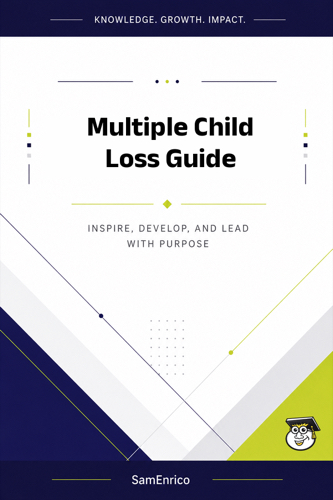
Multiple Child Loss Guide eBook
Grieve the death of more than one child with this
by Cady Trish
Grieve the death of more than one child with this compassionate workbook.
Formats
Free sample
Chapter 1: The Unspeakable Mathematics...--–- You know the number. The one you calculate in the grocery store checkout line when a well-meaning cashier asks, “Any fun plans with your kids this weekend?” You pause. You do the math in your head. How many do you say? How many do you hide?
How many are still breathing, and how many are not? Your cart holds enough food for a family of four, but only two will eat. The other two sets of hands will never reach for a snack from this cart again. That is the unspeakable mathematics of multiple child loss. It is not double grief.
It is not grief times two. It is an entirely different equation, one for which no one gave you the formula, and one that no bestseller has ever taught you how to solve—because until now, no one has written the workbook for parents like you.This book is not for the person who lost one child, though that loss is a hurricane of its own. This book is for the person who has been struck by lightning, survived, built a shelter, and then watched the sky open again. This book is for the parent who has buried two children. Or three.
Or more. It is for the mother who lost a teenager to suicide and then a toddler to cancer, and who cannot figure out why the two griefs feel nothing alike yet somehow compound into something heavier than the sum of their parts. It is for the father who held his stillborn daughter and then, years later, watched his living son die of a genetic condition that no one knew ran in the family. It is for the grandparents raising grandchildren after their own child died, only to lose another grandchild to the same accident. It is for the parent who has no living children left at all, whose identity has collapsed into a pronoun that does not exist in any language—“parent” in the past tense, “bereaved” in the present, “what” instead of “who.”If you are holding this book, you have already done the math.
You have already counted the empty chairs at dinner. You have already learned that the phrase “I have two children” is a lie of omission, and the phrase “I have four children but two are dead” is a truth that makes strangers recoil. You have learned that there is no script for you. Society has scripts for losing one child—“I can’t imagine,” “My deepest condolences,” “They’re in a better place”—but total, absolute, crushing silence for losing two or more. Because losing one child is a tragedy.
Losing two is a statistical impossibility that should not happen to anyone. Losing three makes people wonder what you did wrong.You did nothing wrong.That is the first truth of this book, and it will appear again and again, in different forms, because you will need to hear it on days when you believe it and on days when you do not. You did nothing wrong. Your body did not fail you. Your parenting did not fail your children.
Your love did not fail to protect them. Bad things happen in clusters sometimes—genetic bad luck, environmental bad luck, the cruel randomness of car accidents and undiagnosed conditions and the simple fact that children can die. You did not cause this. And no amount of “protective parenting” (we will talk about that term in a moment) could have stopped it.Welcome to the Unspeakable Mathematics. Let us begin.The Silence After the Second Knock Imagine a door.
The first time grief knocked, you answered. Neighbors brought casseroles. Friends sent flowers. Your employer gave you bereavement leave. People said the right wrong things—“I can’t imagine” being the most common—but at least they said something.
You existed in a recognizable category: the bereaved parent. There were books for you. Support groups. A script.The second time grief knocked, you opened the door to an empty street. The casseroles stopped coming after the second week because no one knows what to bring to a house where this has happened twice.
Your employer asked if you needed “more time off” in a tone that suggested they hoped you would say no. Friends said things like “I don’t know what to say anymore” and then stopped calling. The books you read after the first loss felt useless now—they talked about “healing” and “moving forward” and “finding a new normal,” as if the first loss had a normal and the second loss simply added a footnote. But you are not the same person who grieved the first child. You are someone else entirely.The silence after the second knock is not just the absence of casseroles.
It is the absence of language. English has no word for a parent who has lost two children. We have “widow” and “widower.” We have “orphan.” We have “childless” (which implies you never had children) and “childfree” (which implies you chose not to). But a parent who has buried two children exists in a grammatical void. You cannot introduce yourself without performing a calculation: do I tell the truth and make everyone uncomfortable, or do I lie and erase my children’s existence?This chapter is named “The Unspeakable Mathematics” because that is exactly what you have been doing: calculating, in real time, how much of your truth to share, with whom, and at what cost.
The math changes depending on the audience. At the pediatrician’s office with your surviving child, you say “I have one child” because you do not want the doctor to look at you with pity while examining your living child. At a support group for bereaved parents, you say “I have lost two” and brace yourself for the inevitable comparison: “At least you still have one.” On a bad day, standing in line at the pharmacy, you say nothing at all because opening your mouth might let out a sound that cannot be taken back.The unspeakable mathematics is not just about how many children you have. It is about how many versions of yourself you have become.Cumulative Grief Is Not Double Grief Let us be precise about language, because the right words are the difference between feeling seen and feeling erased. Most people—including many grief therapists—talk about “double grief” as if losing two children means experiencing the same grief twice.
That is incorrect. That model assumes that grief is a discrete event with a beginning, a middle, and an end, and that experiencing it twice simply means two discrete episodes.Cumulative grief does not work that way. The second loss does not add to the first loss. It multiplies. It compounds.
It rewrites the first loss in retrospect.Here is what that means in practice: After your first child died, you developed coping mechanisms. You learned which friends to call at 2 a.m. You learned which songs to avoid. You learned that the anniversary of the death would be hard, so you planned ahead. You built a life around the absence.
It was a shattered life, but it was a life. You knew where the cracks were.Then your second child died.…
This is the end of the free sample. Get the eBook to keep going. Buy now
About this book
Details
- Author
- Cady Trish
- Publisher
- SamEnrico
- Language
- English
- Genre
- Non-Fiction, Self-Help, Multiple Loss
- Released
- 2026-06-06
- Pages (approx.)
- 143
- Available as
- eBook, Audiobook

Read better in the ZLOADR app
Your eBooks on your phone or tablet. Sign in with your SamEnrico account and start reading.
More by Cady Trish
 Cognitive Restructuring PhobiaCady Trish$11.99
 The Student Distraction GuideCady Trish$11.99
 Time Saving Kitchen ToolsCady Trish$11.99
 Pet Loss Nutrition GuideCady Trish$11.99
 Omaha Beach Survivor RecollectionsCady Trish$11.99
 Energy Master GuideCady Trish$11.99
 Insider Threat StatisticsCady Trish$11.99
 The Siege of Thermopylae: 300 Against Persia's TideCady Trish$11.99
 Anansi’s Web: The Trickster and the Frost GiantCady Trish$11.99
 How to Start a Machine Rigging Business (Beginners Guide)Cady Trish$11.99
 A Collector's Handbook to the American Motors (USA) American Motors MatadorCady Trish$11.99
 How to Produce Rooting HormoneCady Trish$11.99