
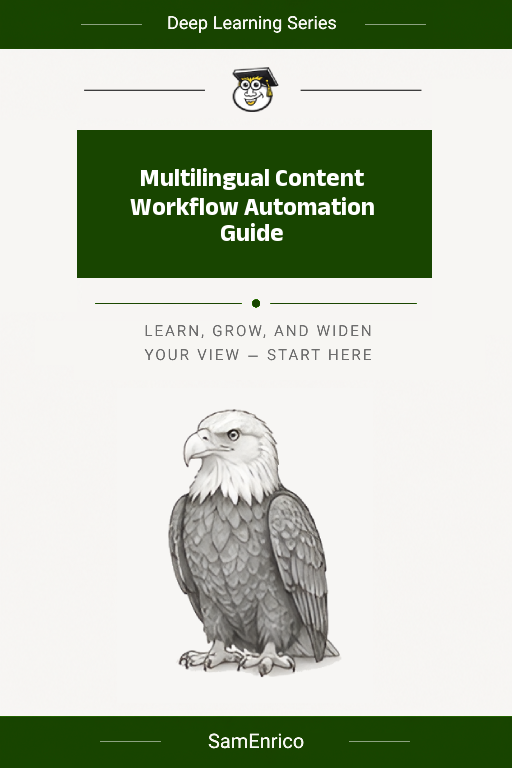
Multilingual Content Workflow Automation Guide eBook
Route source content through translation, review,
Route source content through translation, review, and publishing steps. Use AI to detect change and trigger delta translations automatically.
Formats
Free sample
Chapter 1: The Invisible Leak--–- Every morning, Maria opens her email to find seventeen new messages. Three contain Word documents attached by product marketing. Four are ZIP files from engineering. Two are Google Drive links with "view only" permissions. The rest are scattered requests from sales, support, and legal.
By Wednesday, she will have manually routed forty-seven separate files across nine languages. By Friday, she will discover that the Spanish help center still shows last quarter's pricing, the Japanese FAQ refers to a feature deprecated six weeks ago, and the German legal footer is missing a required disclosure. No one will notice until a customer complains. No one will be held accountable because no one owns the entire pipeline.This is not a failure of effort. It is a failure of architecture.
And it is happening right now in thousands of organizations that believe they are "managing" their multilingual content. The leak is invisible because it never appears on any balance sheet. But it drains revenue, burns trust, and steals time from every team it touches. This chapter exposes the true cost of fragmentation, reveals the three bottlenecks that keep organizations trapped in manual workflows, and introduces the delta workflow—the architectural pattern that stops the leak.The Hidden Cost of Manual Sync The language of modern business is speed. Teams deploy code multiple times per day.
Marketing pushes campaigns in hours, not weeks. Product documentation updates in real time as features ship. Yet for most organizations, the moment content needs to leave English, the clock rewinds to 1999.Consider a typical week in a fragmented localization operation. On Monday, the product team publishes an updated help article in English. The change is small—a single paragraph clarifying how to reset a password.
But because there is no automated connection between the CMS and the translation system, someone must notice the change, download the English file, attach it to an email, and send it to a translation vendor. The vendor receives the email on Tuesday, but the assigned linguist is already working on a different project. By Wednesday, the translation is complete and returned as a Word document. The reviewer, a regional marketing manager in Spain, receives the file on Thursday but is in back-to-back meetings. On Friday, the approved translation is emailed back to the original sender, who must manually upload it to the CMS and publish it.
The entire process took five days for three sentences. And because no one documented the workflow, the same five-day cycle will repeat next week when the English help article changes again.The cost of manual sync is not merely time. It is inconsistency, duplicated effort, and frustrated teams. It is the marketing manager who stops submitting content for translation because the process is too slow. It is the engineer who hard-codes English strings into the product because the localization handoff is too complex.
It is the customer who abandons your Spanish site because the button says "Enviar" in one place and "Entregar" in another. These costs do not appear on any budget line item, but they compound silently until they become existential.Let us quantify the problem. A mid-sized enterprise with five active languages might process two hundred translation jobs per month. If each job requires an average of twenty minutes of manual handoff time—downloading, emailing, uploading, tracking—that is sixty-seven hours per month of pure coordination work. At a fully loaded cost of sixty dollars per hour for a localization coordinator, manual sync consumes over four thousand dollars per month in labor alone.
That does not include the cost of errors, delays, or lost revenue from stale content. Over a year, manual sync can easily exceed fifty thousand dollars in direct labor for a single coordinator. Scale that to ten languages or one thousand jobs per month, and the number becomes staggering.But the true cost is not labor. The true cost is what you cannot do because your team is buried in administrative work. You cannot launch in three new markets simultaneously.
You cannot update your help center daily. You cannot A/B test translated copy because the cycle time is measured in weeks, not hours. Manual sync does not just waste money. It steals opportunity.The Brand Drift Phenomenon Even when content does get translated and published, a more insidious problem emerges: drift. Brand drift occurs when different language versions of the same content fall out of sync over time.
The English site shows version 2.0. The Spanish site still shows version 1.0. The French site shows version 1.5. The Japanese site has a mix of all three. Customers notice.
Trust erodes. And by the time anyone discovers the drift, the damage is done.Consider the case of a mid-sized e-commerce brand that sold consumer electronics. In January, the company updated its return policy from thirty days to fifteen days. The English site was updated immediately. The legal team approved the new wording.
The customer service team was trained. But the translation workflow required a human to notice the change, extract the relevant strings, send them to a vendor, receive the translations, and upload them to each language site. The Spanish site did not receive the updated policy until April. For three months, Spanish customers saw "30-day returns" while English customers saw "15-day returns." When Spanish customers attempted returns on day twenty, they were rejected. Customer service chaos ensued.
The brand's Net Promoter Score in Spain dropped eleven points. The cost of that drift—measured in lost customers, refund disputes, and social media backlash—far exceeded the cost of proper automation.Drift is not a rare accident. It is the natural outcome of manual workflows. Every time source content changes, every language version immediately begins to decay. The decay rate is proportional to the time between source update and translation publication.
In a manual workflow, that time is measured in days or weeks. In an automated delta workflow, it is measured in minutes. The difference is not incremental. It is transformational.The Three Bottlenecks Every manual localization workflow suffers from three fundamental bottlenecks. Understanding these bottlenecks is the first step toward eliminating them.Bottleneck One: Translation Speed The first bottleneck is the time between source content creation and translation availability.
In manual workflows, this bottleneck consists of multiple sub-steps: file extraction, format conversion, vendor allocation, linguist assignment, translation, editing, proofreading, and file return. Each sub-step introduces delay. Each handoff introduces risk. And because the process is human-driven, it cannot scale linearly with content volume.The root cause of the translation speed bottleneck is fragmentation of responsibility. No single system owns the end-to-end pipeline.
The CMS owns the source content. The translation vendor owns the linguistic work. Email owns the handoffs. Spreadsheets own the tracking. When something breaks, no one knows who to call.
When something succeeds, no one knows how to replicate it.Consider the math. A single handoff between two systems or teams introduces a minimum delay of several hours—often longer if time zones are involved. A typical manual workflow might involve six handoffs: CMS to coordinator, coordinator to vendor, vendor to linguist, linguist to reviewer, reviewer to coordinator, coordinator to CMS. At two hours per handoff, the baseline delay is…
This is the end of the free sample. Get the eBook to keep going. Buy now
About this book
Details
- Author
- Bedford Ofelia
- Publisher
- SamEnrico
- Language
- English
- Genre
- Non-Fiction, AI Operator, Language Services, Workflow Automation
- Released
- 2026-05-30
- Pages (approx.)
- 147
- Available as
- eBook, Audiobook

Read better in the ZLOADR app
Your eBooks on your phone or tablet. Sign in with your SamEnrico account and start reading.
More by Bedford Ofelia
 Conjoint Analysis Research GuideBedford Ofelia$11.99
 Thunberg Autism AdvocacyBedford Ofelia$11.99
 Addressing Mental Health to EmployerBedford Ofelia$11.99
 Self Talk for Financial AbundanceBedford Ofelia$11.99
 Tom DaschleBedford Ofelia$11.99
 Practice Squad Perseverance PathBedford Ofelia$11.99
 Habit QuizBedford Ofelia$11.99
 Graduate School BurnoutBedford Ofelia$11.99
 Whispers in the Corn: The Curse of the Wendigo’s HungerBedford Ofelia$11.99
 The Last Stand of the Lion of Judah: Orde Wingate’s Forgotten CrusadeBedford Ofelia$11.99
 Patton's Gambit: The General Who Defied Hitler's Last StandBedford Ofelia$11.99
 The Dancer's Guide to PeabodyBedford Ofelia$11.99