
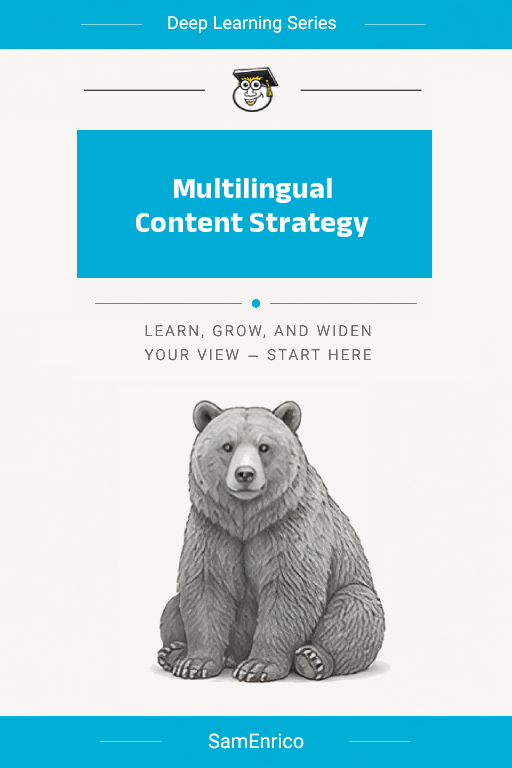
Multilingual Content Strategy eBook
Plan global content operations using AI translatio
by Walton Patsy
Plan global content operations using AI translation at scale. Prioritize 50+ languages based on ROI, set quality tiers per market.
Formats
Free sample
Chapter 1: The Trillion-Dollar Blindspot--–- Maria Chen stared at her screen, watching the dashboard refresh. Another week, another 15,000 visitors from Germany had landed on her company's English-only pricing page. They clicked around. They read the features. They spent an average of four minutes on the site—well above the company's average.
Then they left. Every single one of them. No demo requests. No trial signups. No purchases.Maria was the Head of Growth at a mid-sized B2B Saa S company called Cloud Forge.
She had joined six months earlier with a mandate to expand internationally. The company had already tried the obvious: they hired a German marketing agency to run Linked In ads. They translated their Google Ads keywords into German. They even set up a .de domain. But nothing worked.
The agency blamed the product. The sales team blamed the marketing. The CEO blamed the budget.What no one had noticed—what Maria only discovered by accident while scrolling through Hotjar session recordings—was the moment of failure. In recording after recording, German visitors would land on the English pricing page, read carefully for two or three minutes, and then their cursor would hover over the "Contact Sales" button. They would pause.
And then they would close the tab.Maria dug deeper. She filtered her analytics for users with German browser settings. The data was devastating. Cloud Forge had received 187,000 visits from German IP addresses in the past twelve months. The average time on site was 4 minutes 23 seconds—longer than their US visitors.
The bounce rate was actually lower than their domestic traffic. By every engagement metric, Germans loved the product.But the conversion rate from visit to trial signup was 0.3 percent. For US visitors, it was 4.2 percent.Maria called her head of product. "Do we have a German version of anything?" she asked."We have a German translation of the homepage," he said. "We paid an agency five thousand euros for it last year.
It's live."Maria found the page. It was beautiful. The translation was technically flawless. But the page had one critical flaw: it was buried. There was no link to it from the pricing page.
There was no hreflang tag telling Google to serve it to German users. And most damning of all, the "Contact Sales" button still went to an English form with no explanation that the sales team could handle German inquiries.The company had spent money on translation but zero dollars on localization. They had checked a box. And they had lost a fortune.Maria's discovery is not unusual. It is the rule.The $3 Trillion Silent Scream In 2018, the research firm Common Sense Advisory (now CSA Research) conducted a landmark study of 8,700 consumers across 29 countries.
The findings, replicated multiple times since, should have changed how every global company operates. Instead, they have been largely ignored.The study found that 65 percent of consumers prefer content in their native language, even if the English version is perfectly understandable. That number rises to 73 percent for purchase consideration. More critically, 40 percent of consumers will never buy from a website that is presented only in English.Let that sink in. Forty percent.
Nearly half of the world's consumers will reject your product immediately if you do not speak their language.When you translate those numbers into economic terms, the scale is staggering. The global digital economy is projected to reach 15trillionby2027.If40percentofconsumerscannotorwillnotengagewith English−onlybusinesses,thatisa15 trillion by 2027. If 40 percent of consumers cannot or will not engage with English-only businesses, that is a 15trillionby2027.If40percentofconsumerscannotorwillnotengagewith English−onlybusinesses,thatisa6 trillion addressable market left on the table. Even if you believe the number is overstated by half, you are still looking at $3 trillion in lost revenue every single year.This is the trillion-dollar blindspot. It is the gap between the customers who want your product and the customers who can actually buy it because you have removed the language barrier.And here is the cruel irony: most companies do not even know they have this problem.
They look at their analytics and see low conversion rates from Germany or Japan or Brazil, and they conclude that the product does not fit the market. They pull out. They retreat to English-only markets. They never realize that the product was perfect—only the presentation was broken.The Cost Center Trap Why does this blindspot persist? Because most companies view localization as a cost center, not a revenue engine.A cost center is something you minimize.
It is a line item on a spreadsheet that provides no direct return. Office supplies are a cost center. Paper towels in the breakroom are a cost center. Translation, in the cost center mindset, is an expense to be reduced, outsourced to the cheapest possible vendor, and forgotten until someone complains.A revenue engine, by contrast, is something you invest in. It has a clear ROI.
You can measure its impact. It pays for itself and then some. Sales teams are revenue engines. Marketing campaigns are revenue engines. Product features that drive upgrades are revenue engines.Localization, when done correctly, is a revenue engine.
But you will never know that if you treat it like a cost center.Consider two identical software companies. Company A spends $100,000 per year on translation. They hire the cheapest agency they can find. They translate their homepage into ten languages, but they never update the translations when the product changes. They do not localize their support documentation.
Their checkout pages are still in English. Their conversion rates in non-English markets are 0.5 percent.Company B spends $250,000 per year on localization. They use a combination of AI and human post-editing. They maintain living style guides for each language. They localize their entire customer journey—from SEO to checkout to support tickets.
Their conversion rates in non-English markets are 4.5 percent.Company A sees localization as a 100,000expense.Company Bseesitasa100,000 expense. Company B sees it as a 100,000expense.Company Bseesitasa250,000 investment that generates $2 million in incremental revenue. Which company is more profitable?The answer seems obvious. Yet almost every company behaves like Company A. They have been trained to see translation as a commodity—as interchangeable as buying pencils or printer paper.
They have never done the math.The High-Intent, Low-Conversion Signal How do you know if you have a trillion-dollar blindspot? The answer is hiding in your analytics, waiting for you to find it.Look for what I call the High-Intent, Low-Conversion Signal. It has four characteristics:First, high time on site. Visitors from a specific non-English market spend more than 90 seconds on your pages—often longer than your domestic average. They are reading.
They are engaged. They are interested.Second, high page depth. These visitors click through multiple pages. They do not bounce immediately. They go from the homepage to the pricing page to the features page to the case studies.
They are educating themselves.Third, low conversion. Despite all this engagement, they do not convert. They do not sign up. They do not buy. They do not fill out forms.
They disappear.Fourth, a specific geographic concentration. The signal is strongest from one or two countries where you have no localized presence. Germany, Japan, Brazil, France, South Korea—these are classic examples.When…
This is the end of the free sample. Get the eBook to keep going. Buy now
About this book
Details
- Author
- Walton Patsy
- Publisher
- SamEnrico
- Language
- English
- Genre
- Non-Fiction, AI Operator
- Released
- 2026-05-30
- Pages (approx.)
- 133
- Available as
- eBook, Audiobook

Read better in the ZLOADR app
Your eBooks on your phone or tablet. Sign in with your SamEnrico account and start reading.
More by Walton Patsy
 Utilities Index Fund StrategyWalton Patsy$11.99
 Sleep Hygiene for Emotional StabilityWalton Patsy$11.99
 Stress and Borderline PartnerWalton Patsy$11.99
 Body Scan for Parkinson'sWalton Patsy$11.99
 Hina's Lament: The First Hula of the StarsWalton Patsy$11.99
 Catalog ManagerWalton Patsy$11.99
 Ultimate Handbook Guide to Hefei : (China) Travel GuideWalton Patsy$11.99
 How to Produce Bolt CuttersWalton Patsy$11.99
You may also like
 Hong Kong Handover 1997Dunn Johnnie$11.99
 Zumba For Postnatal Recovery CourseNeal Christian$11.99
 Zumba for BeginnersLadner Nikia$11.99
 YouTube Comment Mining GuideHumes Pandora$12.99
 Worry Box MeditationCarlin Rudy$11.99
 Workplace Stress MeditationNguyen Lynn$11.99
 Workplace Stress and Sleep RepairHawley Ivory$11.99
 Workplace Perfectionism CureDelaney Jeffry$11.99
 Workplace Injustice Anger GuideWallen Isabelle$11.99
 Work Addiction and Burnout LinkGreenwood Ester$11.99
 Women in Yoga and WellnessBeattie Galina$11.99
 Women in Stand Up ComedyChun Evangeline$11.99