
Non-FictionBusiness BriefCompetition
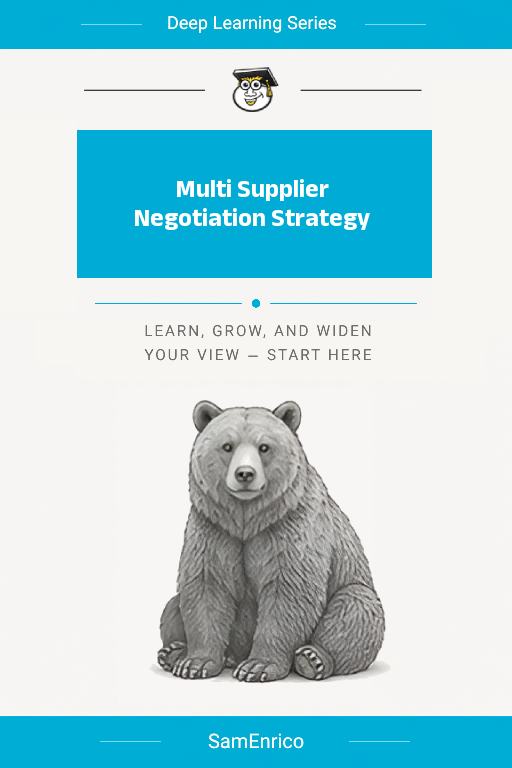
Multi Supplier Negotiation Strategy eBook
Leverage competing quotes from different Chinese s
Leverage competing quotes from different Chinese suppliers to drive down pricing and terms.
Formats
Free sample
Chapter 1: The Foreigner Tax--–- The first quote is never a price. It is a question. And the way you answer determines whether you pay 20% more or 40% less than the factory down the street.The email arrived at 11:47 on a Tuesday morning. The subject line read simply: "Quotation – Your Product." Inside, neatly formatted in a blue-bordered table, were the numbers I had been waiting three weeks to see. Unit price: 8.45.Moldfee:8.45.
Mold fee: 8.45.Moldfee:2,800. Lead time: 45 days. Payment terms: 50% deposit, balance before shipment. I read it twice, then a third time. Something felt wrong, though I could not say what.
The supplier had seemed professional during our video call. Their factory floor was clean. Their English was excellent. By every surface measure, this was a legitimate quote from a legitimate manufacturer.I was about to reply with "Thank you, please send the proforma invoice" when my phone buzzed. It was my friend Marco, who had been sourcing from China for twelve years.
He had built and sold two Amazon brands and now consulted for factories in Guangdong. I forwarded him the quote without comment. Three minutes later, he called me."Delete that email," he said. "Then call me back."I deleted it. I called back.Marco asked me one question: "What do you think that product actually costs to make?"I guessed.
I said maybe four dollars. Maybe five.Marco laughed. Not a cruel laugh, but the laugh of someone who has seen this exact scene play out a hundred times before. "That factory is paying about two dollars and twenty cents for the raw materials," he said. "They are paying another forty cents for labor.
Their overhead is maybe ten cents. They are offering you eight forty-five because you are a foreigner who does not know the domestic price on 1688 dot com. You are paying the Foreigner Tax. And you almost said yes."That night, I went down a rabbit hole. I created an account on 1688, the Chinese domestic B2B platform that most Western buyers have never heard of.
I used Google Translate to search for my product's Chinese name. Within twenty minutes, I found three factories selling almost identical products to local Chinese buyers for prices between 14 and 18 renminbi. That is between two dollars and two dollars and sixty cents US. My $8.45 quote suddenly looked like what it was: not a price, but a starting bid in a negotiation the supplier assumed I did not know how to play.This book exists because of that Tuesday afternoon. Over the following twelve months, I learned to do what Marco did instinctively.
I learned to force suppliers to compete against each other. I learned to use the 1688 backdoor as leverage. I learned to structure RFQs so that apples-to-apples comparison was not just possible but inevitable. And most importantly, I learned that the first quote from any Chinese supplier is not a reflection of reality. It is a psychological probe designed to discover how much you are willing to overpay.This chapter is about that first quote.
It is about why Chinese suppliers quote the way they do, what those numbers actually mean, and why the single most dangerous thing you can do in a negotiation is reveal your budget before you have seen their numbers. By the time you finish this chapter, you will never look at a supplier quotation the same way again.The Three Layers of Every Chinese Quote Every quote you receive from a Chinese supplier contains three distinct layers. Think of them as nested boxes. The outer box is what you see. The middle box is what the supplier expects you to negotiate down to.
The inner box is the actual cost plus a reasonable profit. Your job is to open all three boxes, and you can only do that by forcing competition.Layer One: Cost Plus Risk Premium At the very bottom of every quote is the supplier's actual cost of goods sold. This includes raw materials, direct labor, factory overhead, packaging, and a small profit margin that the supplier considers non-negotiable. In my 8.45quote,thatbottomnumberwasapproximately8.45 quote, that bottom number was approximately 8.45quote,thatbottomnumberwasapproximately2.70. That is what it actually cost the factory to produce one unit, box it, and make a modest 15% margin on their domestic business.But the supplier does not quote you 2.70.Theyaddariskpremium.Exportingcarriesrisksthatdomesticsalesdonot.Currencyfluctuation.Shippingdelays.Qualitydisputes.Paymentdefaults.Aprudentsupplieradds10–202.70.
They add a risk premium. Exporting carries risks that domestic sales do not. Currency fluctuation. Shipping delays. Quality disputes.
Payment defaults. A prudent supplier adds 10–20% to cover these risks. In my quote, that risk premium added roughly 2.70.Theyaddariskpremium.Exportingcarriesrisksthatdomesticsalesdonot.Currencyfluctuation.Shippingdelays.Qualitydisputes.Paymentdefaults.Aprudentsupplieradds10–200.80, bringing the theoretical floor to $3.50.Layer Two: The Negotiation Room Here is where the Foreigner Tax lives. Above the cost and risk premium, suppliers add a layer of pure negotiation margin. This is money they fully expect you to negotiate away, but they will not offer it unless you force them.
The size of this layer depends entirely on how sophisticated they believe you are.For a first-time buyer who asks no hard questions, the negotiation room can be 40% or more. For a buyer who mentions 1688, asks about material grades, and requests a detailed cost breakdown, the negotiation room shrinks to 10–15%. The supplier is not being dishonest. They are being strategic. In Chinese business culture, leaving negotiation room is not deception.
It is respect. It assumes you are a serious negotiator who expects to haggle. The problem is that many Western buyers do not haggle. They see a quote, compare it to another quote, and choose the lower one without ever touching the negotiation room.Layer Three: The Psychological Probe The outermost layer of the quote is the psychological probe. This is not a price at all.
It is a question disguised as a number. The question is: "How much do you know about what this should cost?"If you accept the first quote, the supplier learns that you know nothing. They will quote you high forever. If you counter with a reasonable number backed by market data, they learn that you have done your homework. They will adjust future quotes accordingly.
If you mention that you are collecting multiple bids, they learn that they have competition. The psychological probe is why the same supplier will quote 8.45toonebuyerand8.45 to one buyer and 8.45toonebuyerand3.80 to another buyer for the exact same product.Why Chinese Suppliers Quote Differently to Foreigners It is tempting to call the Foreigner Tax a scam. It is not. It is a rational response to a market reality. Chinese suppliers have learned through decades of experience that foreign buyers fall into three categories, and they price accordingly.Category One: The One-Time Buyer This is someone ordering samples or a small batch for a personal project.
They will never order again. The supplier knows this. They quote high because there is no relationship to maintain and no future volume to reward. If you are in this category, the Foreigner Tax can exceed 100%. The supplier is not trying to build a partnership.
They are trying to maximize profit on a single transaction.Category Two: The Uninformed Repeater This is a small business owner or Amazon seller who places regular orders…
This is the end of the free sample. Get the eBook to keep going. Buy now
About this book
Details
- Author
- Wakefield Magdalene
- Publisher
- SamEnrico
- Language
- English
- Genre
- Non-Fiction, Business Brief, Competition
- Released
- 2026-05-30
- Pages (approx.)
- 145
- Available as
- eBook, Audiobook

Read better in the ZLOADR app
Your eBooks on your phone or tablet. Sign in with your SamEnrico account and start reading.
More by Wakefield Magdalene
 The Artist Who Beautified BlightWakefield Magdalene$11.99
 Breath Awareness MeditationWakefield Magdalene$11.99
 Pelvic Floor for Spinal Cord InjuryWakefield Magdalene$11.99
 Rental Property Tax DeductionsWakefield Magdalene$11.99
 The Mother Mirra AlfassaWakefield Magdalene$11.99
 Pomodoro For Waiting RoomsWakefield Magdalene$11.99
 Breath Meditation For LonelinessWakefield Magdalene$11.99
 Childhood Enmeshment RecoveryWakefield Magdalene$11.99
 Silk Road Inferno: The Han Dynasty's War to Control the WestWakefield Magdalene$11.99
 The Golden Fleece: How Venetian Merchants Shaped the Modern EconomyWakefield Magdalene$11.99
 Mastering The Art of LaosWakefield Magdalene$11.99
 How to Produce Studio Stands and MountsWakefield Magdalene$11.99
You may also like
 Hong Kong Handover 1997Dunn Johnnie$11.99
 Zumba For Postnatal Recovery CourseNeal Christian$11.99
 Zumba for BeginnersLadner Nikia$11.99
 YouTube Comment Mining GuideHumes Pandora$12.99
 Worry Box MeditationCarlin Rudy$11.99
 Workplace Stress MeditationNguyen Lynn$11.99
 Workplace Stress and Sleep RepairHawley Ivory$11.99
 Workplace Perfectionism CureDelaney Jeffry$11.99
 Workplace Injustice Anger GuideWallen Isabelle$11.99
 Work Addiction and Burnout LinkGreenwood Ester$11.99
 Women in Yoga and WellnessBeattie Galina$11.99
 Women in Stand Up ComedyChun Evangeline$11.99