
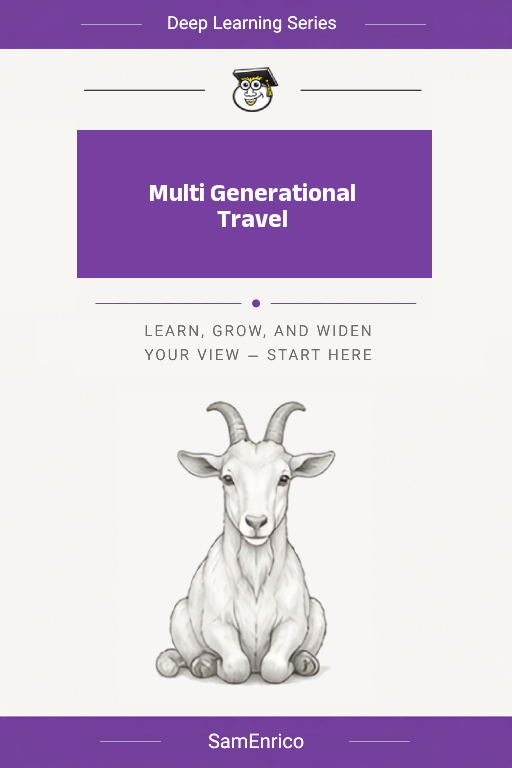
Non-FictionConsumer Mind ReportFamily Travel
Multi Generational Travel eBook
Track spending on family trips including grandpare
Track spending on family trips including grandparents, parents, and children traveling together.
Formats
Free sample
Chapter 1: The Portfolio Shift...--Most families plan a vacation like they plan a trip to the grocery store: they set a rough budget, hope nothing unexpected happens, and argue at the checkout counter about who forgot to add the wine to the total. Then they wonder why traveling together feels more like a root canal than a reunion.This chapter will reframe everything you think you know about paying for multi-generational travel. It will ask you to do something that feels unnatural at first: stop thinking of a family trip as an expense and start thinking of it as an investment. Not a financial investment in the traditional sense—you are not going to get a 10% return on your villa rental—but an investment in something far more valuable and far less talked about: shared memory density, cross-generational connection, and what this book calls your family's Experience Portfolio.If the phrase "experience portfolio" sounds like something a wealth manager would say before charging you a fee, stay with me. It is simpler than it sounds and more powerful than you think.
By the end of this chapter, you will have a completely new way of looking at your money, your time, and your family that will make every subsequent chapter in this book not just useful but urgent.The Vacation Accounting Trap Let us start with a confession. Every book on family travel tells you to "set a budget." That is fine advice as far as it goes, but it misses the deeper question: a budget for what? Most families approach trip planning with what this book calls the Deficit Mindset. They ask: How little can we spend? What can we cut?
Who is going to complain if we skip the nice restaurant? This mindset turns the entire planning process into an exercise in scarcity, and scarcity is the enemy of joy.The Deficit Mindset shows up in predictable ways. Someone suggests a beach house and immediately another voice says, "That's too expensive." Someone mentions flying direct instead of with a layover and someone else says, "We can save two hundred dollars if we connect through Atlanta at midnight." These are not unreasonable concerns. Money is real. Budgets matter.
But when every decision starts with what we cannot afford rather than what we value, the trip becomes a series of compromises rather than a collection of opportunities.This book is not going to tell you to ignore money. That would be irresponsible and unhelpful. But this chapter will ask you to flip the equation. Instead of starting with costs and working backward to experiences, start with experiences and work backward to costs. That shift—from deficit to portfolio—is the single most important mindset change in this entire book.What Is an Experience Portfolio?An Experience Portfolio is simply a way of categorizing how you spend your discretionary money based on what each dollar buys in terms of life satisfaction, memory creation, and relationship strengthening.
It borrows the language of finance because finance already solved this problem. When a financial advisor helps you build an investment portfolio, they do not ask, "How can you spend as little as possible?" They ask, "What are your goals, your timeline, and your risk tolerance?" Then they allocate your money across different asset classes—stocks, bonds, real estate, cash—each serving a different purpose in your overall financial health.The Experience Portfolio does the same thing, but with your time, attention, and disposable income. It divides your "experience spending" into four distinct categories, each with a different job to do in your life and your family's life. These categories are not theoretical. They are based on decades of research in behavioral economics, positive psychology, and family systems theory.
And they will change how you see every single travel decision you make from this moment forward.Let us meet the four categories.Category One: The Security Foundation The Security Foundation is exactly what it sounds like. It is the money you spend on things that keep your life stable, safe, and functional. This includes your rent or mortgage, utilities, insurance, basic groceries, healthcare, debt payments, and emergency savings. It also includes the baseline version of transportation, clothing, and household goods. The Security Foundation is not glamorous.
No one posts a photo of their electric bill on Instagram. But without it, nothing else works.When it comes to travel, the Security Foundation shows up as the non-negotiable baseline. If you cannot pay your rent without going into debt, you are not ready for a multi-generational trip. That sounds harsh, but it is also true. The Security Foundation is the soil in which every other experience grows.
If the soil is poisoned by financial stress, the flowers will not bloom.Most families already understand this intuitively. They would not skip a mortgage payment to go to Disney World. But what they often fail to recognize is how much of their travel stress comes not from the trip itself but from an underfunded Security Foundation. If you are constantly worried about an overdue bill or a looming expense, you will bring that anxiety on vacation with you. It will sit at the dinner table.
It will ride in the rental car. It will whisper in your ear every time someone suggests an upgraded experience.The first step in building your Experience Portfolio is therefore an honest audit of your Security Foundation. Not a judgment. Just a fact-finding mission. Are your basics covered?
Do you have an emergency fund that could handle a surprise car repair or medical bill? If the answer is no, this book can wait. Go handle that first. The trips will still be here when you return.Category Two: The Dream Allocation The Dream Allocation is the money you spend on your individual desires, hobbies, and personal joys. This is the category that most personal finance advice tells you to minimize or eliminate.
Cut the daily coffee. Cancel the streaming services. Brown-bag your lunch. And there is wisdom in that for people digging out of debt or living paycheck to paycheck. But for families with stable foundations, the Dream Allocation is not a vice.
It is a necessity.Why? Because you cannot pour from an empty cup. A parent who never spends money on their own joy becomes resentful. A grandparent who never indulges a personal hobby becomes brittle. A child who never gets to choose an experience for themselves becomes passive.
The Dream Allocation is the oxygen mask principle applied to money: secure your own mask before helping others.In practice, the Dream Allocation looks like the money you spend on your golf membership, your book club dinners, your weekend fishing trips, your spa days, your concert tickets, or your solo weekend away. It is the spending that says, "I am a person with my own preferences, not just a parent or a grandparent or a child."When it comes to multi-generational travel, the Dream Allocation is surprisingly important because it sets the boundary between group expenses and personal expenses. If you have a healthy Dream Allocation in your regular life, you will be much better at distinguishing between "this is a group expense we should…
This is the end of the free sample. Get the eBook to keep going. Buy now
About this book
Details
- Author
- Tracy Charlena
- Publisher
- SamEnrico
- Language
- English
- Genre
- Non-Fiction, Consumer Mind Report, Family Travel
- Released
- 2026-05-29
- Pages (approx.)
- 137
- Available as
- eBook, Audiobook

Read better in the ZLOADR app
Your eBooks on your phone or tablet. Sign in with your SamEnrico account and start reading.
More by Tracy Charlena
 Yahoo Dark Web Data SaleTracy Charlena$11.99
 The Moonlit Night VisualizationTracy Charlena$11.99
 Menopause Endometriosis GuideTracy Charlena$11.99
 Carlos Moya Spanish PioneerTracy Charlena$11.99
 Sugar Relapse PreventionTracy Charlena$11.99
 The Glass Universe: Henrietta Swan Leavitt and the Cosmic RulerTracy Charlena$11.99
 The Last Song of the Dodo: A Forgotten ExtinctionTracy Charlena$11.99
 Education ConsultantTracy Charlena$11.99
 Qualitative Skills Portfolio GuideTracy Charlena$12.99
 How to Start a Cattle Farming Business (Beginners Guide)Tracy Charlena$11.99
 Understanding Gender Identity DisorderTracy Charlena$17.99
You may also like
 Hong Kong Handover 1997Dunn Johnnie$11.99
 Zumba For Postnatal Recovery CourseNeal Christian$11.99
 Zumba for BeginnersLadner Nikia$11.99
 YouTube Comment Mining GuideHumes Pandora$12.99
 Worry Box MeditationCarlin Rudy$11.99
 Workplace Stress MeditationNguyen Lynn$11.99
 Workplace Stress and Sleep RepairHawley Ivory$11.99
 Workplace Perfectionism CureDelaney Jeffry$11.99
 Workplace Injustice Anger GuideWallen Isabelle$11.99
 Work Addiction and Burnout LinkGreenwood Ester$11.99
 Women in Yoga and WellnessBeattie Galina$11.99
 Women in Stand Up ComedyChun Evangeline$11.99