
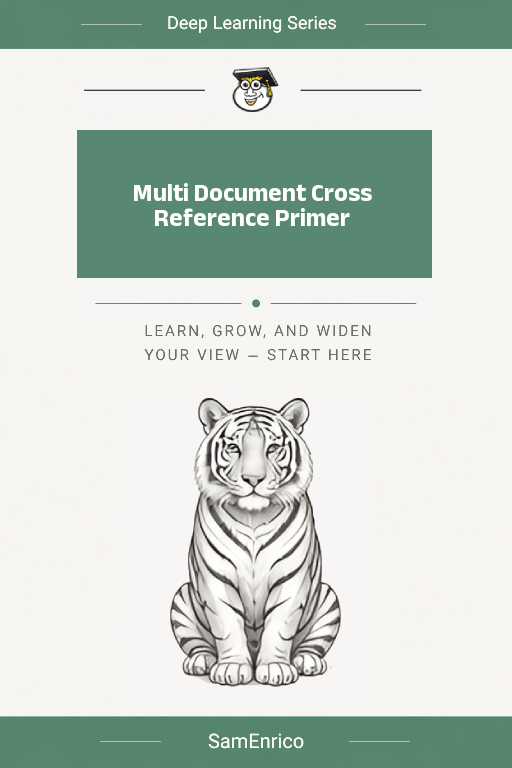
Non-FictionAI OperatorIntelligence GatheringCross Reference Guide
Multi Document Cross Reference Primer eBook
Compare and contrast findings across multiple rese
Compare and contrast findings across multiple research papers, reports, or news articles using AI. Includes agreement detection, outlier identification, and synthesis prompts.
Formats
Free sample
Chapter 1: The Paradox of Plenty--–- Sarah had spent forty-seven hours reading twenty-three reports on the future of electric vehicle batteries. She had highlighted six hundred passages, bookmarked eighty-three pages, and filled twelve pages of handwritten notes. Her executive summary was due in three hours, and she had never been less confident in her life. The first report, from a Mc Kinsey consulting team, projected that solid-state batteries would achieve commercial viability by 2027. The second, a peer-reviewed paper in Nature Energy, said 2030 at the earliest.
The third, an investor presentation from a Tesla competitor, claimed they had already solved the problem. The fourth, a leaked internal memo from a major automaker, admitted they were years behind. The fifth, a news article in Reuters, quoted three experts who gave three different answers. Sarah closed her laptop, put her head in her hands, and whispered something that thousands of analysts, researchers, executives, and students say every single day: "The more I read, the less I know."This is not a failure of intelligence. It is not a failure of effort.
It is not even a failure of technology—at least not in the way most people think. Sarah had access to the best search engines, the most sophisticated databases, and a high-end laptop. She read carefully, took meticulous notes, and tried to hold competing claims in her head simultaneously. She did everything right. And that was precisely the problem.The paradox of modern research is brutal and inescapable: a single document brings clarity, but multiple documents create confusion.
One source gives you an answer. Two sources give you a choice. Three sources give you a headache. Ten sources give you paralysis. This is not a bug in your brain; it is a feature of how information works.
Every document is a lens, and every lens distorts as much as it reveals. When you look through one lens, you see a single image. When you look through twenty lenses at once, you see nothing but a blur of competing colors, shapes, and distortions. The goal of this book is to teach you how to stop looking through twenty lenses and start building a single, coherent picture from all of them.The Cognitive Limits You Never Signed Up For Before we talk about solutions, we need to talk honestly about limits. Your brain is extraordinary.
It can recognize faces in a millisecond, navigate complex social situations, learn languages, compose music, and solve differential equations. But your brain is also, in one very specific way, a profoundly limited machine: it has a terrible working memory for comparison.Psychologists have known this for decades. The famous "magical number seven, plus or minus two" refers to the number of unrelated items you can hold in working memory simultaneously. But comparison is not about holding unrelated items; it is about holding relationships between items. And relationships multiply fast.
If you have three documents, there are three possible pairs to compare. If you have five documents, there are ten pairs. If you have ten documents, there are forty-five pairs. If you have twenty documents, there are one hundred and ninety pairs. Your brain cannot track one hundred and ninety relationships simultaneously.
It was never designed to.This is why Sarah felt less confident after forty-seven hours than she did after forty-seven minutes. At the beginning, she had a few simple, contradictory claims. She could hold them. By the end, she had hundreds of claims, dozens of contradictions, and no mental model capable of integrating them. She was not suffering from information overload.
She was suffering from relationship overload. The problem was not the number of words she had read. The problem was the number of connections she was trying to maintain.Here is the distinction that will save your career, your sanity, and this entire book: aggregation is not synthesis.Aggregation vs. Synthesis: The Distinction That Changes Everything Most people, most of the time, are aggregating when they think they are synthesizing. Aggregation is counting.
Aggregation is listing. Aggregation is saying, "Five papers support X, three papers support Y, and two papers are neutral." Aggregation is useful. Aggregation is necessary. But aggregation is not insight. Aggregation is just taking attendance.Synthesis is different.
Synthesis is creating something new that did not exist before. Synthesis is weaving separate threads into a fabric that no single thread contains. Synthesis is not saying, "Five papers support X and three support Y." Synthesis is saying, "The five papers that support X all come from academic labs using animal models, while the three that support Y come from human clinical trials. Therefore, the apparent contradiction is actually a signal about species differences." That conclusion exists nowhere in any of the eight papers. It emerges only from their comparison.
That is synthesis.Let me give you a concrete example. Imagine you have read ten restaurant reviews for a new place in your neighborhood. Aggregation would produce: "Seven reviews praise the pasta, two say it is average, and one hates it. Five mention slow service. Four rave about the atmosphere." This is useful information.
But synthesis would produce: "The reviewers who love the pasta all dined on weeknights and ordered the seasonal specials. The reviewers who complain about service all dined on Saturday nights. The restaurant is probably great on weekdays and overwhelmed on weekends." That insight changes your behavior. And it exists in no single review.This book is about teaching you to do the second thing—synthesis—at scale, across dozens or hundreds of documents, using artificial intelligence as your collaborative partner. But we cannot skip the first thing.
Aggregation is the raw material of synthesis. You cannot weave threads you have not counted. So we will do both. But we will never confuse them.Why Large Language Models Change the Game You have probably heard of Chat GPT, Claude, Gemini, or any of the other large language models that have captured the world's attention. You may have used them to draft emails, summarize articles, or brainstorm ideas.
You may have been impressed. You may have been underwhelmed. Either way, you have not yet seen what they can do for multi-document cross-referencing, because most people use them wrong.The typical user feeds an LLM one document at a time and asks for a summary. This is like buying a Ferrari and driving it to the mailbox. It works, but you are missing the point.
The power of LLMs for cross-referencing lies not in their ability to read a single document—humans can do that fine—but in their ability to hold multiple documents in "memory" simultaneously and compare them across dozens of dimensions at once.Traditional keyword search, which has dominated information retrieval for decades, works by matching strings of characters. You type "solid-state battery," and the search engine finds every document containing those words in that order. This is fast and reliable, but it is brittle. Documents that use synonyms ("solid electrolyte," "ceramic separator," "lithium metal anode") might be invisible to you even though they are directly relevant. Documents that use the exact words but mean something completely different (a patent about solid-state batteries for pacemakers vs.
for cars) will clutter your results.Semantic understanding changes this. When you ask an LLM to compare documents, it does not…
This is the end of the free sample. Get the eBook to keep going. Buy now
About this book
Details
- Author
- Mcmillian Carmelina
- Publisher
- SamEnrico
- Language
- English
- Genre
- Non-Fiction, AI Operator, Intelligence Gathering, Cross Reference Guide
- Released
- 2026-05-30
- Pages (approx.)
- 156
- Available as
- eBook, Audiobook

Read better in the ZLOADR app
Your eBooks on your phone or tablet. Sign in with your SamEnrico account and start reading.
More by Mcmillian Carmelina
 Grieving Leave Return GuideMcmillian Carmelina$11.99
 Disappointment in Parenting GuideMcmillian Carmelina$11.99
 The Brain Fog Elimination DietMcmillian Carmelina$11.99
 The Gambling Addiction Medication GuideMcmillian Carmelina$11.99
 Childhood Shame Resilience GuideMcmillian Carmelina$11.99
 Phantom Strike: The 1972 Sabena Hijacking RescueMcmillian Carmelina$11.99
 Building Automation System ProgrammingMcmillian Carmelina$11.99
 Warehouse Automation Growth GuideMcmillian Carmelina$12.99
 Understanding Larsen Syndrome, Dominant TypeMcmillian Carmelina$17.99
 A Beginners Guide to Dirt jumping (Volume 1)Mcmillian Carmelina$11.99
You may also like
 Hong Kong Handover 1997Dunn Johnnie$11.99
 Zumba For Postnatal Recovery CourseNeal Christian$11.99
 Zumba for BeginnersLadner Nikia$11.99
 YouTube Comment Mining GuideHumes Pandora$12.99
 Worry Box MeditationCarlin Rudy$11.99
 Workplace Stress MeditationNguyen Lynn$11.99
 Workplace Stress and Sleep RepairHawley Ivory$11.99
 Workplace Perfectionism CureDelaney Jeffry$11.99
 Workplace Injustice Anger GuideWallen Isabelle$11.99
 Work Addiction and Burnout LinkGreenwood Ester$11.99
 Women in Yoga and WellnessBeattie Galina$11.99
 Women in Stand Up ComedyChun Evangeline$11.99