
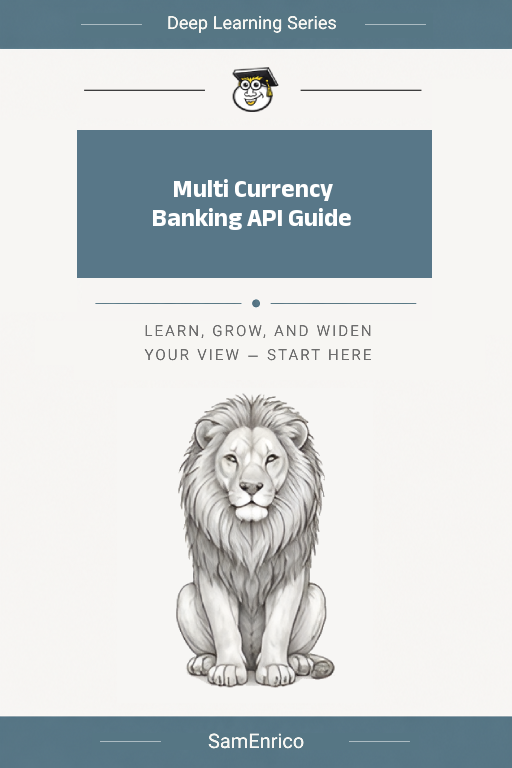
Multi Currency Banking API Guide eBook
Access foreign exchange rates and multi-currency a
Access foreign exchange rates and multi-currency account data through open banking APIs.
Formats
Free sample
Chapter 1: The $47 Trillion Wound--–- The first time I lost money on a currency transfer, I didn’t even know it happened.I was twenty-four years old, freelancing as a software consultant for a retail analytics company in London while living in New York. My client paid me £8,000 for a three‑week engagement. I checked my bank account a few days later and saw 9,968.32.Ididthemathinmyhead:£8,000attherate Ihadgoogledthatmorning—1.31dollarstothepound—shouldhavebeen9,968.32. I did the math in my head: £8,000 at the rate I had googled that morning—1.31 dollars to the pound—should have been 9,968.32.Ididthemathinmyhead:£8,000attherate Ihadgoogledthatmorning—1.31dollarstothepound—shouldhavebeen10,480. I was short more than five hundred dollars.I called my bank.
After twenty‑three minutes on hold, a representative explained, with the cheerful tone of someone who had delivered this news a thousand times, that the “interbank rate” was only for banks trading with each other. My rate included a “currency conversion fee” of 2.9 percent, plus a “wire transfer handling charge” of $15, plus a “correspondent bank fee” that could not be determined in advance because it depended on how many intermediary banks the payment touched. She could not tell me exactly how much I had lost. She could only tell me that it was correct.That was my introduction to the hidden economy of cross‑border finance. In that single transaction, I paid roughly 5 percent of the value of my work to a system that offered me no transparency, no choice, and no recourse.
I did not know the rate before I agreed to the transfer. I did not know the fees. I did not know that there was any alternative.I spent the next decade learning that my story was not an anomaly. It was the rule.The Scale of the Problem Every day, more than 7.5trillionmovesacrossborders.Thatnumber—7.5 trillion moves across borders. That number—7.5trillionmovesacrossborders.Thatnumber—7,500,000,000,000—is so large that it resists intuition.
It is roughly the combined annual GDP of Germany, Japan, and the United Kingdom. It is the value of every good and service produced on planet Earth in approximately nine days. And it is moving through a financial infrastructure that was designed in the 1970s, patched repeatedly, and never rebuilt for the internet age.SWIFT, the messaging network that underpins most international payments, was founded in 1973. It does not move money. It sends messages about money.
The actual settlement of funds happens through a web of correspondent banking relationships that can involve three, four, or five different banks on each side of a transaction. Each of those banks takes a fee. Each of those banks applies its own exchange rate markup. Each of those banks holds the funds for anywhere from a few hours to several days, earning interest on your money while you wait.The result is a system that is slow, expensive, and opaque. The World Bank estimates that the average cost of sending 200acrossbordersis6.2percent.Forsmalleramounts,thepercentageishigher.Forremittancessentbymigrantworkerstotheirfamilies—a200 across borders is 6.2 percent.
For smaller amounts, the percentage is higher. For remittances sent by migrant workers to their families—a 200acrossbordersis6.2percent.Forsmalleramounts,thepercentageishigher.Forremittancessentbymigrantworkerstotheirfamilies—a600 billion annual flow that sustains entire economies—the cost can exceed 10 percent. Ten cents of every dollar, extracted by a system that offers no alternative.But this book is not about remittances. It is about something larger, faster, and more transformative: the programmatic movement of multi‑currency funds through open banking APIs.The Three Waves of Change That Made This Book Necessary Three massive, simultaneous shifts have created the demand for multi‑currency banking APIs. If you understand these three waves, you will understand why this book exists and why the skills you are about to learn are among the most valuable in modern software development.Wave One: The Globalization of Work In 2010, a typical software company hired employees in one country, contractors in perhaps two others, and sold primarily to domestic customers.
By 2025, that same company hires full‑time employees in five countries, contractors in ten more, and sells to customers in thirty. The rise of remote work, enabled by tools like Slack, Zoom, and Git Hub, has decoupled labor from geography.Consider a typical mid‑sized Saa S company in 2025. It employs software engineers in Poland (paid in PLN), customer support in the Philippines (paid in PHP), sales representatives in the United States (paid in USD), and a product manager in Germany (paid in EUR). It sells subscriptions in USD, EUR, GBP, and JPY. It pays cloud hosting bills in USD, marketing vendors in GBP, and legal fees in EUR.
Its treasury department—if it has one—spends hours each week manually calculating exposure, initiating transfers, and reconciling ledgers.This company is not a bank. It does not want to be a bank. But it needs banking capabilities that, until recently, were available only to multinational corporations with dedicated treasury teams and seven‑figure banking relationships.Wave Two: The Platform Economy The second wave is even larger. E‑commerce platforms like Shopify and Amazon, freelance marketplaces like Upwork and Fiverr, and gig economy apps like Uber and Door Dash all share a fundamental need: they must hold money in multiple currencies on behalf of millions of users, and they must move that money efficiently across borders.Shopify alone processes tens of billions of dollars annually for merchants in more than 175 countries. A merchant in Australia selling to customers in Canada needs to receive CAD, convert to AUD, and pay suppliers in CNY.
Shopify does not open a physical bank account for each merchant. Instead, it uses virtual accounts and multi‑currency ledgers—concepts we will explore in depth in Chapter 10.These platforms have discovered a painful truth: their growth is constrained by their ability to move money. Every new country they enter requires new banking relationships, new compliance regimes, and new API integrations. The platform that solves multi‑currency movement fastest wins the market.Wave Three: The API‐ification of Banking The third wave is the most important because it is the enabler of the first two. Open banking regulations—starting with PSD2 in Europe in 2018, followed by the UK Open Banking standard, and now spreading to Hong Kong, Singapore, Brazil, Canada, and the United States—have forced traditional banks to expose APIs.Before open banking, your money was locked inside your bank’s proprietary system.
You could log into their website or use their mobile app, but you could not build your own tools on top of your own data. If you wanted to automatically sweep excess funds from a USD account to a EUR account when the exchange rate crossed a threshold, you had no programmatic way to do it.Now, you do. Banks must provide standardised APIs for account information (AISP) and payment initiation (PISP). Third‑party providers like Plaid, Yapily, Salt Edge, and Tink aggregate these bank APIs into a single interface, handling the complexity of regional differences, authentication flows, and data normalisation.The result is that a single developer sitting in a coffee shop can now build what once required a team of bankers, lawyers, and compliance officers. That is not hyperbole.
It is the reality of modern multi‑currency API development, and it is exactly what this book will teach you to do.What…
This is the end of the free sample. Get the eBook to keep going. Buy now
About this book
Details
- Author
- Marshall Wilbur
- Publisher
- SamEnrico
- Language
- English
- Genre
- Non-Fiction, Business Brief, Multi Currency
- Released
- 2026-05-30
- Pages (approx.)
- 149
- Available as
- eBook, Audiobook

Read better in the ZLOADR app
Your eBooks on your phone or tablet. Sign in with your SamEnrico account and start reading.
More by Marshall Wilbur
 Sitting Posture for MeditationMarshall Wilbur$11.99
 ABC Prioritization for Military PersonnelMarshall Wilbur$11.99
 The Priority and Hofstadter LawMarshall Wilbur$11.99
 Alcohol Recovery Phone Apps GuideMarshall Wilbur$11.99Alcohol Recovery Phone Apps GuideMarshall Wilbur$11.99
 LinkedIn Success ComparisonMarshall Wilbur$11.99
 James Van Praagh GuideMarshall Wilbur$11.99
 Pomodoro For Anxiety ManagementMarshall Wilbur$11.99
 Mentally Ill Parent RecoveryMarshall Wilbur$11.99
 Yuki-Onna's Lament: The Snow Woman's Unspoken LoveMarshall Wilbur$11.99
 Loke's Lament: The Hidden Ballads of the Norse TricksterMarshall Wilbur$11.99
 Mastering The Art of Longquan (龙拳) Dragon FistMarshall Wilbur$11.99
You may also like
 Multi Currency Pricing for Exporters WorkbookSteiner Lashawnda$12.99
 Multi Currency Account GuideBrenner Caryn$12.99
 AI Multi Currency Accounting GuideKeeton Cliff$12.99
 Multi Currency Banking API WorkbookLooney Lindsey$12.99
 Flutterwave Cross Border GuideLyles Temple$12.99
 AI Multi Currency Accounting ToolsHoy Noella$12.99
 Multi Currency Bank AccountBarron Maximina$12.99
 AI Accounting For Multiple CurrenciesNowlin Adelia$12.99
 Multi Currency Accounting PrimerWay Brigette$12.99