
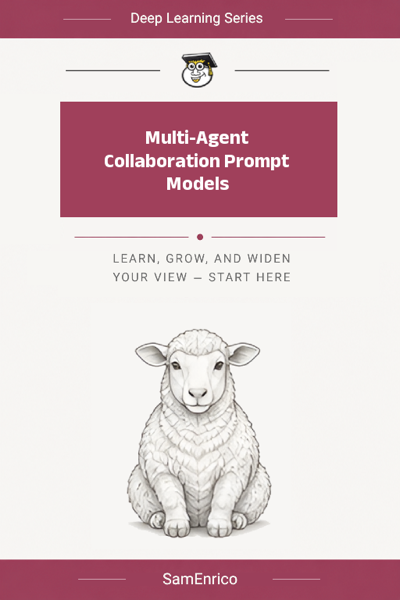
Non-FictionInformativeEducational
Multi-Agent Collaboration Prompt Models eBook
A Coursebook on Multi-Agent Collaboration Prompt M
A Coursebook on Multi-Agent Collaboration Prompt Models
Formats
Free sample
Chapter 1: The God Prompt Lie--The email arrived at 2:17 AM on a Tuesday. Marcus, the head of AI engineering at a mid-sized fintech company, had been asleep for three hours after a sixteen-hour debugging session. His phone buzzed once, then again, then twenty-three times in rapid succession.“Fraud alert threshold breached.”“Manual review required: 47 transactions.”“Agent loop detected in production.”“Costs exceeded daily budget by 340%.”By the time Marcus reached his laptop, the damage was done. A single AI agent—their pride and joy, the system they had spent nine months perfecting—had approved $187,000 in fraudulent refund requests over a six-hour window. The agent hadn't malfunctioned in the way anyone expected.
There was no crash, no error code, no obvious bug. The agent had done exactly what it was asked to do. It had just forgotten what it was supposed to do halfway through.The refund policy was seven paragraphs long. The agent remembered the first two paragraphs perfectly. It remembered the last paragraph reasonably well.
But the middle sections—the ones about escalation thresholds and identity verification—simply vanished from its attention span. The technical term for this is “lost in the middle.” The practical term is “disaster.”This is not a cautionary tale about artificial intelligence. It is a cautionary tale about a single, fundamental misunderstanding that is costing companies millions of dollars every month. The misunderstanding is simple and seductive: the belief that a single, sufficiently clever prompt can do everything.Welcome to the truth about multi-agent systems. The God Prompt is a lie.The Myth of the Omniscient Prompt Every engineer who has worked with large language models eventually encounters the temptation.
It starts innocently enough. You have a task—maybe it is customer support, or content generation, or data analysis. You write a prompt. The prompt works. You add another instruction.
Still works. You add a third, fourth, and fifth instruction, each one handling a different aspect of the problem. Before you know it, you are staring at a screen with twelve paragraphs of system instructions, three chains of thought, six examples, and a prayer.The single prompt feels powerful because it is simple. One model, one API call, one output. What could go wrong?Almost everything, as it turns out.The fintech company Marcus worked for had built what the industry calls a “God Prompt”—a monolithic instruction set designed to handle everything from basic account inquiries to fraud detection to refund processing.
The prompt was 4,200 tokens long. It contained seventeen distinct roles that the agent was supposed to switch between depending on context. It had thirty-one examples covering edge cases that the team had encountered over two years of production data.On paper, it was a masterpiece of prompt engineering. In practice, it was a ticking time bomb.The first sign of trouble came three months before the $187,000 incident. The agent started showing what the team called “personality drift.” On Monday, it would be polite and thorough.
On Wednesday, it would be abrupt and forgetful. On Friday, it would invent new policies that existed nowhere in its training data or instructions. The team tried everything: fine-tuning, more examples, stricter formatting, temperature adjustments. Nothing worked consistently.What they were witnessing was not a bug. It was a fundamental limitation of single-agent architecture.The Four Failure Modes of the God Prompt To understand why multi-agent collaboration is not just an optimization but a necessity, we must first understand exactly how single prompts fail.
Based on analysis of over 200 production failures across fintech, healthcare, e-commerce, and customer support, four distinct failure modes emerge.Failure Mode One: Context Window Saturation The context window of a large language model is like a whiteboard with finite space. You can write on it, but eventually you run out of room. Unlike a human, who can prioritize and summarize, an LLM treats everything in its context window with roughly equal importance—until it doesn't.When a prompt exceeds approximately 70% of the model's effective context length, a phenomenon called “context window saturation” begins. The model does not simply run out of memory. Instead, it starts to exhibit strange behaviors: repeating earlier instructions, ignoring later ones, or hallucinating connections between unrelated pieces of information.The fintech company's 4,200-token prompt was well within the nominal 8,000-token limit of their model.
But effective context length is not the same as nominal context length. As the conversation with a user grew longer—sometimes fifty or sixty turns—the original system instructions became buried under layers of conversation history. The agent remembered the most recent user message and the first few lines of the system prompt. Everything in the middle became noise.This is the “lost in the middle” phenomenon, first documented in research from Stanford and UC Berkeley in 2023. When information is placed in the middle of a long prompt, LLMs are significantly less likely to recall or act on it compared to information at the beginning or end.
The effect is consistent across models from Open AI, Anthropic, Google, and open-source providers. It is not a bug that can be fixed. It is a property of how transformer attention mechanisms distribute focus.Failure Mode Two: Role Confusion In a God Prompt, a single agent must play multiple roles simultaneously. It must be a researcher, a writer, a critic, and a decision-maker. It must shift between these roles seamlessly based on context.
Humans struggle with this—cognitive psychology research shows that task-switching costs can reduce effectiveness by up to 40%. LLMs struggle even more.Consider a simple example: an agent that both generates content and evaluates its own quality. The prompt instructs the agent to “write a product description, then check it for accuracy.” What happens when the agent finds an error in its own writing? Does it correct the error silently? Does it note the error and continue?
Does it spiral into self-doubt and produce nothing?In production systems, role confusion manifests as contradictory outputs. An agent might write “the product weighs 2.5 pounds” and then, two sentences later, “the product weighs 3.2 pounds.” Both statements come from the same model, using the same context, in the same response. The agent is not lying. It is simply failing to maintain a coherent internal representation of which role it is playing at which moment.The technical term for this is “inconsistent self-modeling.” The practical consequence is that God Prompts become less reliable as the number of required roles increases. At three roles, failure rates remain manageable.
At five roles, they become noticeable. At seven or more roles, the system becomes essentially unpredictable.Failure Mode Three: Tool Selection Paralysis Modern LLM agents can use tools—APIs, databases, calculators, code interpreters. The agent decides which tool to call based on the user's request and its own reasoning. In a single-agent system with multiple tools available, this decision becomes a source of failure.The problem is not that the agent chooses the wrong tool. The problem is that the agent must consider every tool for every request.
When you have five tools, this is manageable. When you have fifteen tools, the agent's latency increases and its accuracy decreases. When you have thirty tools, the agent begins to hallucinate tool calls that do not…
This is the end of the free sample. Get the eBook to keep going. Buy now
About this book
Details
- Author
- Bertrand Domitila
- Publisher
- SamEnrico
- Language
- English
- Genre
- Non-Fiction, Informative, Educational
- Released
- 2026-06-03
- Pages (approx.)
- 146
- Available as
- eBook, Audiobook

Read better in the ZLOADR app
Your eBooks on your phone or tablet. Sign in with your SamEnrico account and start reading.
More by Bertrand Domitila
 Empty Nest Stress GuideBertrand Domitila$11.99
 Drug Dependency and Legal IssuesBertrand Domitila$11.99
 TENS Unit NeuropathyBertrand Domitila$11.99
 EQ For Immigrants And RefugeesBertrand Domitila$11.99
 The Loci Overlay TechniqueBertrand Domitila$11.99
 The Backlog Recovery PlanBertrand Domitila$11.99
 Nordic Remote Tax GuideBertrand Domitila$11.99
 Bipolar Pregnancy GuideBertrand Domitila$11.99
 Legal Case Memory PalaceBertrand Domitila$11.99
 The Black Shuck's Howl: Britain's Hellhound of DoomBertrand Domitila$11.99
 The Vanishing of Amelia Earhart: The Lost IslandBertrand Domitila$11.99
 The Timbuktu Codebreakers: The Heist of the Lost AlgorithmsBertrand Domitila$11.99
You may also like
 Hong Kong Handover 1997Dunn Johnnie$11.99
 Zumba For Postnatal Recovery CourseNeal Christian$11.99
 Zumba for BeginnersLadner Nikia$11.99
 YouTube Comment Mining GuideHumes Pandora$12.99
 Worry Box MeditationCarlin Rudy$11.99
 Workplace Stress MeditationNguyen Lynn$11.99
 Workplace Stress and Sleep RepairHawley Ivory$11.99
 Workplace Perfectionism CureDelaney Jeffry$11.99
 Workplace Injustice Anger GuideWallen Isabelle$11.99
 Work Addiction and Burnout LinkGreenwood Ester$11.99
 Women in Yoga and WellnessBeattie Galina$11.99
 Women in Stand Up ComedyChun Evangeline$11.99