
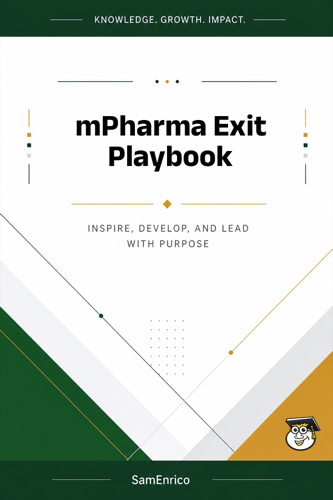
Non-FictionBusiness BriefPharma Tech
mPharma Exit Playbook eBook
Analyze the Ghanaian pharmacy supply chain's path
Analyze the Ghanaian pharmacy supply chain's path to pan African scale.
Formats
Free sample
Chapter 1: The 3:47 AM Epiphany--The call that changed African healthcare came at 3:47 on a Tuesday morning, and Gregory Rockson answered it knowing exactly what he would hear."Your father's sugar is four hundred," his mother said. "The pharmacy down the street is closed. I've called three others. Nobody has insulin."Rockson was twenty-four years old, living in a cramped apartment above his mother's garage in Accra, surviving on instant noodles and the kind of desperate optimism that only a Stanford-educated, Mc Kinsey-trained, Goldman Sachs-interrupted founder could maintain. His startup had burned through most of his savings.
His credit card was maxed. His father was a diabetic. And at 3:47 AM, in a city of four million people, there was no insulin to be found.He drove to seven pharmacies that morning. Seven. The first was locked, the steel shutters pulled down like a mouth clamped shut.
The second had insulin, but the expiration date had passed six months earlier—the pharmacist shrugged and said, "It's probably still good." The third had insulin in packaging that looked wrong, the font slightly off, the hologram missing from the corner. In a market where counterfeit drugs account for one in ten medical products, Rockson couldn't take that chance. The fourth, fifth, sixth, and seventh pharmacies simply had nothing to sell.By 5:30 AM, he was sitting in his car, forehead pressed against the steering wheel, crying. His father was a former diplomat, a man who had negotiated with governments and corporations, a man who had taught his son that problems had solutions if you looked hard enough. And here was a problem with no solution: a man who needed insulin to live, in a city with pharmacies on every corner, and not a single vial of medicine that anyone could trust.His father didn't die that morning.
A private hospital on the outskirts of Accra had a single vial in a locked cabinet, reserved for emergencies. But that morning changed Rockson's life. Because he realized something that would become the founding insight of m Pharma: the problem wasn't that Ghana lacked insulin. The problem was that Ghana's pharmaceutical supply chain was designed by people who had never held a dying man's hand at dawn.The Paradox They Call Normal Here is the strange thing about broken systems: the people inside them stop seeing the breakage.Ask any pharmacist in Accra, Lagos, or Nairobi about stock-outs, and they will give you a look that says, "What else is new?" Ask them about expired medicine, and they will show you the shelf in the back where the dead inventory lives. Ask them about counterfeit drugs, and they will lower their voice and tell you which distributor to avoid.
They know the system is broken. They have always known. But knowing and fixing are different things.The African pharmaceutical supply chain suffers from what economists call a coordination failure. Not a lack of medicine—the drugs exist, manufacturers are willing to sell them, and patients are desperate to buy them. Not a lack of infrastructure—warehouses exist, trucks exist, pharmacies exist.
Not even a lack of capital—there is money in the system, flowing in from patients, governments, and donors. The problem is that these pieces are not talking to each other.Small pharmacies order in tiny quantities because they cannot afford more. Distributors order in huge quantities because manufacturers demand minimums. Manufacturers ship to a black box, with no visibility into whether their products actually reach patients. The result is the bullwhip effect, named for the way a small flick of the wrist creates a massive crack at the end of a whip.
A single diabetic patient's monthly need for insulin ripples up the supply chain, amplified by every intermediary, until it becomes a warehouse full of expired medicine and a family sitting in a dark car at 5:30 AM.The numbers are staggering. Fragmented distribution networks inflate drug prices by thirty to sixty percent across the continent. One in ten medical products in low- and middle-income countries is substandard or falsified, according to the World Health Organization. Families managing chronic conditions spend half or more of their disposable income on out-of-pocket healthcare costs, often choosing between buying medicine and buying food.And here is the thing that keeps Gregory Rockson up at night, even now, even after raising millions of dollars and building a company that serves four hundred thousand patients: this system is not an accident. It is the inevitable result of decades of underinvestment, yes.
But it is also the result of a deeper failure: the failure to see fragmentation as a problem that can be solved.Most people look at a thousand independent pharmacies and see chaos. Rockson looked at those same pharmacies and saw the greatest consolidation opportunity of his generation.The Fragmentation Opportunity Every great business is built on a paradox. The paradox that launched m Pharma is this: fragmentation creates value destruction, but consolidation creates value capture.Think about the most valuable companies in history. Standard Oil consolidated the fragmented oil industry. Walmart consolidated the fragmented retail industry.
Amazon consolidated the fragmented e-commerce industry. Uber consolidated the fragmented taxi industry. In every case, the insight was the same: a market with many small, inefficient participants is a market waiting for a platform that can coordinate them.The Ghanaian pharmaceutical market, when m Pharma launched in 2013, was a textbook case of fragmentation. Thousands of independent pharmacies operated in isolation. Each negotiated its own prices with distributors.
Each managed its own inventory with paper records and intuition. Each bore the full risk of expiry and stock-outs alone. There was no data sharing, no collective bargaining, no coordination whatsoever.This fragmentation was not a bug. It was a feature of the regulatory environment. Pharmacies were licensed individually.
Distributors operated regionally. Manufacturers shipped to Africa as an afterthought, allocating inventory based on historical orders rather than real demand. The system was not designed poorly. It was not designed at all.Rockson saw what others missed: fragmentation is the mother of platform businesses. Because when a market is fragmented, the participants are desperate for coordination.
They are losing money to inefficiency. They are watching inventory expire. They are turning away patients who need medicine. They know the system is broken, and they will embrace anyone who can fix it.The question was not whether consolidation would happen. The question was who would do the consolidating, and how.The Three Founders Who Saw It Differently Gregory Rockson did not build m Pharma alone.
He was joined by Dan Shoukimas and James Finucane, two Stanford classmates who brought complementary skills to the founding team.Rockson was the visionary, the one who had lived the 3:47 AM phone call and could not forget it. He had studied management science and engineering at Stanford, consulted for Mc Kinsey in Nigeria, and interned at Goldman Sachs in London. He knew how to build things and how to sell them. But more than that, he knew why m Pharma needed to exist.Shoukimas was the operator, the one who had worked in pharmaceutical supply chains in the United States and understood the mechanics of getting medicine from manufacturers to patients. He knew about cold chain…
This is the end of the free sample. Get the eBook to keep going. Buy now
About this book
Details
- Author
- Custer Renata
- Publisher
- SamEnrico
- Language
- English
- Genre
- Non-Fiction, Business Brief, Pharma Tech
- Released
- 2026-06-06
- Pages (approx.)
- 146
- Available as
- eBook, Audiobook

Read better in the ZLOADR app
Your eBooks on your phone or tablet. Sign in with your SamEnrico account and start reading.
More by Custer Renata
 Body Awareness for DissociationCuster Renata$11.99
 Radical Resource RestrictionCuster Renata$11.99
 The Postpartum Vaccination GuideCuster Renata$11.99
 Caffeine Anger ConnectionCuster Renata$11.99
 Anansi’s Shadow Games: The Spider’s Web of DeceptionCuster Renata$11.99
 How to Start a Hobby in UnicyclingCuster Renata$11.99
 Electric Utility MapCuster Renata$12.99
 Competitive Analysis for Lean PlanCuster Renata$12.99
 Understanding Pheochromocytoma As PArt of NfCuster Renata$17.99
 Will Smith: From Fresh Prince to Oscar ControversyCuster Renata$11.99
You may also like
 Hong Kong Handover 1997Dunn Johnnie$11.99
 Zumba For Postnatal Recovery CourseNeal Christian$11.99
 Zumba for BeginnersLadner Nikia$11.99
 YouTube Comment Mining GuideHumes Pandora$12.99
 Worry Box MeditationCarlin Rudy$11.99
 Workplace Stress MeditationNguyen Lynn$11.99
 Workplace Stress and Sleep RepairHawley Ivory$11.99
 Workplace Perfectionism CureDelaney Jeffry$11.99
 Workplace Injustice Anger GuideWallen Isabelle$11.99
 Work Addiction and Burnout LinkGreenwood Ester$11.99
 Women in Yoga and WellnessBeattie Galina$11.99
 Women in Stand Up ComedyChun Evangeline$11.99