
Non-FictionSelf-HelpRelocation
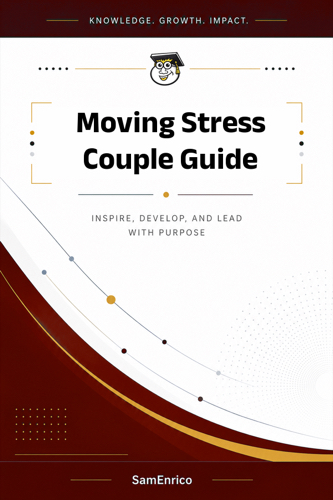
Moving Stress Couple Guide eBook
Handle relocation anxiety, packing fights, and adj
Handle relocation anxiety, packing fights, and adjustment to new city together.
Formats
Free sample
Chapter 1: The Unspoken Farewell...--–- The moving truck was scheduled to arrive at eight the next morning. Lena had been packing for twelve days straight. Her husband, Marcus, had been working late every night, closing out his projects before the transfer. Their dining table was buried under half-filled boxes. Their bedroom smelled of cardboard and tape.
Their dog, sensing the chaos, had taken to hiding under the couch.At ten-thirty at night, Lena found herself standing in the kitchen, holding a cast-iron skillet that had belonged to her grandmother. The skillet was heavy, seasoned by decades of Sunday dinners, and completely impractical for the small induction cooktop in their new apartment. Marcus had pointed this out three times. Lena had ignored him each time.Now, alone in the kitchen, she burst into tears. Not because of the skillet.
Because the skillet was her grandmother, who had died two years ago. Because her grandmother had taught her to cook in that skillet. Because her grandmother had lived fifteen minutes away, and now Lena was moving four hundred miles from the cemetery where she was buried.Marcus found her crying and did the thing he always did when he didn't understand: he tried to fix it. "We can ship the skillet," he said. "We'll find a storage unit.
We'll figure something out.""That's not the point," Lena said."Then what is the point?"She couldn't answer. Not because she didn't know, but because the answer was too large and too sad and too much to say at ten-thirty at night when the moving truck was coming at eight in the morning. The point was that she was leaving her grandmother behind. The point was that she was leaving her whole life behind. The point was that Marcus didn't seem to be leaving anything at all.This is the moment that breaks couples during a move.
Not the fights about who packed what or who forgot to cancel the cable. The quiet, midnight moments when one partner is grieving and the other partner doesn't know how to help. The skillet is never just a skillet. The fight is never just about the fight.Moving is a farewell. And most of us are terrible at saying goodbye.The Grief No One Talks About Here is what the moving industry will not tell you: moving is a death.
Not a literal death, but a death nonetheless. You are losing a version of yourself that existed in a particular place, surrounded by particular people, sustained by particular routines. That self dies when you leave. A new self will be born in the new city. But the space between the death and the birth is grief.We know how to talk about grief when someone dies.
We allow for sadness. We allow for tears. We allow for irrational behavior. We bring casseroles. We say, "Take all the time you need."We do not do this for moving.
When someone moves, we say, "How exciting!" We say, "You'll make new friends!" We say, "Think of the adventure!" We say these things even when the person moving is clearly struggling, because we have been trained to believe that relocation is a positive event that should be met with enthusiasm rather than mourning.This cultural script is a lie. And it causes enormous damage.When you suppress the grief of moving—when you tell yourself to be positive, to look forward, to stop being sentimental—that grief does not disappear. It goes underground. It becomes irritability. It becomes exhaustion.
It becomes a short fuse with your partner. It becomes fights about nothing that are actually about everything.The partners who survive moves intact are not the ones who feel no grief. They are the ones who name the grief, share it with each other, and make space for it without trying to fix it or rush through it.Why Your Brain Treats a Move Like a Breakup Neuroscience offers a disturbing explanation for why moving feels so terrible. The same neural circuits that activate during romantic rejection—the anterior cingulate cortex, the insula, the ventral striatum—also activate when people leave familiar environments. Your brain literally cannot tell the difference between losing a person and losing a place.This makes evolutionary sense.
For most of human history, knowing your territory was a matter of survival. You knew where the water was, where the predators hid, where the edible plants grew. Leaving that territory meant risk, uncertainty, and potential death. Your brain evolved to treat territorial loss as a threat because, for your ancestors, it was.Your modern brain does not know that you are moving to a city with reliable utilities, a functioning police force, and a grocery store on every corner. Your modern brain only knows that you are leaving the familiar and entering the unknown.
And the unknown, to your ancient neural architecture, is dangerous.This is why moving makes you tired, irritable, and prone to crying over skillets. Your body is in a state of low-grade threat response. Your cortisol levels are elevated. Your sleep is disrupted. Your patience is depleted.
You are not weak. You are not failing. You are human.The mistake that couples make is interpreting these physiological responses as relationship problems. "You're so irritable lately." "You never want to have sex." "You're snapping at me over nothing." These are not accurate descriptions of character flaws. They are accurate descriptions of what happens to human bodies under prolonged stress.
The irritability is real. The low libido is real. The snapping is real. But the cause is not a failing partner. The cause is a nervous system that has been in fight-or-flight mode for weeks.Naming this—saying to your partner, "I'm not angry at you, I'm exhausted and my brain thinks we're being chased by predators"—can transform a fight into a moment of connection.
Your partner is not the enemy. The move is the enemy. And you are on the same team.The Hidden Farewells We Never Make Every move contains dozens of small farewells. Most of them go unmourned because they seem too trivial to mention. But trivial losses add up.
And unmourned losses do not disappear. They accumulate.Consider the farewells embedded in an average relocation:The farewell to the route you drive every day. You know every pothole, every traffic light pattern, every shortcut. You drive it on autopilot, your brain free to think about other things. In the new city, you will have to pay attention to every turn.
Your brain will be exhausted by the effort of navigation for months.The farewell to the grocery store where you know the layout. You know where the good cheese is. You know which checkout line moves fastest. You know the cashier who asks about your kids. In the new city, you will wander aisles like a tourist, unable to find the salsa, frustrated by the unfamiliar placement of everything.The farewell to the coffee shop where you are known.
The barista who remembers your order. The corner table where you grade papers or scroll through news or just sit. These small recognitions—being seen, being known, having a place—are not…
This is the end of the free sample. Get the eBook to keep going. Buy now
About this book
Details
- Author
- Huggins Annamaria
- Publisher
- SamEnrico
- Language
- English
- Genre
- Non-Fiction, Self-Help, Relocation
- Released
- 2026-06-09
- Pages (approx.)
- 117
- Available as
- eBook, Audiobook

Read better in the ZLOADR app
Your eBooks on your phone or tablet. Sign in with your SamEnrico account and start reading.
More by Huggins Annamaria
 Alpha Diversity InterpretationHuggins Annamaria$11.99
 Meditation for Sleep Apnea CopingHuggins Annamaria$11.99
 Eyes Closed Meditation TechniqueHuggins Annamaria$11.99
 Medical Worker Sleep AidHuggins Annamaria$11.99
 CFA Formula Peg SystemHuggins Annamaria$11.99
 UAE Remote Tax GuideHuggins Annamaria$11.99
 Neuropathic Pain BooksHuggins Annamaria$11.99
 Bipolar Exercise Energy ManagementHuggins Annamaria$11.99
 Zero Day: The Hunt for Stuxnet's Shadow ArchitectsHuggins Annamaria$11.99
 The Underground Warriors: Europe's Forgotten MMA Pioneers (1950-1980)Huggins Annamaria$11.99
 The Ghost in the Machine: How a Hacker Almost Stole an ElectionHuggins Annamaria$11.99
 Assumptions Validation ChecklistHuggins Annamaria$12.99
You may also like
 Hong Kong Handover 1997Dunn Johnnie$11.99
 Zumba For Postnatal Recovery CourseNeal Christian$11.99
 Zumba for BeginnersLadner Nikia$11.99
 YouTube Comment Mining GuideHumes Pandora$12.99
 Worry Box MeditationCarlin Rudy$11.99
 Workplace Stress MeditationNguyen Lynn$11.99
 Workplace Stress and Sleep RepairHawley Ivory$11.99
 Workplace Perfectionism CureDelaney Jeffry$11.99
 Workplace Injustice Anger GuideWallen Isabelle$11.99
 Work Addiction and Burnout LinkGreenwood Ester$11.99
 Women in Yoga and WellnessBeattie Galina$11.99
 Women in Stand Up ComedyChun Evangeline$11.99