
Non-FictionSelf-HelpMindfulness
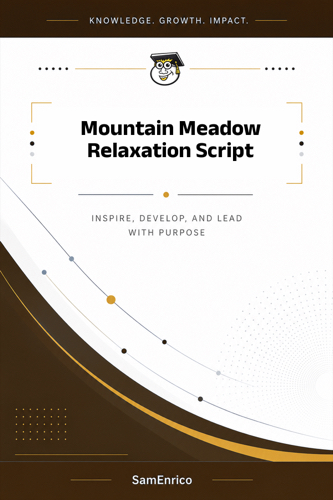
Mountain Meadow Relaxation Script eBook
Visits an alpine meadow with wildflowers, butterfl
Visits an alpine meadow with wildflowers, butterflies, and gentle breeze.
Formats
Free sample
Chapter 1: The Meadow Breath...--–- Before you can enter the meadow, you must first leave the place you are standing. Not physically—your body can remain exactly where it is, on this chair, this couch, this floor, this bed. But the part of you that has been running, solving, predicting, protecting—that part needs permission to pause. This chapter gives you that permission. You will learn not only how to prepare your inner landscape but also how to breathe in a way that tells your nervous system: You are safe.
There is no emergency. You can rest now.The Difference Between Doing and Being Most of us spend our waking hours in what psychologists call task-positive mode. This is the brain state where you make lists, answer emails, worry about the future, replay conversations from yesterday, and generally try to do things. It is an essential mode—without it, you would never pay a bill or pick up your child from school. But when this mode runs continuously, without interruption, your nervous system begins to interpret everything as a task.
Even rest becomes a task. I must relax correctly. I should be calmer. Why can’t I fall asleep?The meadow asks something different from you. It asks for being mode.In being mode, there is no goal to achieve.
No progress to measure. No wrong way to do it. You are not trying to relax—you are simply here. The difference is subtle but profound. Trying to relax is like trying to fall asleep by commanding yourself to sleep.
It backfires. Relaxation is not something you do; it is something that happens when the conditions are right. This chapter, and every chapter that follows, exists to create those conditions.Before we go any further, say this to yourself—not as a command, but as an offering:I now enter the meadow.You do not need to believe it. You do not need to feel anything yet. You only need to be willing to imagine that it could be true.The Only Posture Rule That Matters You have probably read relaxation books that insist on a specific posture: spine straight, hands on knees, lotus position, or lying perfectly supine with palms facing the ceiling.
Those postures work for some people. But the moment you tell a tired parent or a desk-worker with chronic back pain that they must sit a certain way, you have already introduced tension. And tension is what we are trying to release.Here is the only posture rule that matters in this book: Choose a position you can hold without effort for the duration of the chapter.That might be:Lying supine (on your back) with a small pillow under your head and, if needed, a rolled blanket under your knees. This is ideal for deep relaxation and for sleep-onset practices. It is also the recommended posture if you plan to read all twelve chapters sequentially.Seated upright in a chair with your feet flat on the floor, your hands resting on your thighs, and your spine in its natural curve—not forced straight, not slumped.
This works well for alert calm, for practices you do at work, and for anyone who falls asleep too quickly when lying down.Standing only for the briefest resets (two to three minutes). Standing visualization is useful in moments of sudden stress—before a meeting, after difficult news—but it is not recommended for full chapter practices.For this chapter specifically, if you are reading sequentially, choose lying down. If you are reading a single chapter as a standalone practice, choose whichever posture honors where your body is today.One more thing: You do not need to close your eyes unless that feels comfortable. Softening your gaze—looking at a blank wall, the floor, or simply letting your eyes lose focus—works just as well. Some people find closed eyes disorienting or anxiety-provoking.
That is fine. The meadow does not require your eyelids to cooperate.The Permission Mantra (You Will See It Again)Before your first breath, let me give you a phrase that will appear in every chapter of this book. Consider it the meadow’s first gift to you. It is not a command. It is not an affirmation you must believe.
It is simply an allowance.Repeat it once, silently or aloud:There is no wrong way to be here.If your mind races, you are not doing it wrong. If you feel nothing, you are not doing it wrong. If you fall asleep, you are not doing it wrong. If you scratch your nose, adjust your leg, or suddenly remember you forgot to buy milk—you are still not doing it wrong.The meadow does not test you. It does not grade you.
It only waits.The Meadow Breath: Your Foundational Practice Most relaxation scripts teach a different breathing pattern in every chapter. You will not find that here. This book gives you one foundational breath that you will use in almost every practice. Learning it now will save you confusion later. You will encounter only one variation—the butterfly breath in Chapter 4—and even that is a temporary departure from this foundation.The Meadow Breath is simple: inhale for four counts, exhale for six counts.Why four and six?
Research on heart rate variability (HRV) shows that a longer exhale than inhale activates the parasympathetic nervous system—the branch of your nervous system responsible for rest, digestion, and repair. The exact ratio matters less than the difference. A six-count exhale is longer than a four-count inhale. That is the signal your body needs.Let us practice it now.First, find your counting speed. Do not use a stopwatch.
Do not try to make each count exactly one second. Instead, count at the natural pace of your own quiet speech—the same speed you would use to say “one… two… three… four” to yourself in a calm moment. Some people count faster, some slower. Neither is correct. Your nervous system knows its own rhythm.Inhale through your nose if possible.
If nasal breathing is difficult or uncomfortable, inhale through your mouth. The meadow does not police your nostrils.Count silently: one, two, three, four.Notice the air moving. Do not try to pull it deep or force it into your belly. Just let it arrive.Exhale through your mouth with a soft, unforced sigh—not a loud exhale, not a whisper, just whatever comes naturally.Count silently: one, two, three, four, five, six.Do not push the air out. Let it leave as if it were ready to go.
Imagine a feather resting on your lower lip; your exhale should be gentle enough not to blow it away.Repeat five more times. That is one complete set of six Meadow Breaths.After six breaths, return to your normal breathing for a few moments. Do not judge your normal breath. It is not too shallow, not too quick. It is simply your breath right now.What You Might Notice (Or Not)As you practice The Meadow Breath, several things might happen.
None of them are required.You might feel your shoulders drop slightly.Your jaw might unclench without you telling it to.You might…
This is the end of the free sample. Get the eBook to keep going. Buy now
About this book
Details
- Author
- Newby Krysten
- Publisher
- SamEnrico
- Language
- English
- Genre
- Non-Fiction, Self-Help, Mindfulness
- Released
- 2026-06-09
- Pages (approx.)
- 124
- Available as
- eBook, Audiobook

Read better in the ZLOADR app
Your eBooks on your phone or tablet. Sign in with your SamEnrico account and start reading.
More by Newby Krysten
 Kids Sleep Meditation GuideNewby Krysten$11.99
 Time Dash Improv GameNewby Krysten$11.99
 Harrier Jump Jet PilotNewby Krysten$11.99
 Downsizing Heirlooms and Family TreasuresNewby Krysten$11.99
 Clancy Brown Mr KrabsNewby Krysten$11.99
 Morning Routine for TruckersNewby Krysten$11.99
 Hair Thinning Menopause SolutionsNewby Krysten$11.99
 The Dutch Cartographers: Mapping the World in Gold and InkNewby Krysten$11.99
 Love in the Shadows: The Secret Letters of a Mayan Opera SingerNewby Krysten$11.99
 How to Produce Label Tapes and Refill RollsNewby Krysten$11.99
 MSC Sustainable Seafood GuideNewby Krysten$12.99
 Passport Validity for PGWPNewby Krysten$12.99
You may also like
 Hong Kong Handover 1997Dunn Johnnie$11.99
 Zumba For Postnatal Recovery CourseNeal Christian$11.99
 Zumba for BeginnersLadner Nikia$11.99
 YouTube Comment Mining GuideHumes Pandora$12.99
 Worry Box MeditationCarlin Rudy$11.99
 Workplace Stress MeditationNguyen Lynn$11.99
 Workplace Stress and Sleep RepairHawley Ivory$11.99
 Workplace Perfectionism CureDelaney Jeffry$11.99
 Workplace Injustice Anger GuideWallen Isabelle$11.99
 Work Addiction and Burnout LinkGreenwood Ester$11.99
 Women in Yoga and WellnessBeattie Galina$11.99
 Women in Stand Up ComedyChun Evangeline$11.99