
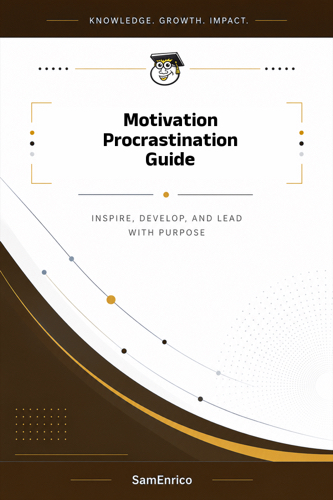
Non-FictionSelf-HelpMotivation
Motivation Procrastination Guide eBook
Overcome task avoidance and build study momentum w
Overcome task avoidance and build study momentum with behavioral activation.
Formats
Free sample
Chapter 1: The Relief-Remorse Trap--–- You are not lazy. You are not broken. You are not lacking willpower. If you have ever spent hours avoiding a task that would take thirty minutes—cleaning your room instead of studying, watching videos instead of writing a paper, reorganizing your files instead of making a single phone call—you have likely concluded something about yourself. You have likely thought: I have a motivation problem.
Or worse: I am a procrastinator. That label feels permanent, as if procrastination is a personality trait carved into your bones. But here is the first and most important truth this book will teach you: procrastination is not a character flaw. It is an emotion regulation problem. And once you understand that, everything changes.The question this chapter answers is simple but profound: why does your brain choose short-term relief over long-term success, even when you know better?
Why do you repeat the same avoidance patterns despite the guilt and stress that follow? The answer lies not in your character but in the ancient architecture of your brain. By the end of this chapter, you will understand the neurological and emotional machinery behind procrastination. You will see why waiting for motivation is a trap. And you will be ready for the solution that comes in Chapter 2: Behavioral Activation.The Procrastination Paradox: Knowing vs.
Doing Let us begin with a puzzle. You have an exam in three days. You know that studying now will reduce your anxiety, improve your grade, and free up time later. You have every reason to act. Yet you find yourself scrolling through social media, cleaning your desk, or suddenly interested in a television show you have never cared about before.
You are aware of the consequences. You feel the pressure. But you do not move.This is the procrastination paradox: knowing what is good for you does not translate into doing it. If knowledge alone were enough, no one would procrastinate. Every smoker knows smoking is harmful.
Every person avoiding the gym knows exercise is beneficial. Every student avoiding a paper knows the deadline will not disappear. And yet avoidance continues.The reason is that procrastination is not a knowledge problem. It is a conflict between two different brain systems—one that prioritizes immediate relief and one that prioritizes future goals. The ancient parts of your brain were not designed for essays, exams, or long-term projects.
They were designed for survival in a world where threats were immediate and rewards were instant. When you sit down to study, your brain does not see a textbook. It sees something that feels boring, difficult, or threatening to your self-esteem. And it reacts the same way it would react to any threat: it tries to escape.The Two Brains: Limbic System vs. Prefrontal Cortex To understand procrastination, you need to meet two characters inside your head.
The first is the limbic system. This is the ancient, fast, emotional part of your brain. It includes the amygdala (fear and threat detection), the nucleus accumbens (pleasure and reward), and other structures that operate below your conscious awareness. The limbic system does not think. It feels.
And it acts immediately. When you see a snake on a hiking trail, your limbic system makes you jump back before your conscious brain has even registered what you saw. That speed is excellent for survival. But it is terrible for studying.The second character is the prefrontal cortex (PFC). This is the newer, slower, rational part of your brain, located right behind your forehead.
The PFC is responsible for planning, goal-setting, delaying gratification, and inhibiting impulses. It is what allows you to say, “I will study now so I can relax later.” The PFC understands cause and effect. It can imagine the future. It knows that short-term discomfort leads to long-term gain. But the PFC is also easily tired, easily overridden, and much slower than the limbic system.Here is what happens when you sit down to study.
Your PFC says, “Open the book. You have three days until the exam.” But your limbic system scans the situation and asks, “Does this feel good?” The answer is often no. The task feels boring. Or difficult. Or you worry that if you try and fail, you will feel stupid.
The limbic system detects a threat—not a physical threat, but an emotional one—and sounds the alarm. It floods your brain with signals that say, Do something else. Do anything else. Escape.And you do. You check your phone.
You get a snack. You reorganize your notes. For a few seconds or minutes, the aversive feeling subsides. That relief is real. It is a tiny spike of dopamine, the same neurotransmitter involved in addiction.
Your limbic system has successfully protected you from discomfort. The problem is that the relief is temporary, and the cost is enormous.Task Aversion: Why Studying Feels Bad Psychologists call the negative emotional response to a task task aversion. Task aversion is not the same as objective difficulty. A task can be objectively easy (send one email) but feel highly aversive (because you are worried about the recipient’s response). A task can be objectively hard (write a twenty-page paper) but feel manageable (because you are interested in the topic and confident in your skills).
Task aversion is about emotion, not effort.Common sources of task aversion include:Boredom: The task is repetitive, under-stimulating, or feels meaningless. Your brain craves novelty, and studying feels like the opposite of novelty.Difficulty: The task requires mental effort, and effort is uncomfortable. Your brain is wired to conserve energy, not spend it.Ambiguity: You are not sure how to start, what “good” looks like, or how long it will take. Ambiguity creates anxiety, and anxiety triggers avoidance.Fear of failure: You worry that if you try and do poorly, you will confirm a negative belief about yourself (e.g., “I’m not smart enough”). Avoiding the task protects you from that evidence.Perfectionism: You believe that the task must be done perfectly, and since perfection is impossible, you cannot start.
Perfectionism is not high standards; it is fear disguised as standards.Resentment: You feel the task is unfair, imposed by someone else, or a waste of time. Resentment fuels passive avoidance.Notice what all these sources have in common. They are not about time management. They are not about organization. They are about how you feel when you contemplate the task.
Procrastination is an emotion regulation strategy. It is a maladaptive attempt to feel better in the present moment. And it works—temporarily.The Relief-Remorse Cycle: A Step-by-Step Breakdown Now let us walk through the complete cycle of procrastination. I call this the Relief-Remorse Cycle, and once you see it, you will see it everywhere—in your own behavior, in your students, in your colleagues.Step 1: Task Presentation. You become aware of a task that needs to be done.
It could be a notification from your professor, a calendar reminder, or simply the memory that you have not started. At this moment, your PFC activates. It knows the task is important.Step 2: Task Aversion. Within milliseconds, your limbic system evaluates the task. It asks…
This is the end of the free sample. Get the eBook to keep going. Buy now
About this book
Details
- Author
- Blanchard Kathyrn
- Publisher
- SamEnrico
- Language
- English
- Genre
- Non-Fiction, Self-Help, Motivation
- Released
- 2026-06-09
- Pages (approx.)
- 140
- Available as
- eBook, Audiobook

Read better in the ZLOADR app
Your eBooks on your phone or tablet. Sign in with your SamEnrico account and start reading.
More by Blanchard Kathyrn
 Medical Comorbidities and Relapse RiskBlanchard Kathyrn$11.99
 Loot Box and Gacha AddictionBlanchard Kathyrn$11.99
 Childhood Emotional Abuse RecoveryBlanchard Kathyrn$11.99
 The Academic Perfectionist CureBlanchard Kathyrn$11.99
 Guilt Management for CaregiversBlanchard Kathyrn$11.99
 Disappointment In PoliticsBlanchard Kathyrn$11.99
 Karl-Gerät Superheavy Mortar LogisticsBlanchard Kathyrn$11.99
 The Great Unplug: How a Remote Island Banned the Internet and Changed the WorldBlanchard Kathyrn$11.99
 Baybars the Victorious: The Mamluk Lion of EgyptBlanchard Kathyrn$11.99
 Silent Witness: The Unsung Hero of the TitanicBlanchard Kathyrn$11.99
 Understanding Aromatic Amino ACID Decarboxylase DeficiencyBlanchard Kathyrn$17.99
 Accounting InternBlanchard Kathyrn$11.99
You may also like
 Hong Kong Handover 1997Dunn Johnnie$11.99
 Zumba For Postnatal Recovery CourseNeal Christian$11.99
 Zumba for BeginnersLadner Nikia$11.99
 YouTube Comment Mining GuideHumes Pandora$12.99
 Worry Box MeditationCarlin Rudy$11.99
 Workplace Stress MeditationNguyen Lynn$11.99
 Workplace Stress and Sleep RepairHawley Ivory$11.99
 Workplace Perfectionism CureDelaney Jeffry$11.99
 Workplace Injustice Anger GuideWallen Isabelle$11.99
 Work Addiction and Burnout LinkGreenwood Ester$11.99
 Women in Yoga and WellnessBeattie Galina$11.99
 Women in Stand Up ComedyChun Evangeline$11.99