
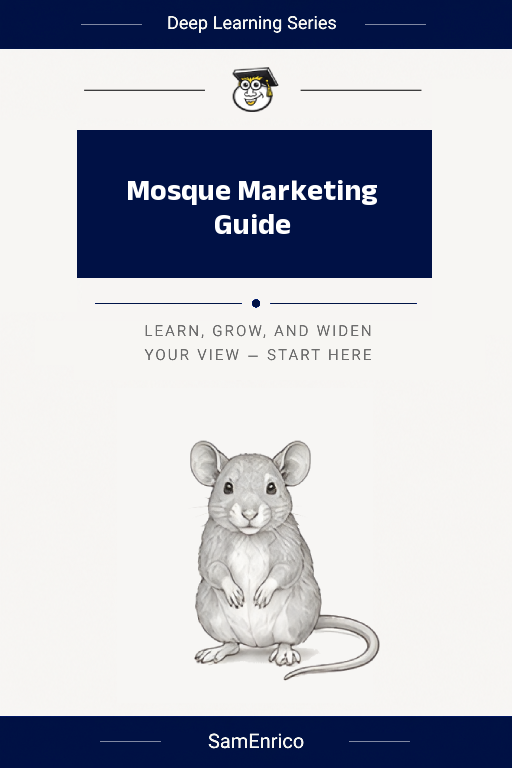
Non-FictionStartup GuideOffline Growth
Mosque Marketing Guide eBook
Market through mosques in offline regions. Communi
by Webb Ramon
Market through mosques in offline regions. Community engagement and trusted channels.
Formats
Free sample
Chapter 1: The DKM Effect...--–- The first time Ahmed tried to announce a free health camp at his local mosque, he did everything right. He had printed five hundred flyers. He had secured three doctors who volunteered their Saturdays. He had even arranged for a van to pick up elderly community members who couldn't drive. The event cost him nothing but six weeks of sleepless nights and four hundred dollars of his own money for printing and snacks.
When the Friday morning arrived, he stood at the back of the prayer hall, heart pounding with anticipation, watching the doors for the crowds he knew would come.Seventeen people showed up.Seventeen. In a community of over three thousand Muslim families.Ahmed was devastated. He replayed every decision, every conversation, every flyer he had distributed. The design was professional. The timing was perfect—a Saturday when most people were off work.
The need was undeniable; he had personally spoken to dozens of families who complained about the cost of healthcare. Nothing made sense.Then an elderly uncle pulled him aside after the event. The man had attended the health camp, waited an hour for a blood pressure check, and then sat quietly in the corner until everyone else had left. When Ahmed approached to thank him for coming, the uncle looked him in the eye and said something that would change everything."The board members don't trust you, young man. And if they don't trust you, neither do we."That was the moment Ahmed learned what this book calls The DKM Effect.
The uncle was referring to the mosque's Prosperity Committee—in many communities known by its Arabic acronym DKM (Dewan Kemakmuran Masjid) or simply as the board of trustees, the shura, or the executive committee. These are the half-dozen or dozen individuals who hold the keys, control the bank accounts, and decide which announcements are made from the pulpit. Their credibility—or lack thereof—determines the success or failure of every single initiative launched from the mosque, regardless of how well designed that initiative might be.Ahmed's mistake was not in his marketing. His mistake was in failing to understand that in mosque communities, trust flows from the top down. The board is the gatekeeper of credibility.
If the board is perceived as corrupt, opaque, or disconnected from the community, no campaign will work. No flyer will be believed. No announcement will be remembered. No event will be attended. The congregation does not evaluate each program on its own merits; they evaluate the messenger first, and only then decide whether to even consider the message.This chapter is about the psychology of trust in Muslim communities.
It will give you the tools to diagnose your mosque's trust health, repair broken credibility, and build a foundation upon which every subsequent marketing effort can succeed. Without these foundations, the rest of this book is useless. With them, even modest efforts can produce extraordinary results.The Three Pillars of Mosque Marketing Before we dive into the specific mechanics of trust, we must establish the framework that will appear throughout this book. These are The Three Pillars of Mosque Marketing. They are introduced here in full, and later chapters will reference them without redefinition.
Commit them to memory, because everything that follows rests upon them.Pillar One: Transparency. This means open financial books, clear decision-making processes, publicly available meeting minutes, and a visible separation between personal funds and community funds. When a community member asks, "Where did last month's donations go?" they should be able to get a clear answer within twenty-four hours, not twenty-four days. Transparency is not just about honesty; it is about the perception of honesty. A board can be completely ethical but still be perceived as corrupt if they operate behind closed doors.
Perception is reality in trust-based marketing.Pillar Two: Inclusivity. This means welcoming all socioeconomic strata, ethnic backgrounds, ages, and levels of religious observance without favoritism or judgment. The mosque that only serves its wealthiest donors will fail. The mosque that only serves one ethnic group will fail. The mosque that makes new converts feel like outsiders will fail.
Inclusivity is not about lowering standards; it is about raising welcome. The most successful mosque marketers understand that a community of ten thousand with a hundred internal divisions is weaker than a community of one thousand that stands united.Pillar Three: Service (Ghairu Mahdha). This means prioritizing community service alongside ritual worship. The Arabic term Mahdha refers to acts of worship whose benefit is primarily spiritual—prayer, fasting, Quran recitation. Ghairu Mahdha refers to acts whose benefit is primarily social—feeding the hungry, visiting the sick, teaching a skill, providing healthcare.
Both are forms of worship, but many mosques have forgotten the second category. The most trusted mosques are those that serve their communities in tangible, practical ways that have nothing to do with sermons or prayer rugs. When a mosque runs a free food pantry, the trust of the community multiplies. When a mosque offers job training, the trust multiplies again. Service is the fastest path to credibility.Throughout this book, we will return to these pillars.
When you see a reference to "the transparency pillar" or "recall inclusivity from Chapter One," you will know exactly what is meant.The Anatomy of Trust in Muslim Communities Trust in Muslim communities operates differently than trust in secular or purely commercial contexts. Understanding these differences is essential before you attempt any marketing initiative.First, trust in Muslim communities is inherited but fragile. A family may have attended the same mosque for three generations. That generational loyalty creates a baseline of trust that new mosques cannot easily replicate. However, that same inherited trust can be destroyed in a single afternoon by a single scandal.
One embezzled dollar, one inappropriate comment, one exclusionary policy can erase decades of goodwill. The fragility of trust means that mosque boards must operate with a level of caution that would seem excessive in a business context. In business, a mistake costs customers. In a mosque, a mistake costs souls—or at least the perception of spiritual leadership.Second, trust in Muslim communities is mediated by relationships, not by institutions. In a corporation, you trust the brand.
In a mosque, you trust the people. If you trust the Imam personally, you will attend his events even if the board is questionable. If you trust the board president, you will donate even if the facilities are poor. If you trust the volunteer who hands out flyers, you will show up even if the poster design is ugly. Conversely, if the messenger is distrusted, no amount of institutional branding can compensate.
This is why this book focuses so heavily on training individual ambassadors (covered in depth in Chapter Two) rather than on abstract "mosque branding."Third, trust in Muslim communities is reinforced by shared vulnerability. When a community prays together, fasts together, and mourns together, they share emotional and spiritual vulnerability. That shared vulnerability creates bonds that are much stronger than the bonds created by shared consumption (as in commercial marketing). You can use this principle ethically by designing marketing that acknowledges shared struggles. An announcement that says "We…
This is the end of the free sample. Get the eBook to keep going. Buy now
About this book
Details
- Author
- Webb Ramon
- Publisher
- SamEnrico
- Language
- English
- Genre
- Non-Fiction, Startup Guide, Offline Growth
- Released
- 2026-06-01
- Pages (approx.)
- 154
- Available as
- eBook, Audiobook

Read better in the ZLOADR app
Your eBooks on your phone or tablet. Sign in with your SamEnrico account and start reading.
More by Webb Ramon
 Vinegar Insulin Blocker GuideWebb Ramon$11.99
 MDD with Mixed FeaturesWebb Ramon$11.99
 Facebook Life Milestone RaceWebb Ramon$11.99
 Alcohol and Pancreatitis PreventionWebb Ramon$11.99
 The Vanishing of Amelia Earhart: Insects, Corrosion, and the Search for CluesWebb Ramon$11.99
 Chrysocolla MiningWebb Ramon$11.99
 Learn to Play the HarmonicaWebb Ramon$11.99
 How to Start a Navigational Service to Shipping BusinessWebb Ramon$11.99
You may also like
 Hong Kong Handover 1997Dunn Johnnie$11.99
 Zumba For Postnatal Recovery CourseNeal Christian$11.99
 Zumba for BeginnersLadner Nikia$11.99
 YouTube Comment Mining GuideHumes Pandora$12.99
 Worry Box MeditationCarlin Rudy$11.99
 Workplace Stress MeditationNguyen Lynn$11.99
 Workplace Stress and Sleep RepairHawley Ivory$11.99
 Workplace Perfectionism CureDelaney Jeffry$11.99
 Workplace Injustice Anger GuideWallen Isabelle$11.99
 Work Addiction and Burnout LinkGreenwood Ester$11.99
 Women in Yoga and WellnessBeattie Galina$11.99
 Women in Stand Up ComedyChun Evangeline$11.99