

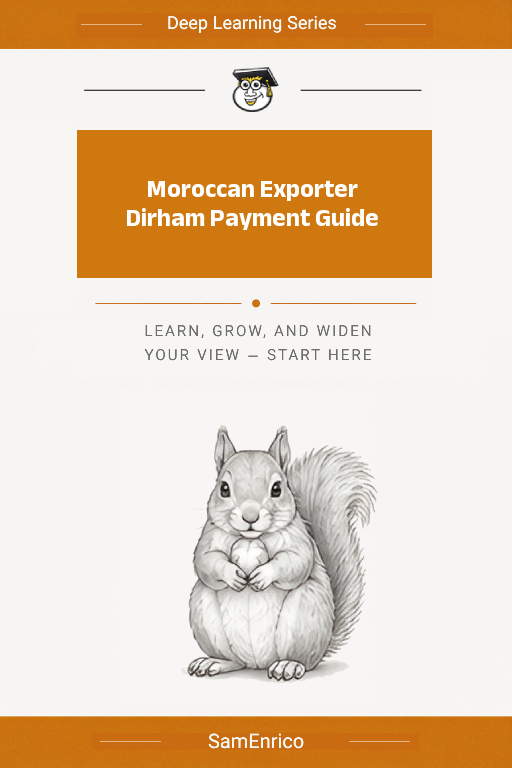
Non-FictionBusiness BriefRegulatory Guide
Moroccan Exporter Dirham Payment Guide eBook
Navigate MAD convertibility rules and offshore dir
Navigate MAD convertibility rules and offshore dirham accounts for receiving cross-border export proceeds.
Formats
Free sample
Chapter 1: The Convertibility Paradox--Every year, Moroccan exporters leave nearly 800 million dirhams on the table. Not because their products are inferior. Not because their clients refuse to pay. But because they do not understand the account their own bank gave them.You are about to learn something that most Moroccan exporters discover only after losing money—or worse, after receiving a formal notice from the Office des Changes. The Moroccan Dirham presents a paradox that has confused business owners for decades.
On paper, the dirham is a "convertible" currency. You can use it for international trade. You can receive foreign currency from clients abroad. You can even hold euros or dollars in certain accounts. But in practice, the dirham operates under one of the most tightly controlled currency regimes in North Africa.
And if you do not understand how this system works, you will find yourself fighting to access your own money.This chapter resolves that paradox. You will learn why the Office des Changes prohibits free private holding of foreign currency, how the repatriation and retention framework actually works without the confusing terminology found in other guides, and who the key players are that control every dirham crossing Morocco's borders. By the end of this chapter, you will understand why your money is not entirely your money—and what you can do about it.The Illusion of Convertibility Let us start with a simple truth. When a Moroccan bank tells you the dirham is "convertible," they are not lying. But they are not telling you the whole truth either.Convertibility, in international finance, means that a currency can be freely exchanged for other currencies without government restriction.
The United States dollar is fully convertible. The euro is fully convertible. The British pound is fully convertible. The Japanese yen is fully convertible. If you have dollars in New York, you can send them to London, Tokyo, or Dubai without asking permission from anyone.
You can hold those dollars in any country. You can convert them to any currency at any time. You can wake up at three in the morning and transfer a million dollars to a bank in Singapore simply because you feel like it.The Moroccan dirham is not that.What the banks mean when they say "convertible" is that the dirham can be exchanged for foreign currency for approved current transactions. The key word is "approved." Every significant movement of money into or out of Morocco requires authorization, documentation, or both. You cannot simply decide to send a million dirhams to a supplier in Turkey because you found a better price.
You cannot hold foreign currency in your safe at home or in a personal account abroad without declaring it to the authorities. And you certainly cannot receive money from a foreign client and use it however you wish without following a strict set of rules.This is what this book calls the Convertibility Paradox. The dirham looks convertible from a distance. Up close, it is a tightly managed currency designed to protect Morocco's foreign reserves, control capital flight, and maintain economic stability. For the exporter, this means one thing: you must play by rules that most of your international competitors never have to think about.
A German exporter receives euros and spends euros. A Chinese exporter receives dollars and, with some restrictions, can retain those dollars. A Moroccan exporter receives foreign currency and must immediately navigate a framework of repatriation deadlines, retention percentages, mandatory sales, and authorized accounts.The paradox is not a bug. It is a feature. The Moroccan government intentionally designed this system to balance two competing needs: the need for exporters to have access to foreign currency for their supply chains, and the need for the state to maintain control over capital flows and foreign reserves.
Understanding this balance is the first step toward mastering the system rather than being mastered by it.The Office des Changes: The Gatekeeper You Cannot Ignore Every conversation about Moroccan export payments begins with one institution and one institution only: the Office des Changes.Created by royal decree in 1966 and operating under the authority of the Ministry of Economy and Finance, the Office des Changes is Morocco's foreign exchange regulator. Think of it as the gatekeeper for every dirham that enters or leaves the country. No bank transaction involving foreign currency happens without its oversight. No export proceeds are credited to your account without its rules being applied. No exception to the standard repatriation requirements is granted without its explicit, written approval.The Office des Changes does not handle your daily banking.
That is not its role. What it does is write the rules that every bank must follow. It issues the General Instructions that constitute the legal framework for all foreign exchange operations. It conducts inspections of banks and exporters. It investigates suspicious transactions.
It imposes penalties for non-compliance. And when an exporter makes a mistake—even an honest one, even a mistake caused by bad advice from a bank teller—the Office des Changes is the institution that decides whether that mistake costs you money, time, or both.Most exporters never interact directly with the Office des Changes. They interact with their bank, which applies the Office's rules. This distance creates a dangerous illusion. Because you never see the regulator, you may forget that the regulator exists.
Your bank processes your payments. Your bank sends you statements. Your bank answers your questions. It feels like your bank is in charge.But the bank is merely an intermediary. The Office des Changes is always there, embedded in every wire transfer form you sign, every account application you complete, every declaration you submit.
When your bank asks for a "justification of funds," that is the Office des Changes. When your bank requires a "domiciliation" of your invoice, that is the Office des Changes. When your bank refuses to release funds because the documentation is incomplete, that is the Office des Changes.Understanding the Office des Changes is not optional. It is not a technical detail for lawyers and accountants. It is the first and most important step toward mastering your export payment workflow.
You cannot outrun the Office des Changes. You cannot hide from it. You can only learn its rules and follow them.Bank Al-Maghrib: The Rate Setter While the Office des Changes writes the rules, Bank Al-Maghrib sets the numbers.Bank Al-Maghrib is Morocco's central bank, established in 1959, two years after the country's independence. Its primary responsibilities include monetary policy, currency issuance, banking supervision, and the management of Morocco's foreign exchange reserves. For exporters, the most relevant function of Bank Al-Maghrib is its role in setting the dirham's exchange rate.Historically, the dirham was pegged to a basket of currencies.
The basket consisted primarily of the euro and the United States dollar, with the euro receiving a weight of approximately sixty percent and the dollar forty percent. The peg provided stability but limited flexibility. Exporters could predict their exchange rates with reasonable certainty, but the central bank had limited ability to respond to market forces.In 2018, Bank Al-Maghrib introduced a major reform. The dirham moved from a fixed peg to a managed float with a fluctuation…
This is the end of the free sample. Get the eBook to keep going. Buy now
About this book
Details
- Author
- Lovett Barbra
- Publisher
- SamEnrico
- Language
- English
- Genre
- Non-Fiction, Business Brief, Regulatory Guide
- Released
- 2026-05-29
- Pages (approx.)
- 154
- Available as
- eBook, Audiobook

Read better in the ZLOADR app
Your eBooks on your phone or tablet. Sign in with your SamEnrico account and start reading.
More by Lovett Barbra
 Giraffe Language HandbookLovett Barbra$11.99
 Design Thinking Collaboration GuideLovett Barbra$11.99
 Call To Action Copywriting GuideLovett Barbra$11.99
 The Homeless Shelter PipelineLovett Barbra$11.99
 Cameo Celebrity InfluencerLovett Barbra$11.99
 Blue Zone Meat ConsumptionLovett Barbra$11.99
 The Stress Sleep Insomnia LinkLovett Barbra$11.99
 The Welcome HomeLovett Barbra$11.99
 Nap for Night Workers GuideLovett Barbra$11.99
 The Maid of Orléans: Joan's Fire Against the CrownLovett Barbra$11.99
 The Love That Mapped the Stars: Hipparchus and the Lost Lighthouse of AlexandriaLovett Barbra$11.99
 The Great Unwind: How a Forgotten 1970s Policy Reshaped the Modern EconomyLovett Barbra$11.99
You may also like
 Hong Kong Handover 1997Dunn Johnnie$11.99
 Zumba For Postnatal Recovery CourseNeal Christian$11.99
 Zumba for BeginnersLadner Nikia$11.99
 YouTube Comment Mining GuideHumes Pandora$12.99
 Worry Box MeditationCarlin Rudy$11.99
 Workplace Stress MeditationNguyen Lynn$11.99
 Workplace Stress and Sleep RepairHawley Ivory$11.99
 Workplace Perfectionism CureDelaney Jeffry$11.99
 Workplace Injustice Anger GuideWallen Isabelle$11.99
 Work Addiction and Burnout LinkGreenwood Ester$11.99
 Women in Yoga and WellnessBeattie Galina$11.99
 Women in Stand Up ComedyChun Evangeline$11.99