
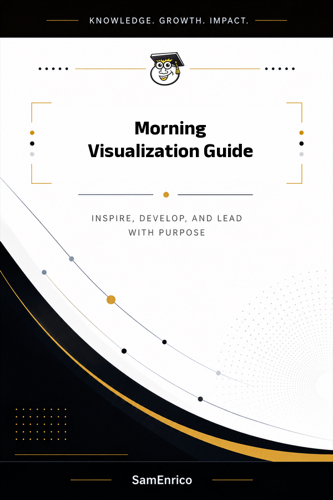
Free sample
Chapter 1: The Golden Window...–- The first light of dawn slipped through the gap in the curtains, landing softly on the pillow next to Sarah’s face. Her eyes opened, unfocused and heavy. For a moment, there was nothing—no to-do list, no email anxiety, no memory of yesterday’s failures. Just quiet. Then, like a floodgate opening, the thoughts rushed in: The presentation is at 10 AM.
Did I reply to David? I need to pick up milk. Why did I say that in the meeting yesterday? Within sixty seconds of waking, Sarah’s brain had gone from a peaceful blank slate to a churning storm of stress, obligation, and self-criticism. She didn’t know it, but she had just squandered the most valuable neurological real estate of her entire day.This book exists because Sarah’s experience is nearly universal—and it is a tragedy.
The moment you wake up, your brain is not yet fully online. It drifts through a hypnopompic state, lingering in theta brainwaves, the same frequency used in hypnosis, deep meditation, and the kind of profound learning that changes lives. This state lasts approximately twenty minutes after you open your eyes. In those twenty minutes, your subconscious is a clean slate, your Reticular Activating System is unprogrammed, and your cortisol levels are at their daily nadir. It is, without exaggeration, a neurological golden window.But here is what almost everyone gets wrong.
They assume that because they cannot dedicate twenty minutes to this practice, it is not worth doing at all. Or they believe that “visualization” means daydreaming about a beach while they brush their teeth, producing no measurable change in their lives. Or they have tried manifestation techniques from popular books and felt like failures when the money didn’t appear and the promotions didn’t materialize. The truth is that visualization—real, active, neuro-scientific visualization—is one of the most rigorously studied performance tools in psychology. And you do not need twenty minutes to make it work.The research is clear.
Studies from the field of motor imagery, sports psychology, and cognitive neuroscience consistently show that even five minutes of active visualization delivers approximately eighty percent of the benefits of a full twenty-minute session. This is the Pareto Principle applied to your morning brain: eighty percent of the rewiring happens in the first five minutes of the golden window. The remaining fifteen minutes offer diminishing returns—valuable for elite performers, but entirely optional for the rest of us. This chapter will teach you why the first twenty minutes matter, how to capture the most potent five of them, and what distinguishes active visualization from the passive daydreaming that has wasted your mornings for years.The Hypnopompic State: Your Brain’s Factory Reset Before we go any further, you need to understand what is actually happening inside your skull when you wake up. Sleep is not a single state but a cycling through stages: NREM (non-rapid eye movement) sleep, which includes deep slow-wave sleep, and REM (rapid eye movement) sleep, where most dreaming occurs.
As you transition from sleep to wakefulness, you pass through a boundary state called the hypnopompic state. This is the mirror image of the hypnagogic state you experience as you fall asleep.In the hypnopompic state, your brainwaves are not yet the fast, choppy beta waves of full wakefulness (13-30 Hz). Instead, they linger in theta range (4-8 Hz) and low alpha (8-12 Hz). Theta waves are associated with deep relaxation, creativity, and what neuroscientists call “implicit learning”—the kind of learning that happens without conscious effort. This is the same state targeted by hypnotherapists, meditation masters, and high-performance coaches who charge thousands of dollars per hour.Why does this matter for you?
Because in the theta state, your subconscious mind is more receptive to new programming than at any other point in your waking day. The critical filter that normally separates your conscious awareness from your deeper belief structures—a filter called the “critical factor”—is temporarily lowered. Think of it as a security guard who has not yet started their shift. In the first twenty minutes after waking, you can install new mental blueprints directly into your operating system without the usual resistance from your skeptical, analytical mind.This is why morning visualization works and evening planning often fails. By evening, your brain has been running for sixteen hours.
Your cortisol levels—the stress hormone—may still be elevated. Your prefrontal cortex, responsible for willpower and focused attention, is fatigued. Your subconscious has already been programmed by the events of the day, many of which reinforced the very limitations you are trying to overcome. Evening planning is not impossible, but it is an uphill battle against a tired, cluttered brain.Morning visualization, by contrast, is a downhill glide on fresh snow.Active vs. Passive Visualization: The Difference That Changes Everything At this point, some readers might be thinking: I already visualize.
I imagine my day going well while I’m in the shower. It doesn’t seem to do much. This is the single most common reason people abandon visualization practices. They are doing passive visualization and mistaking it for the real thing.Passive visualization is what happens when you let images float through your mind without direction, intention, or emotional engagement. You might picture yourself giving a successful presentation, but you do not feel the weight of the remote in your hand, hear the specific creak of the floorboard as you step to the podium, or experience the slight tremor in your voice before you steady it.
Passive visualization is the mental equivalent of watching a movie about someone else’s life. It is entertaining. It is not transformative.Active visualization, by contrast, is a full sensory, first-person, emotionally engaged rehearsal. When you actively visualize, you are not watching yourself from a distance. You are inside the scene.
You feel the fabric of your clothes against your skin. You hear the specific ambient sounds—the hum of the air conditioner, the shuffle of papers, the cough from the third row. You notice the knot in your stomach, and then you watch it dissolve as you take a slow, deliberate breath. Active visualization activates the same neural networks as physically performing the action. Your motor cortex fires.
Your emotional centers light up. Your brain releases dopamine and serotonin as if you had actually succeeded.The difference is not subtle. A 2012 study published in the journal Frontiers in Human Neuroscience compared two groups of piano players. One group physically practiced a two-octave scale for two hours daily. The other group mentally rehearsed the same scale, visualizing each finger movement without touching the keys.
At the end of the study, both groups showed nearly identical changes in cortical mapping and motor skill acquisition. The brain, it turns out, cannot reliably distinguish between a vividly imagined action and a physically performed one.This is the secret that Olympic athletes, concert pianists, and Navy SEALs have known for decades. And it is available to you in the first twenty minutes of every single morning.The Reticular Activating System: Your Brain’s Opportunity Filter There is another piece of neuroanatomy you need to understand, because it…
This is the end of the free sample. Get the eBook to keep going. Buy now
About this book
Details
- Author
- Manning Bradley
- Publisher
- SamEnrico
- Language
- English
- Genre
- Non-Fiction, Self-Help / Visualization
- Released
- 2026-06-08
- Pages (approx.)
- 157
- Available as
- eBook, Audiobook

Read better in the ZLOADR app
Your eBooks on your phone or tablet. Sign in with your SamEnrico account and start reading.
More by Manning Bradley
 Grit for Students with ADHDManning Bradley$11.99
 Half Smile for AnxietyManning Bradley$11.99
 Team Creative WarmupsManning Bradley$11.99
 Microstress Detection GuideManning Bradley$11.99
 London Staffing SolutionsManning Bradley$11.99
 Offering Choices GuideManning Bradley$11.99
 POLST Form GuideManning Bradley$11.99
 The Symphony of the Deep: How Western Composers Conquered the Ocean’s SoulManning Bradley$11.99
 The Philosophers of Axum: Wisdom from the Horn of AfricaManning Bradley$11.99
 Service Providers Guide to FacialistsManning Bradley$11.99
 A Collector's Handbook to the Matra-simca BagheeraManning Bradley$11.99
 YouTrack JetBrains AgileManning Bradley$12.99
You may also like
 Hong Kong Handover 1997Dunn Johnnie$11.99
 Zumba For Postnatal Recovery CourseNeal Christian$11.99
 Zumba for BeginnersLadner Nikia$11.99
 YouTube Comment Mining GuideHumes Pandora$12.99
 Worry Box MeditationCarlin Rudy$11.99
 Workplace Stress MeditationNguyen Lynn$11.99
 Workplace Stress and Sleep RepairHawley Ivory$11.99
 Workplace Perfectionism CureDelaney Jeffry$11.99
 Workplace Injustice Anger GuideWallen Isabelle$11.99
 Work Addiction and Burnout LinkGreenwood Ester$11.99
 Women in Yoga and WellnessBeattie Galina$11.99
 Women in Stand Up ComedyChun Evangeline$11.99