
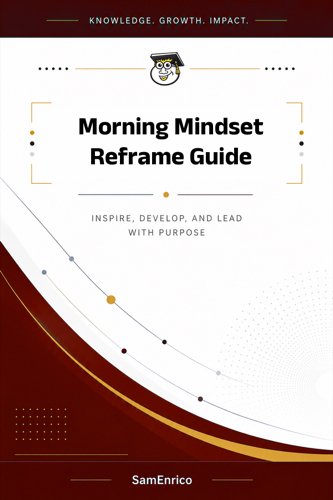
Morning Mindset Reframe Guide eBook
Shifts from can't to can thinking like peak perfor
Shifts from can't to can thinking like peak performers.
Formats
Free sample
Chapter 1: The Autopilot Crash--–- The alarm screams. Your hand emerges from the blankets like a zombie from a grave. Slap. Silence. Then the voice in your head begins its morning sermon: I can't do this today.
I'm just not a morning person. I need more sleep. I'll start tomorrow.You have just crashed the autopilot.Not literally, of course. But neurologically, you have done something remarkable. Within three seconds of waking, you have activated a chain reaction of limiting beliefs that will dictate your energy, your mood, and your performance for the next four to six hours.
And you did it so automatically, so habitually, that you didn't even notice you were making a choice.This chapter is about that crash. Not the kind that makes the evening news, but the kind that happens inside your skull every single morning. The crash that convinces you that your energy is out of your control, that your morning personhood is genetic destiny, and that willpower is something you simply don't have enough of.Every one of those beliefs is a lie. And by the end of this chapter, you will know exactly why.The Three Lies of the Morning Autopilot Let me tell you about the three most expensive lies you tell yourself before your feet hit the floor. I call them expensive not because they cost you money directly, but because they cost you something far more valuable: momentum, confidence, and the quiet satisfaction of a morning won before the world even asks anything of you.Lie #1: "I need more sleep."You probably do need more sleep.
But that is not why you hit snooze.The average American adult sleeps 6.8 hours per night. The recommended amount is 7 to 9 hours. So yes, statistically, you are sleep deprived. But here is the lie: you are using "I need more sleep" as a justification for staying in bed when more sleep is not what you actually need in that moment.What you need at 6:00 AM is not another 90-minute sleep cycle. You need a transition.
You are waking up in the middle of a sleep cycle (more on that in Chapter 8), and your brain is groggy. That grogginess feels like exhaustion, but it is actually sleep inertia—a temporary state of reduced cognitive function that typically lasts 15 to 30 minutes after waking.The difference between a high performer and someone who stays stuck is simple: the high performer knows that sleep inertia feels like "I can't," but acts anyway. The stuck person interprets the feeling as evidence that they genuinely need more rest, rolls over, and loses the morning.Here is the truth bomb: if you are getting between 6.5 and 8 hours of sleep, you do not need more sleep. You need better sleep quality and a better waking protocol. Chapter 8 will give you the quality protocol.
The waking protocol starts in three paragraphs.Lie #2: "I lack willpower."This is the lie that hurts the most because it feels like a character flaw. "I lack willpower" sounds like "I am weak." But willpower is not a muscle that some people have and others don't. Willpower is a finite resource that high performers have learned to conserve.Let me be very clear about what willpower actually is and is not.Willpower is real. You have a limited amount of it each day, and every decision you make—should I get up? what should I eat?
what should I wear? should I check my phone?—depletes it. This is called ego depletion, and it has been replicated in dozens of studies. When you wake up and spend ten minutes negotiating with yourself about whether to get out of bed, you are burning willpower that should be reserved for your Most Important Task later that morning.The lie is not that willpower exists. The lie is that you lack it.You don't lack willpower.
You lack a compelling why and, more critically, you lack systems that reduce the number of decisions you have to make before 9:00 AM. High performers do not have more willpower than you. They have simply designed their mornings so that willpower is rarely required. They have turned "should I get up?" into "I get up because that is who I am."The reframe: willpower is a precious resource. Stop spending it on the decision to get out of bed.
Make that decision the night before. Make it an identity, not a negotiation.Lie #3: "My energy is out of my control."This is the most seductive lie because it appears to be supported by evidence. You wake up tired. You feel tired. Therefore, you believe your energy is something that happens to you, not something you generate.But energy is not a weather pattern.
It is a function of three things: physiology, expectation, and movement. All three are within your control.Physiology: Your morning cortisol levels (the chronic kind, as we will distinguish shortly) are influenced by when you ate last, how much light you were exposed to the previous day, and your hydration status. All of these are modifiable.Expectation: If you tell yourself "I am going to be exhausted all day," your brain will comply. This is the nocebo effect—the evil twin of the placebo. Your expectations literally shape your neurochemistry.Movement: You cannot think your way to high energy.
You must move your body to release acute cortisol and adrenaline. Chapter 6 is dedicated entirely to this principle.The lie that your energy is out of your control is actually a form of learned helplessness. You have repeated it so many times that it has become a neural pathway—a deep groove in your brain that your thoughts automatically follow. This chapter is the beginning of carving a new groove.The Science of "I'm Not a Morning Person"Let me ask you a question that might make you uncomfortable. How many times have you said "I'm not a morning person" in the last year?
Fifty times? A hundred? Now ask yourself: have you ever tested that hypothesis?The phrase "morning person" (technically called a "lark") versus "night person" (an "owl") refers to your chronotype—your natural inclination toward sleep and wakefulness at certain times. Chronotypes are real. They have a genetic component.
If you are a true night owl, your circadian rhythm runs about two hours longer than a lark's.But here is what the research actually says: chronotype accounts for approximately 15 to 20 percent of your waking experience. The remaining 80 to 85 percent is conditioned behavior, habit architecture, and, most critically, the story you tell yourself.In other words, you are not a morning person not because of your genes, but because you have practiced not being one. Every time you hit snooze, every time you say "I can't do mornings," every time you groan and roll over, you are strengthening the neural pathway that says "I am not a morning person."This is the identity loop:Belief → Action → Evidence → Strengthened Belief You believe you are not a morning person. Therefore, you act like one (you sleep in, you groan, you avoid). That action produces evidence (you woke up late, you felt groggy).
That evidence strengthens your original belief. Repeat for ten years, and you have a seemingly unshakeable identity.But identities are not…
This is the end of the free sample. Get the eBook to keep going. Buy now
About this book
Details
- Author
- Meyer Candace
- Publisher
- SamEnrico
- Language
- English
- Genre
- Non-Fiction, Self-Help, Mindset
- Released
- 2026-06-10
- Pages (approx.)
- 131
- Available as
- eBook, Audiobook

Read better in the ZLOADR app
Your eBooks on your phone or tablet. Sign in with your SamEnrico account and start reading.
More by Meyer Candace
 Logical Creativity HandbookMeyer Candace$11.99
 Relationship Anger RestructuringMeyer Candace$11.99
 The Sherman Alexie StoryMeyer Candace$11.99
 Time Restricted EatingMeyer Candace$11.99
 Okinawan Longevity SecretsMeyer Candace$11.99
 Gut Brain Immune TriangleMeyer Candace$11.99
 Affirmations For AgingMeyer Candace$11.99
 Pegasus and the Parthenon: Horses of Ancient AthensMeyer Candace$11.99
 The Last Supper: Australia's Death Row Meals and the Final Hours of the CondemnedMeyer Candace$11.99
 The Essential Guide to Contemporary FolkMeyer Candace$11.99
 B2B Sales for Maritime SectorMeyer Candace$12.99
 ROI Calculator for PromotionMeyer Candace$12.99
You may also like
 Hong Kong Handover 1997Dunn Johnnie$11.99
 Zumba For Postnatal Recovery CourseNeal Christian$11.99
 Zumba for BeginnersLadner Nikia$11.99
 YouTube Comment Mining GuideHumes Pandora$12.99
 Worry Box MeditationCarlin Rudy$11.99
 Workplace Stress MeditationNguyen Lynn$11.99
 Workplace Stress and Sleep RepairHawley Ivory$11.99
 Workplace Perfectionism CureDelaney Jeffry$11.99
 Workplace Injustice Anger GuideWallen Isabelle$11.99
 Work Addiction and Burnout LinkGreenwood Ester$11.99
 Women in Yoga and WellnessBeattie Galina$11.99
 Women in Stand Up ComedyChun Evangeline$11.99