
Non-FictionSelf-HelpBiohacking
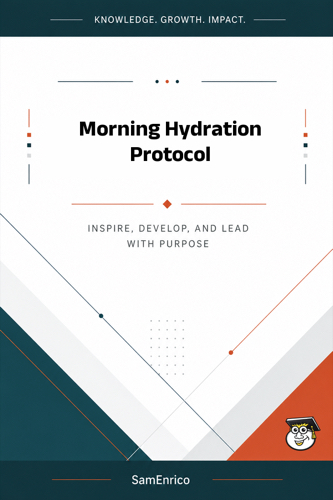
Morning Hydration Protocol eBook
Water, electrolytes, and timing strategies used by
by Kohler Dona
Water, electrolytes, and timing strategies used by biohackers to boost cognitive function.
Formats
Free sample
Chapter 1: The 73% Lie...--–- The most dangerous health advice you’ve never questioned begins with a number. Eight glasses. Sixty-four ounces. Two liters. You’ve heard it so many times that it has become biological scripture, whispered by wellness influencers, printed on water bottles, and repeated by doctors who should know better.
But here is the truth that will change how you think about hydration forever: the “eight glasses a day” rule has no scientific basis whatsoever.It was never derived from a clinical study. No research trial validated it. The origin of this ubiquitous recommendation traces back to a single 1945 publication from the U.S. Food and Nutrition Board, which noted that a reasonable allowance for water for adults was 2.5 liters daily. Buried in the same paragraph, however, was a detail everyone ignored: “Most of this quantity is contained in prepared foods.” In other words, the board assumed you would get most of your water from food—from soups, fruits, vegetables, and even meat.
But the food part was forgotten, and the 2.5 liters became a standalone commandment.You have been chasing a phantom. And in doing so, you have missed the one variable that actually matters: not how much you drink over the entire day, but when you drink it first thing in the morning.This chapter will dismantle everything you thought you knew about hydration. It will show you why your brain—an organ that is roughly seventy-three percent water and has no storage tanks of its own—suffers measurable cognitive decline from the simple act of sleeping. It will introduce you to the concept of “Dead Water,” the silent saboteur sitting in your reverse osmosis filter or your distilled water jug. And it will reframe hydration not as a volume game, but as a timing-and-composition strategy that begins the moment your eyes open.By the end of this chapter, you will understand why the first sixty minutes after waking are the most critical window of your entire day.
You will never drink a glass of plain water again without asking: where are the minerals? And you will be ready to build a morning protocol that delivers what eight glasses of tap water never could: sustained cognitive clarity, stable energy, and a brain that fires on all cylinders from dawn to dusk.Let us start with the organ that matters most.The Brain’s Impossible Math Your brain is a water-dependent machine with no reservoir. Unlike your liver, which stores glycogen, or your fat cells, which store triglycerides, your brain has no dedicated water tank. It operates on just-in-time delivery. Every neuron, every synapse, every neurotransmitter release depends on water arriving precisely when needed.
If delivery lags, performance degrades immediately.The numbers are staggering. The average adult brain weighs about three pounds, but approximately seventy-three percent of that weight is water. That is roughly two point two pounds of water suspended in neural tissue. The remaining twenty-seven percent is a mixture of fats, proteins, carbohydrates, and salts—all dissolved or suspended in that aqueous environment. Change the water volume by even a small percentage, and you change the concentration of every electrolyte, every neurotransmitter, every metabolic substrate in the brain.Think of a swimming pool.
If the water level drops by one percent, the pool still looks full. The chemical balance remains largely unchanged. But the brain is not a swimming pool. It is a精密 electrochemical organ where sodium ions must be at exactly 145 millimoles per liter outside the cell and potassium at 4 millimoles per liter inside for neurons to fire correctly. A one percent drop in water volume increases the concentration of sodium and potassium by roughly one percent.
That might sound trivial. It is not.The sodium-potassium pump, the microscopic machine that generates the electrical charge powering every thought you have, requires precise osmotic pressure to function. When water volume drops, osmotic pressure rises, and the pump must work harder. Neural firing slows. Reaction times lengthen.
The default mode network—the brain system responsible for focus, working memory, and self-monitoring—begins to fragment.Here is where the common wisdom gets it dangerously wrong. Most people believe that dehydration only becomes a problem when you feel thirsty. By the time you feel thirst, you are already in deficit. But even worse, most people believe that drinking eight glasses of water throughout the day protects them from that deficit. It does not, because the deficit that matters most is not cumulative daily volume.
It is the overnight crash.The Science That Was Misquoted The famous statistic—that a one to two percent body water loss impairs cognitive function—comes from a 2009 study by Kempton and colleagues using exercise-induced dehydration in healthy adults. Participants cycled in a heated room until they lost one to two percent of their body weight through sweat. Then they underwent functional MRI scans while performing cognitive tasks. The results were clear: brain volume decreased, the default mode network slowed, and reaction times increased to levels comparable to mild alcohol intoxication.This study is cited constantly in hydration literature. But almost no one mentions the crucial limitation: overnight dehydration is not exercise-induced dehydration.
When you sleep, you lose water through two mechanisms. First, respiration. Every breath you take exhales humidified air. Over eight hours, that amounts to approximately eight to twelve ounces of water. Second, insensible perspiration.
Even without sweating, your skin loses four to six ounces of water overnight through diffusion. The total overnight loss is typically twelve to sixteen ounces, which for a one hundred fifty pound person represents roughly half of one percent of body weight.Half a percent, not one to two percent.Does half a percent matter? Absolutely. Studies specifically examining mild, asymptomatic dehydration—the kind that occurs overnight—show measurable impairments in attention, short-term memory, and psychomotor speed. A 2013 meta-analysis in the Journal of Nutrition found that even a one percent loss reduces cognitive performance, with the most consistent effects on attention and working memory.
A 2018 study on morning dehydration specifically found that participants who drank no water after waking performed worse on vigilance tasks than those who drank sixteen ounces immediately upon waking.The point is not that the one to two percent statistic is wrong. The point is that you do not need to be severely dehydrated to feel the effects. You need only be slightly dehydrated at the moment your brain demands the most: the first hour of the day, when cortisol is rising, when the glymphatic system has just finished its overnight cleanup, and when your decision-making for the entire day is being set.The Eight-Glass Myth Let us trace the origin of the eight-glass rule more carefully because its debunking is essential to understanding why timing matters more than volume.In 1945, the U.S. Food and Nutrition Board wrote: “A suitable allowance of water for adults is 2.5 liters daily in most instances. Most of this quantity is contained in prepared foods.” That final sentence—the acknowledgment that food provides the majority of water—was systematically ignored.
By the 1970s, the food part had vanished from public guidance. The 2.5 liters remained, converted into the more memorable “eight eight-ounce glasses” (which is actually 1.9…
This is the end of the free sample. Get the eBook to keep going. Buy now
About this book
Details
- Author
- Kohler Dona
- Publisher
- SamEnrico
- Language
- English
- Genre
- Non-Fiction, Self-Help, Biohacking
- Released
- 2026-06-08
- Pages (approx.)
- 139
- Available as
- eBook, Audiobook

Read better in the ZLOADR app
Your eBooks on your phone or tablet. Sign in with your SamEnrico account and start reading.
More by Kohler Dona
 1031 Exchange Vacation Home RulesKohler Dona$11.99
 Compass Dream MeaningKohler Dona$11.99
 Ayurvedic Immunity GuideKohler Dona$11.99
 Visuospatial Memory GuideKohler Dona$11.99
 Road Rage and Horn UseKohler Dona$11.99
 From Foreign Degree to Fortune 500Kohler Dona$11.99
 Weekly Time Block PlanningKohler Dona$11.99
 Needs Based CommunicationKohler Dona$11.99
 The Fire and the Furnace: Joule’s African Odyssey and the Birth of ThermodynamicsKohler Dona$11.99
 The Cosmic Visionaries of Axum: Africa's Forgotten AstronomersKohler Dona$11.99
 Whispers in the Pines: The Vanishing of the 1971 Camp Wilderness CounselorsKohler Dona$11.99
 GoodNotes iPad ProductivityKohler Dona$11.99
You may also like
 Hong Kong Handover 1997Dunn Johnnie$11.99
 Zumba For Postnatal Recovery CourseNeal Christian$11.99
 Zumba for BeginnersLadner Nikia$11.99
 YouTube Comment Mining GuideHumes Pandora$12.99
 Worry Box MeditationCarlin Rudy$11.99
 Workplace Stress MeditationNguyen Lynn$11.99
 Workplace Stress and Sleep RepairHawley Ivory$11.99
 Workplace Perfectionism CureDelaney Jeffry$11.99
 Workplace Injustice Anger GuideWallen Isabelle$11.99
 Work Addiction and Burnout LinkGreenwood Ester$11.99
 Women in Yoga and WellnessBeattie Galina$11.99
 Women in Stand Up ComedyChun Evangeline$11.99