
Non-FictionHealth & WellnessEmotional Health
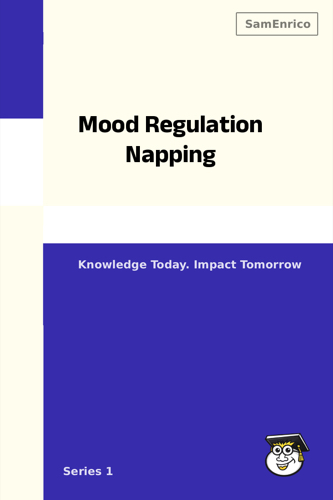
Mood Regulation Napping eBook
Uses naps to reduce irritability and emotional rea
Uses naps to reduce irritability and emotional reactivity.
Formats
Free sample
Chapter 1: The Hidden Tax--–- You wake up already irritated. Not the slow, groggy confusion of a bad alarm. Something sharper. Something that has been waiting for you since before you opened your eyes. The coffee maker is too slow.
Your partner’s breathing is too loud. The morning news anchor’s enthusiasm is offensive. By the time you pour your first cup, you have already felt anger three times—and nothing has even happened yet.This is not a bad day. This is a pattern. And you are not alone.Millions of adults wake up irritable, move through their days irritable, and go to bed wondering why they cannot seem to regulate their own emotions.
They apologize for snapping. They apologize for overreacting. They promise themselves that tomorrow will be different. And then tomorrow arrives, and the same invisible weight presses down on their patience, their kindness, their ability to be the person they actually want to be.The weight has a name. It is called sleep debt.
And it is the most underdiagnosed, undertreated, and underestimated cause of emotional suffering in modern life.This book is about paying off that debt in a way that does not require you to quit your job, abandon your children, or move to a cabin in the woods. It is about using strategic, targeted naps to restore your emotional regulation, reduce your reactivity, and finally feel like yourself again. But before we get to the solution, we must understand the full scope of the problem. This chapter is that understanding.The Accumulation You Cannot Feel Here is the first thing you need to know about sleep debt: it is invisible to the person carrying it.When you miss one hour of sleep, you feel it. You yawn.
You crave caffeine. You move a little more slowly. But when you miss one hour of sleep every night for a week, something strange happens. Your subjective sense of fatigue stops increasing. You plateau.
You wake up on day seven feeling roughly as tired as you did on day three. Your brain, in an act of desperate adaptation, recalibrates what “normal” feels like. You are not less tired. You have simply forgotten what being well-rested feels like.This is the trap.Research from the University of Pennsylvania’s Sleep and Chronobiology Laboratory has demonstrated this phenomenon repeatedly. In one landmark study, participants who were restricted to six hours of sleep per night for two weeks performed as poorly on cognitive tests as participants who had been awake for forty-eight hours straight.
But here is the terrifying part: when asked how tired they felt, the six-hour group rated their fatigue as mild. They had no idea how impaired they were.This is you. This is most adults in the industrialized world. You are walking around with a level of cognitive and emotional impairment that would be considered legally drunk, and you have no idea it is happening. Your brain has hidden the evidence from you.The Amygdala on Empty To understand why sleep debt makes you irritable, you need to meet two characters in your brain.
The first is the amygdala. The amygdala is your brain’s smoke detector. It scans the environment constantly for threats, and when it finds one—a car swerving toward you, a stranger yelling, a sudden loud noise—it sets off an alarm. That alarm is fear, anger, or both. The amygdala does not care about context.
It does not care about social appropriateness. It cares about survival.The second character is the prefrontal cortex. This is your brain’s fire chief. When the amygdala sounds the alarm, the prefrontal cortex rushes in to evaluate the situation. Is that really a car swerving toward you, or is it just someone changing lanes too fast?
Is that really a threat, or is it a misunderstanding? The prefrontal cortex decides whether to let the alarm continue or to shut it down.Here is what happens when you are sleep-deprived: the amygdala becomes hyperactive. It starts setting off the alarm for smaller and smaller triggers. A slow-loading website. A mildly critical email.
A towel left on the bed. These are not threats. But your amygdala does not know that. It is exhausted and overworked, and its threshold for sounding the alarm has dropped dramatically.At the same time, your prefrontal cortex becomes hypoactive. It is too tired to do its job effectively.
It cannot rush in and shut down the false alarms because it does not have the energy. So the alarm keeps ringing. You feel anger. You snap. You say something you regret.
And later, when your prefrontal cortex finally catches up, you think, Why did I do that?You did it because you were tired. Not because you are a bad person. Not because you lack self-control. Because your smoke detector was broken and your fire chief was asleep.The Sixty Percent Problem The numbers here are worth remembering. Functional MRI studies have shown that after sleep deprivation, the amygdala becomes approximately sixty percent more reactive to negative emotional stimuli.
Sixty percent. That is not a small shift. That is the difference between a minor annoyance and a full-blown rage response.Put another way: the same event that would have annoyed you slightly when you were well-rested will now make you genuinely angry. The same comment that would have rolled off your back will now feel like a personal attack. The same inconvenience that would have prompted a deep breath will now prompt a curse word.This is not psychological.
It is neurological. Your brain has literally changed shape. The neural pathways that connect your prefrontal cortex to your amygdala have thinned. The communication between the two regions has degraded. You are not imagining your irritability.
You are experiencing the physical consequences of sleep deprivation.The Blood Alcohol Equivalent If numbers help you understand scale, consider this one: after seventeen hours of wakefulness, your cognitive performance is equivalent to someone with a blood alcohol concentration of 0.05 percent. After twenty-four hours, it is equivalent to 0.10 percent—legally drunk in every state in America.Now think about your typical day. You wake at 7 a.m. By midnight, you have been awake for seventeen hours. That means every single night, for the last several hours before you go to bed, you are operating with the cognitive capacity of someone who has had two or three drinks.
You are, in a very real sense, drunk on fatigue.Would you let someone with a 0.05 percent blood alcohol level drive your children to school? Would you let a surgeon with that level of impairment operate on your heart? Of course not. And yet you expect yourself to parent patiently, work productively, and communicate kindly during those same impaired hours. You are holding yourself to a standard that you would not hold anyone else to.
And then you are blaming yourself for failing to meet it.Stop blaming yourself. Start understanding the biology.The Caffeine Trap Most people’s response to this information is to reach for coffee. This is understandable. Caffeine works. It blocks adenosine, the chemical that builds up in your brain throughout the day and makes you feel sleepy.…
This is the end of the free sample. Get the eBook to keep going. Buy now
About this book
Details
- Author
- Tejada Catrice
- Publisher
- SamEnrico
- Language
- English
- Genre
- Non-Fiction, Health & Wellness, Emotional Health
- Released
- 2026-06-09
- Pages (approx.)
- 147
- Available as
- eBook, Audiobook

Read better in the ZLOADR app
Your eBooks on your phone or tablet. Sign in with your SamEnrico account and start reading.
More by Tejada Catrice
 Procrastination Script GuideTejada Catrice$11.99
 Micronutrients For Wound Healing GuideTejada Catrice$11.99
 Crossover Round TermsTejada Catrice$11.99
 Strength Training For LongevityTejada Catrice$11.99
 The One Liner KingTejada Catrice$11.99
 Rental Market Analysis GuideTejada Catrice$11.99
 Caregiver Medication ManagementTejada Catrice$11.99
 The Air Force Pilot Stress PlanTejada Catrice$11.99
 The Raven’s Oath: A Lone Warrior’s Quest in the Land of the ThunderbirdsTejada Catrice$11.99
 The House That Rockefeller Built: How a Rivalry Reshaped FinanceTejada Catrice$11.99
 The Cosmic Visionaries of the Dogon: Decoding the Stars of MaliTejada Catrice$11.99
 Prompting for Market Sentiment AnalysisTejada Catrice$11.99
You may also like
 Hong Kong Handover 1997Dunn Johnnie$11.99
 Zumba For Postnatal Recovery CourseNeal Christian$11.99
 Zumba for BeginnersLadner Nikia$11.99
 YouTube Comment Mining GuideHumes Pandora$12.99
 Worry Box MeditationCarlin Rudy$11.99
 Workplace Stress MeditationNguyen Lynn$11.99
 Workplace Stress and Sleep RepairHawley Ivory$11.99
 Workplace Perfectionism CureDelaney Jeffry$11.99
 Workplace Injustice Anger GuideWallen Isabelle$11.99
 Work Addiction and Burnout LinkGreenwood Ester$11.99
 Women in Yoga and WellnessBeattie Galina$11.99
 Women in Stand Up ComedyChun Evangeline$11.99