
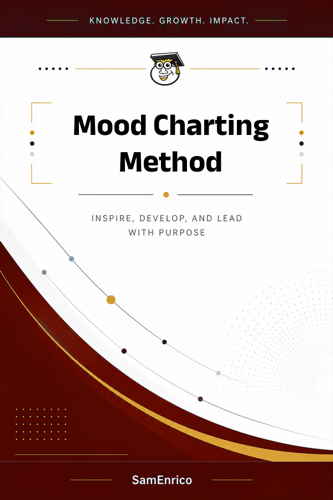
Mood Charting Method
Teaches tracking daily mood, sleep, and medication
by Holm Rosario
Teaches tracking daily mood, sleep, and medications.
Formats
About this book
Free sample
Chapter 1: The Memory Trap--–- On a Tuesday morning in March, a woman we’ll call Sarah sat across from her psychiatrist of three years. She had arrived with a list—wrinkled, coffee-stained, and urgent. “I’ve been feeling worse,” she said. “Much worse. I think the Lamictal stopped working about two months ago.
My sleep is terrible. I’m crying every day.” The psychiatrist, a compassionate but time-pressured clinician, nodded. He had fifteen minutes. He increased her Lamictal from 200mg to 300mg and added a low-dose SSRI for the “breakthrough depression.” Sarah left feeling heard. She also left feeling terrified—because what she had just told the doctor was not entirely accurate.Three weeks later, Sarah found a notebook she had forgotten about.
It was a mood chart she had kept for sixty days the previous autumn. She had stopped charting because she felt better—the very paradox this book will dismantle. As she flipped through the pages, a different story emerged. In those sixty days of autumn, her average depression score on a 0–10 scale had been a 3.2. Her sleep had averaged seven hours per night.
She had recorded two “orange days” (moderate warning signs) and zero “red days.” She had been stable.Then she found a second chart—one she had started in January after a stressful family event but abandoned after only two weeks. Even those fourteen days showed a depression average of 4.1 and three nights of sleep under six hours. The data she had just given her doctor—“two months of feeling much worse”—was not a lie. It was a memory failure. The human brain, for all its evolutionary brilliance, is a terrible historian.This chapter is about that failure.
It is about why “just trying harder” will never work for mood disorders, why your memory is actively conspiring against your treatment, and why the simple act of writing down three numbers every day can outperform intuition, clinical judgment, and even some medical tests. Welcome to the data-driven approach to mental health.The Peak-End Rule: Why Your Brain Lies to You In 1993, psychologist Daniel Kahneman…
This is the end of the free sample. Get the eBook to keep going. Buy now
Contents
- Chapter 1
- Chapter 2
- Chapter 3
- Chapter 4
- Chapter 5
- Chapter 6
- Chapter 7
- Chapter 8
- Chapter 9
- Chapter 10
- Chapter 11
- Chapter 12
Details
- Author
- Holm Rosario
- Publisher
- SamEnrico
- Language
- English
- Genre
- Non-Fiction, Health & Wellness, Tracking
- Released
- 2026-06-07
- Pages (approx.)
- 147
- Available as
- eBook, Audiobook

Read better in the ZLOADR app
Your eBooks on your phone or tablet. Sign in with your SamEnrico account and start reading.
More by Holm Rosario
 Guilt Persuasion TechniqueHolm Rosario$11.99
 Tech Industry Transaction AnalysisHolm Rosario$11.99
 Armistice Carriage TreatyHolm Rosario$11.99
 The Husband Sold MeHolm Rosario$11.99
 Binge Eating and Sleep Apnea LinkHolm Rosario$11.99
 Avalanche Companion RescueHolm Rosario$11.99
 Hobby Shopping AddictionHolm Rosario$11.99
 The Last Masterpiece: The Enigma of the Sistine Chapel's Hidden CodeHolm Rosario$11.99
 The Archimedes Code: Geometry, War, and the Birth of Western ScienceHolm Rosario$11.99
 How to Produce Termites (Control Products)Holm Rosario$11.99
 How to Produce a Hori HoriHolm Rosario$11.99
 UTZ Certification Transition GuideHolm Rosario$12.99
You may also like
 Nap Journal TrackerPressley Walton$11.99
 Ketosis Measurement MethodsLindgren Trinh$11.99
 Constipation JournalEllsworth Del$11.99
 Beginner Fitness Tracking GuideCornwell Dennis$11.99
 The IBS Symptom TrackerVenegas Dorene$11.99
 HIIT Tracking Progress GuideRuss Princess$11.99
 Diarrhea JournalCarr Lydia$11.99
 Food Intolerance JournalThorn Kami$11.99
 Sleep Diary Tracking GuidePitre Aurelia$11.99
 ED Journal WorkbookMerrick Ashlea$11.99
 The Food Scale GuideHaney Tania$11.99
 Intermittent Fasting JournalGibbs Wm$11.99