
Non-FictionBusiness BriefLong-term Care
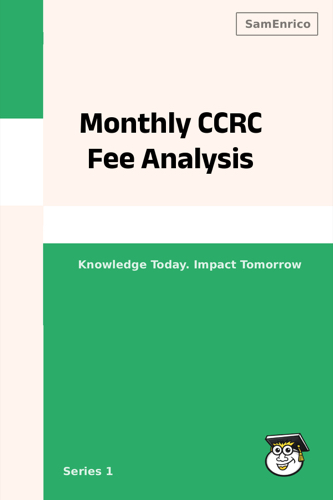
Monthly CCRC Fee Analysis eBook
Projects lifetime costs of service fees versus a l
by Coe Michaele
Projects lifetime costs of service fees versus a la carte options.
Formats
Free sample
Chapter 1: The Million-Dollar Mistake--The call came on a Tuesday afternoon, three weeks after my father signed the papers. My mother had fallen in the garage—a simple misstep, a broken hip, the kind of accident that happens to active 78-year-olds who still refuse to use a cane. The ambulance took her to the hospital. The surgery went well. The recovery was projected at six to eight weeks in skilled nursing.
And that was when the financial reality crashed down like a wave no one had seen coming.My father, an engineer who had spent forty years running spreadsheets for a living, had chosen the "affordable" contract. The one with the $100,000 entrance fee and the $3,200 monthly service fee. The one the sales director called "the smart choice for healthy people who don't want to pay for care they'll never need." My parents were healthy. They walked three miles a day. They had no history of dementia, no chronic diseases, no reason to believe they would ever need the expensive care that the other contract—the one with the $450,000 entrance fee and the $5,000 monthly fee—was designed to cover.But my mother fell.
And the "affordable" contract, as my father discovered while sitting in a hospital waiting room, did not cover skilled nursing. Not at the $3,200 monthly rate. Not even close. The community's skilled nursing facility charged $450 per day. That was $13,500 per month.
And there was no cap. No limit. No "after sixty days we start charging you less." Just a simple line in the contract, buried on page 37, that read: "Residents selecting the Fee-for-Service option shall be responsible for all costs associated with higher levels of care at the then-prevailing daily rate."My father had read that line. He had even highlighted it. But he had convinced himself—because the sales director had encouraged this conviction—that they would never need it.Now, sitting in the hospital cafeteria, he did what engineers do.
He built a spreadsheet on a napkin. His mother had lived to ninety-two. His father had died at eighty-eight. He himself was seventy-six and in excellent health. If he lived another fifteen years, and if his wife needed skilled nursing for even three of those years, the math was devastating.
The $100,000 entrance fee would look like a cruel joke. The $13,500 monthly nursing bills would consume their savings within two years. After that, they would qualify for Medicaid. But Medicaid, in their state, did not guarantee a bed in the community they had chosen. It guaranteed a bed somewhere—perhaps an hour away, perhaps in a facility with a poor reputation, perhaps in a shared room with a roommate who watched television all night.The other couple in their bridge club, the ones who had chosen the expensive contract with the $450,000 entrance fee, were paying the same $5,000 monthly fee they had always paid.
Their mother-in-law had been in skilled nursing for fourteen months. Her cost: $5,000 per month. My father's cost, if his wife needed the same care: $189,000 so far, and climbing.This is not a story about a specific family, though it could be. It is a composite drawn from dozens of real cases, from court records, from financial advisor files, from the confidential archives of elder law attorneys who have watched families make the same mistake again and again. The names change.
The numbers shift slightly. But the pattern is invariant: seniors fixate on the entrance fee, ignore the monthly fee, and fail to understand that the contract type determines everything.The Psychology of Sticker Shock Why do otherwise intelligent, financially sophisticated people make this mistake? The answer lies in a cognitive bias that behavioral economists call "anchoring." When presented with a large number—say, a $500,000 entrance fee—the human brain fixates on that number and compares everything else to it. A $100,000 entrance fee feels like a bargain by comparison. Never mind that the monthly fees are higher.
Never mind that the catastrophic risk is uninsulated. The anchor has been set, and the brain rationalizes everything else around it.The CCRC industry knows this. They have known it for decades. That is why marketing materials always lead with the entrance fee in large, bold type. "Entry fees starting as low as $89,000!" The monthly fee is printed smaller, often in a footnote.
The contract type is described in vague, reassuring language: "Our standard plan offers flexibility and choice." The catastrophic risk is buried in fine print.This chapter is designed to break that anchor. Before we discuss contract types, before we compare Type A versus Type B versus Type C, before we run a single calculation, we must rewire the brain to understand one simple truth: the entrance fee is not the primary driver of lifetime cost. The monthly fee—and more importantly, how that monthly fee behaves when you need higher levels of care—is the variable that will determine whether you die with money in the bank or die broke in a Medicaid bed.Consider two communities. Community A has a $200,000 entrance fee and a $6,000 monthly fee. Community B has a $400,000 entrance fee and a $4,000 monthly fee.
Which is more expensive over twenty years? Most people, anchored to the entrance fee, would say Community A is cheaper. But the math says otherwise. Over twenty years, Community A costs $200,000 plus ($6,000 × 240 months) = $1,640,000. Community B costs $400,000 plus ($4,000 × 240 months) = $1,360,000.
That is a $280,000 difference—enough to fund several years of home care, or a substantial inheritance for grandchildren.Now add the care variable. If you need five years of skilled nursing, Community A (assuming it is a Fee-for-Service contract) might add $13,500 per month to your bill, or $810,000 over five years. Community B (assuming it is a Lifecare contract) adds nothing. The lifetime difference becomes over a million dollars.The entrance fee is a distraction. It is a shiny object placed in front of you to prevent you from looking at the real numbers.What This Book Will Do For You This book is not a generic guide to retirement communities.
It is not a collection of warm anecdotes about people who found their "forever home." It is not published by a CCRC trade association or written by a sales director who wants to soften your objections. This book is a financial analysis tool disguised as a book. It will teach you to:Calculate your personal lifetime cost under each contract type, using your own health history, family longevity, and local nursing home rates.Identify hidden fees that are almost never disclosed in initial conversations, from second-person fees to guest meal charges to transportation surcharges.Compare refundability structures and understand the massive difference between a 90% refundable entrance fee (which returns most of your money to your heirs) and a non-refundable fee (which is simply gone).Stress-test communities against bankruptcy risk, fee escalation clauses, and occupancy declines.Run the "couple scenario" that terrifies financial advisors: one spouse needs memory care for a decade while the other remains independent. Under most contracts, this bankrupts families. Under the right contract, it is managed seamlessly.Build your own decision spreadsheet—not a black-box online calculator that might be sponsored by the CCRC industry, but your own tool that you control and trust.By the end of this book, you will know more about CCRC…
This is the end of the free sample. Get the eBook to keep going. Buy now
About this book
Details
- Author
- Coe Michaele
- Publisher
- SamEnrico
- Language
- English
- Genre
- Non-Fiction, Business Brief, Long-term Care
- Released
- 2026-06-08
- Pages (approx.)
- 160
- Available as
- eBook, Audiobook

Read better in the ZLOADR app
Your eBooks on your phone or tablet. Sign in with your SamEnrico account and start reading.
More by Coe Michaele
 NVC In Policing GuideCoe Michaele$11.99
 The Gratitude Opener HandbookCoe Michaele$11.99
 Franchising Your Local Brand Across Borders Innovation SourcingCoe Michaele$11.99
 Cocaine and Work PerformanceCoe Michaele$11.99
 Elderly Campers DisappearancesCoe Michaele$11.99
 Fertility Diet For MenCoe Michaele$11.99
 Cramming Last Minute GuideCoe Michaele$11.99
 Cartier's Crown Jewels: How a Parisian House Conquered the World (1950-1980)Coe Michaele$11.99
 The Sultan's Symphony: Lala Mustafa Pasha and the Conquest of CyprusCoe Michaele$11.99
 A Collector's Handbook to the Datsun Cedric 260cCoe Michaele$11.99
 Italian Student Employment GuideCoe Michaele$12.99
 Interest Reserve Loan Structure GuideCoe Michaele$12.99
You may also like
 Hong Kong Handover 1997Dunn Johnnie$11.99
 Zumba For Postnatal Recovery CourseNeal Christian$11.99
 Zumba for BeginnersLadner Nikia$11.99
 YouTube Comment Mining GuideHumes Pandora$12.99
 Worry Box MeditationCarlin Rudy$11.99
 Workplace Stress MeditationNguyen Lynn$11.99
 Workplace Stress and Sleep RepairHawley Ivory$11.99
 Workplace Perfectionism CureDelaney Jeffry$11.99
 Workplace Injustice Anger GuideWallen Isabelle$11.99
 Work Addiction and Burnout LinkGreenwood Ester$11.99
 Women in Yoga and WellnessBeattie Galina$11.99
 Women in Stand Up ComedyChun Evangeline$11.99